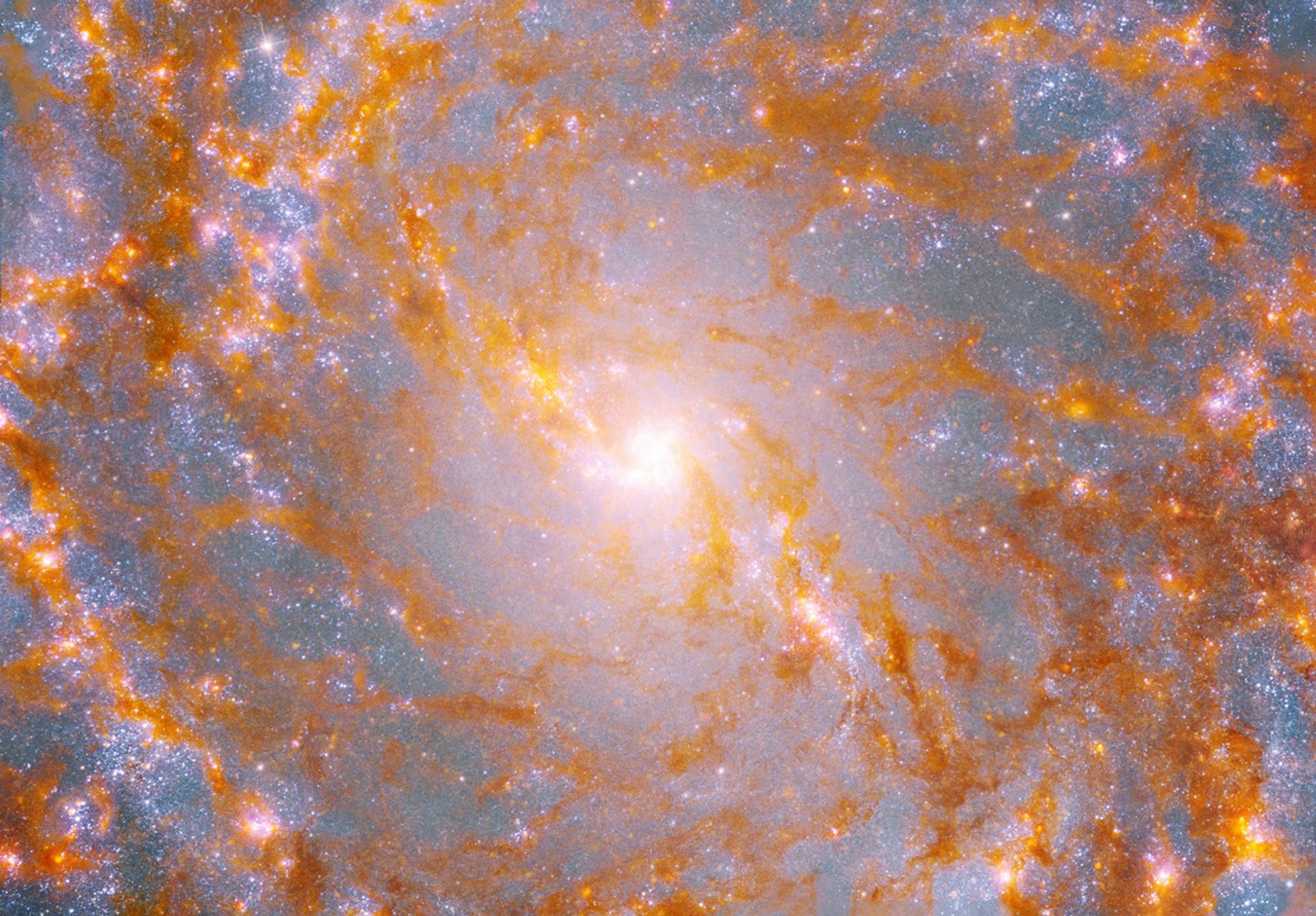
NASA has released a new composite image of the core of Messier 101 — the Pinwheel Galaxy — combining observations from both the Hubble Space Telescope and the James Webb Space Telescope. That's the entirety of the available content: a single-sentence image release. The pairing matters more than the brevity suggests. Hubble and Webb observe in fundamentally different wavelength regimes. Hubble captures ultraviolet and visible light, revealing hot young stars, ionised gas, and the surface structure of galaxies. Webb operates primarily in infrared, seeing through dust to expose embedded star formation, older stellar populations, and molecular gas structures invisible to Hubble. Combining both datasets in a single image of a galaxy's core produces a view that neither telescope can achieve alone — the visible architecture layered with the infrared skeleton. Messier 101 is a face-on spiral galaxy roughly 21 million light-years away in the constellation Ursa Major. It's one of the best-studied galaxies in astronomy, a frequent calibration and reference target. Its face-on orientation makes it ideal for studying spiral structure, star formation regions, and the density profile of a galactic core without the obscuring effects of viewing a galaxy edge-on. Hubble has imaged M101 multiple times over its 36-year mission. Webb's infrared view of the same object adds a layer of data that didn't exist before its launch in December 2021. The broader context is that NASA has been producing these Hubble-Webb composite images with increasing frequency — using them to demonstrate the complementary capabilities of both observatories. It's a subtle institutional argument: Hubble, now in its fourth decade, remains scientifically productive precisely because Webb doesn't replace it. They see different things. The composites are scientific data, but they're also a case for continued Hubble funding. As an image release with a single sentence of description, this is a placeholder — the scientific content will live in the full-resolution data and any accompanying papers. What we have is a postcard from two of humanity's most capable instruments, pointed at the same spiral and seeing different truths.
Worth reading?
OPTIONAL
Score
42
/100
What Is What to Watch?
What to Watch highlights the specific signals, decisions, or events that will determine which direction this story goes next.
About GRINANY ACCOMPANYING SCIENTIFIC
Any accompanying scientific papers or data releases that use this combined Hubble-Webb dataset to study M101's core stellar populations, dust distribution, or star formation history
HUBBLE'S OPERATIONAL STATUS
Hubble's operational status — the telescope has experienced gyroscope issues and is operating in a degraded mode; each new Hubble image is a reminder that the observatory's remaining lifespan is finite and uncertain
NASA CONTINUES INVESTING
Whether NASA continues investing in Hubble-Webb composite observations as a scientific programme or whether they remain primarily communication products
Verified Facts (1)
This new image from the Hubble Space Telescope and the James Webb Space Telescope takes a closer look at the core of Messier 101, also known as the Pinwheel Galaxy
Solution Focus (3)
The combination of Hubble's UV/visible data with Webb's infrared data on the same galactic core produces a multi-wavelength view that neither telescope can achieve independently
Messier 101's face-on orientation makes it one of the cleanest laboratories for studying spiral structure and core density — a reason it keeps being revisited across telescope generations
The composite image format is itself an institutional argument: Hubble remains scientifically productive because it complements Webb rather than being replaced by it
Community Actions (3)
Any accompanying scientific papers or data releases that use this combined Hubble-Webb dataset to study M101's core stellar populations, dust distribution, or star formation history
Hubble's operational status — the telescope has experienced gyroscope issues and is operating in a degraded mode; each new Hubble image is a reminder that the observatory's remaining lifespan is finite and uncertain
Whether NASA continues investing in Hubble-Webb composite observations as a scientific programme or whether they remain primarily communication products
More latest news
Read all