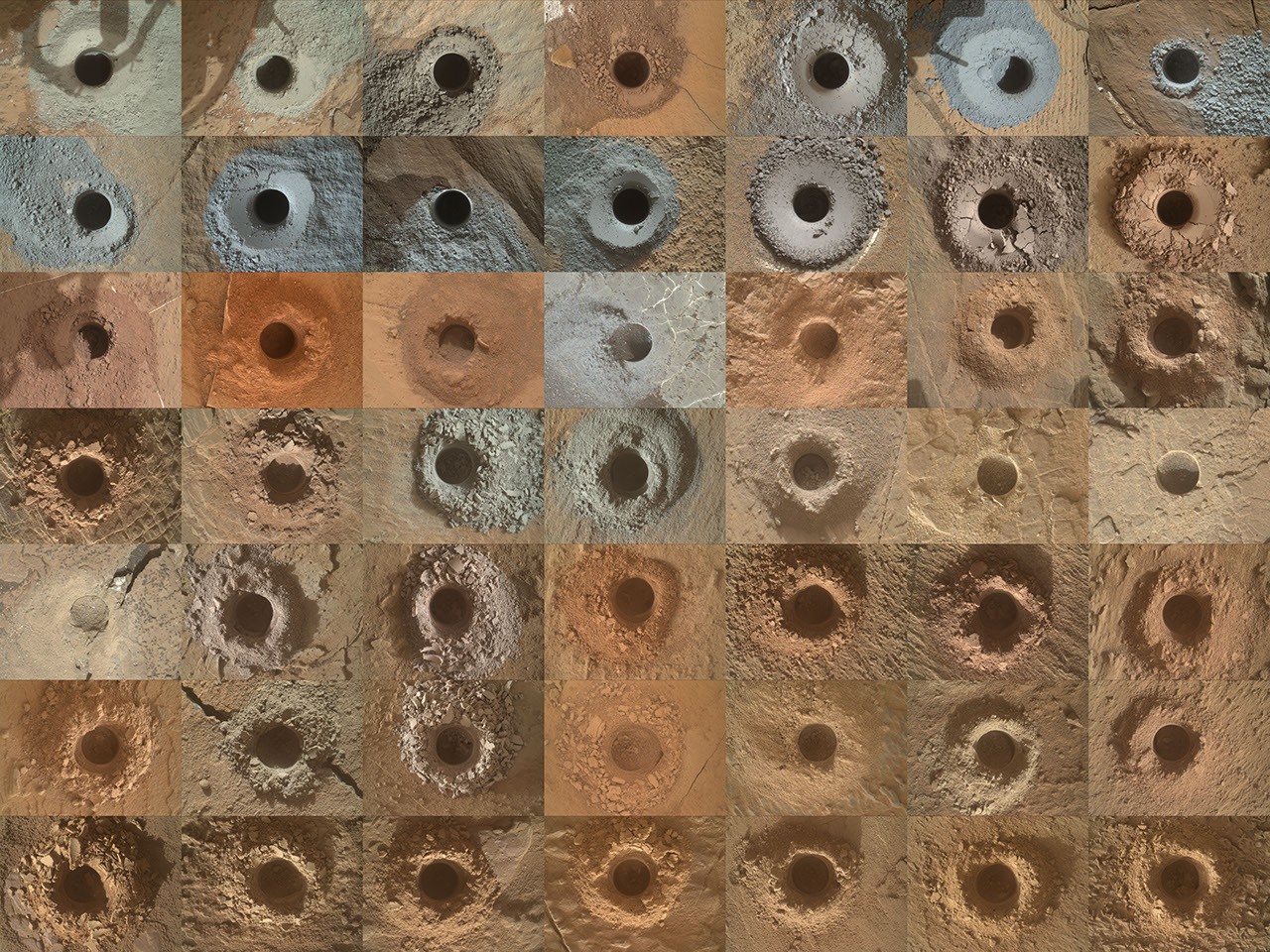
There's something unexpectedly beautiful about 49 identical holes in alien rock, arranged in a grid. Each one is 0.63 inches across — roughly the diameter of a pencil — drilled by a robot arm 140 million miles from the nearest human hand. NASA released this collage as a Photojournal image (PIA26802), and while it's filed under science, it reads like conceptual art: a typology of Martian geology told through absence. Curiosity's drill sits at the end of its robotic arm. It bores into rock, pulverizes the sample, and drops the powder into instruments housed in the rover's body for chemical analysis. The process is mechanical and repetitive by design. But the collage, shot by the Mars Hand Lens Imager (MAHLI) — a macro camera also mounted on the arm — reveals that no two holes look alike. The surrounding rock varies from smooth gray to rusty, fractured, layered, veined. The uniformity of the drill diameter makes the geological variety pop. This is 49 samples collected through November 2026 — roughly 14 years of surface operations since Curiosity landed in Gale Crater in August 2012. That's an average of about 3.5 drill holes per year, which tells you something about the pace of planetary science. Each hole represents weeks of planning: selecting a target, positioning the rover, drilling, analyzing, transmitting results back to Earth at the speed of light with a 4-to-24-minute delay. The MAHLI camera was built by Malin Space Science Systems in San Diego. It functions as a geological hand lens — the same tool a field geologist would hold up to a rock face on Earth, except this one is bolted to a robot on Mars and operated by remote command. The images it produces are startlingly intimate: you can see individual mineral grains, drill marks, the texture of Martian dust. Curiosity was built by NASA's Jet Propulsion Laboratory, managed by Caltech in Pasadena. JPL leads the mission for NASA's Science Mission Directorate in Washington as part of the Mars Exploration Program. The rover was designed for a two-year primary mission. It is now in its fourteenth year of operations, which is either a testament to conservative engineering margins or to the stubbornness of the people who refuse to let it stop working. What makes the collage resonate isn't the science — it's the accumulation. Forty-nine holes is not a breakthrough. It's a body of work. Each one was a decision, a week of execution, a data point. Stacked together they become something else: proof of sustained attention across planetary distances and bureaucratic cycles and budget fights and hardware degradation. The collage is a document of institutional stamina as much as geological sampling.
Worth reading?
RECOMMENDED
Score
48
/100
Anyone who finds beauty in methodical accumulation — fans of typological photography, space nerds who want a visceral sense of what 14 years of surface operations looks like, or anyone who wants a 30-second encounter with something genuinely alien rendered at human scale.
Cultural Placement
Like Bernd and Hilla Becher's industrial typologies but shot by a robot on another planet, with the methodical seriality of Ed Ruscha's 'Every Building on the Sunset Strip' and the slow-accumulation patience of long-duration land art by Richard Long. The collage isn't trying to be art, which is partly why it works as art — the typological grid format and macro-lens intimacy create an aesthetic object out of pure operational documentation. It sits in the tradition of found scientific beauty, closer to the Hubble Heritage images or Ernst Haeckel's biological illustrations than to any deliberate art project.
Honest assessment
This isn't a work of art in any intentional sense — it's a JPL data product. But the collage format accidentally produces something with real visual and emotional weight: 49 windows into Martian geology that double as a record of institutional persistence across 14 years. Worth a minute of anyone's attention; it won't change your life but it might adjust your sense of scale.
What Is NOVEL?
48
/ 100
BedrockNews applies a structured analytical framework called NOVEL to cultural works — games, books, film, music, and more.
How NOVEL worksNerve
1/5
Originality
3/5
Voice
3/5
Endurance
3/5
Lineage
2/5
What did the artist risk? What could have failed?
Zero artistic risk — this is operational documentation assembled into a grid. The nerve belongs to the mission itself (14 years on Mars), not to the image-making, which is routine procedure.
Verified Facts (6)
49 drill holes captured as of November 2026
Each hole has a diameter of 0.63 inches (16 millimeters)
Images taken by the Mars Hand Lens Imager (MAHLI)
Curiosity was built by NASA's Jet Propulsion Laboratory, managed by Caltech in Pasadena, California
MAHLI was built by Malin Space Science Systems in San Diego
Image ID PIA26802
More latest news
Read all