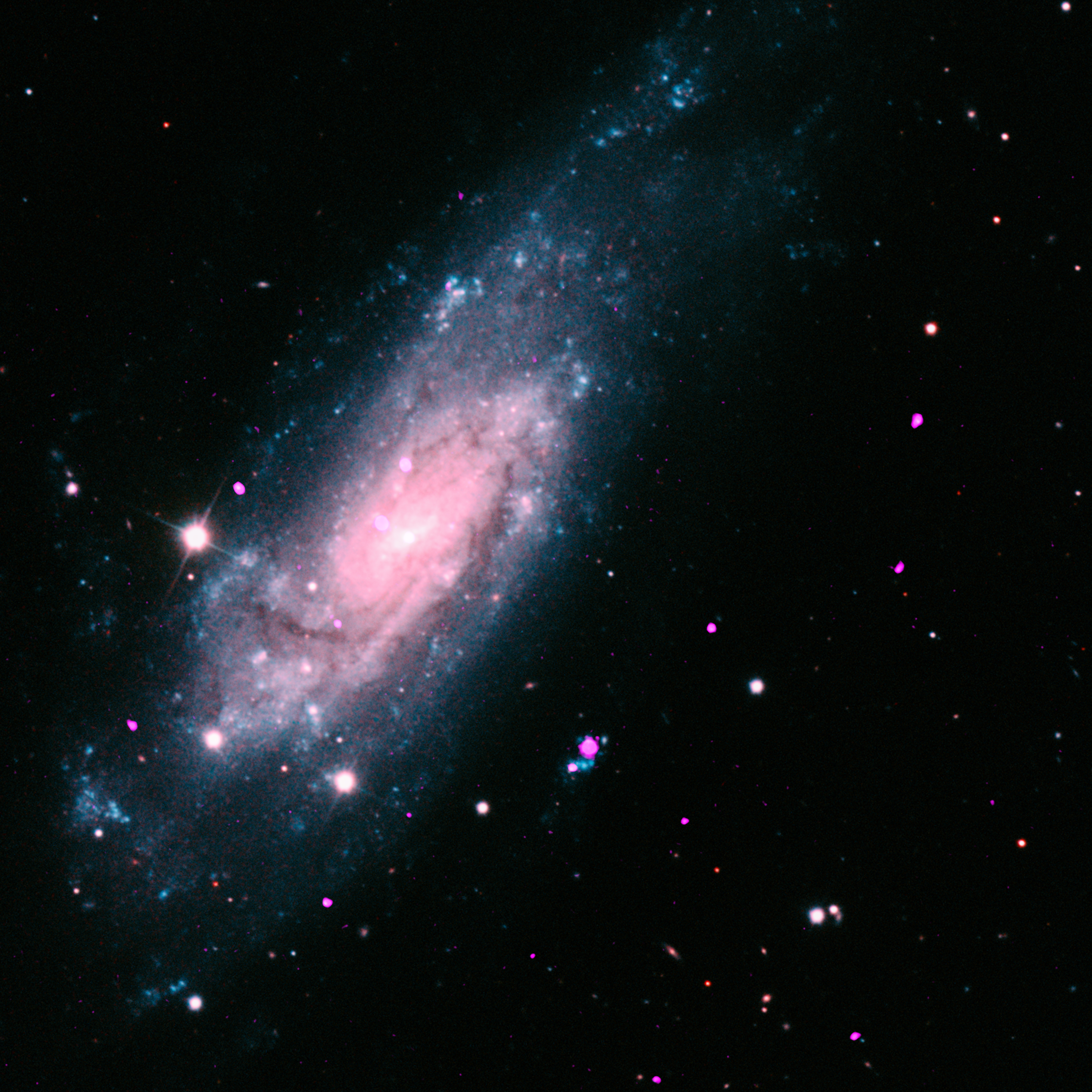
Imagine a drummer who only hits the cymbal when someone bumps their elbow. You hear the crash and assume the drummer is unstable — but actually, the real story is the person doing the bumping. That is the mechanism Chandra has uncovered: a massive, unstable star produces dramatic outbursts, but the trigger is a compact companion — a black hole or neutron star — whose orbital passes provoke the eruptions on a schedule. The core claim is observational, not theoretical: using NASA's Chandra X-ray Observatory, astronomers have identified a previously hidden compact object (black hole or neutron star) in a binary system with a giant, unstable star. The companion's existence was inferred from X-ray signatures that could not be explained by the massive star alone. The repeated outbursts from the giant star, previously attributed to intrinsic instability, now have an external gravitational trigger. This sits in a well-established tradition of X-ray binary discovery. Chandra has been the workhorse instrument for resolving compact companions in crowded stellar environments since its 1999 launch. The methodological ladder here is straightforward: prior optical and infrared observations of this massive star's outbursts could not identify a companion. X-ray imaging, with Chandra's sub-arcsecond angular resolution, resolved what other wavelengths could not. This is less a breakthrough in technique than a clean application of existing capability to a specific puzzle. Architecturally, the observation leverages Chandra's Advanced CCD Imaging Spectrometer (ACIS), which operates in the 0.1–10 keV X-ray band. The detection of a compact companion relies on identifying X-ray emission consistent with accretion onto a neutron star or black hole — emission that the massive star's wind alone cannot produce. The key structural choice is wavelength: X-rays cut through the dusty, dense environment surrounding massive stars where optical instruments are blind. The integrity question is important here. This is a direct observational result — Chandra pointed at a known eruptive star and found X-ray emission inconsistent with a single-star model. The validation is as non-circular as observational astronomy gets: the instrument detected photons, and the spectral and temporal signatures pointed to a compact object. However, the nature of the companion (black hole vs. neutron star) remains ambiguous from the available data, and the team is honest about this degeneracy. The milestone trajectory for this kind of system is about confirmation and characterization. The immediate next step is multi-epoch X-ray monitoring to establish the orbital period and constrain the companion's mass. If the companion's mass exceeds roughly 3 solar masses, it is a black hole; below that, a neutron star. Future X-ray missions with higher spectral resolution (like XRISM, already operational, or the proposed Athena) could break this degeneracy. The obvious experiment not yet run is a radial velocity campaign in the optical/near-infrared to independently confirm the binary orbit from the massive star's motion. This is technically demanding — massive unstable stars have messy spectra — but it is the standard confirmation path for X-ray binary candidates. The honest read: this requires significant telescope time on large ground-based facilities, and the team likely needs the Chandra result published first to justify the allocation.
The analogy
A drummer who only crashes the cymbal when someone bumps their elbow. You assumed intrinsic instability, but the real story is the hidden person doing the bumping on each orbital pass.
Elbow bump
An external, periodic nudge that triggers a seemingly spontaneous crash from a drummer
Compact companion
A hidden black hole or neutron star whose orbital passes gravitationally trigger eruptions from an unstable massive star
Honest assessment
This is a clean observational discovery — a hidden compact companion found around a known eruptive massive star — using Chandra's established strengths. It advances the binary-trigger hypothesis for massive-star eruptions but represents no methodological novelty. Important for the specific subfield of massive-star binary evolution; unlikely to register beyond it until the companion type is confirmed.
What Is CLAIMS?
57
/ 100
BedrockNews applies a structured analytical framework called CLAIMS to academic papers and technical research releases.
How CLAIMS worksClaim
2/5
Ladder
3/5
Architecture
2/5
Integrity
4/5
Milestone
3/5
Successor
3/5
What is this paper actually committing to?
New system, not new method. Discovery of a hidden compact companion triggering a massive star's outbursts is a solid observational result for this specific target, but the technique is 25 years old.
The field fight
Are massive-star eruptions intrinsically driven or externally triggered by binary companions?
Side A
Eruptions arise from intrinsic instability — pulsations, super-Eddington winds, envelope instabilities
Held by: Single-star modelers, LBV community
Side B
Hidden companions are common and gravitational perturbation triggers many 'intrinsic' eruptions
Held by: Binary interaction advocates, this paper
Milestone tracker
Unlocks: Definitive classification of the companion and a model for how binary interaction drives massive-star eruptions
Current
1
detection
Companion identified via X-ray
Next
~3
M☉ mass constraint
BH/NS determination
~2-5 years with multi-epoch X-ray + XRISM spectral follow-up
Verified Facts (3)
Using Chandra, astronomers have discovered a previously hidden black hole or neutron star companion
The companion is triggering repeated outbursts from a giant, unstable star
The compact object was previously hidden — not detected by prior observations
Practical Implications (3)
Supports systematic X-ray surveys of eruptive massive stars to identify hidden compact companions that optical surveys miss
Strengthens the case that binary interactions are underappreciated drivers of massive-star variability, with implications for supernova progenitor models
Demonstrates continued scientific value of Chandra after 25+ years of operation, relevant to NASA mission-extension decisions
More latest news
Read all