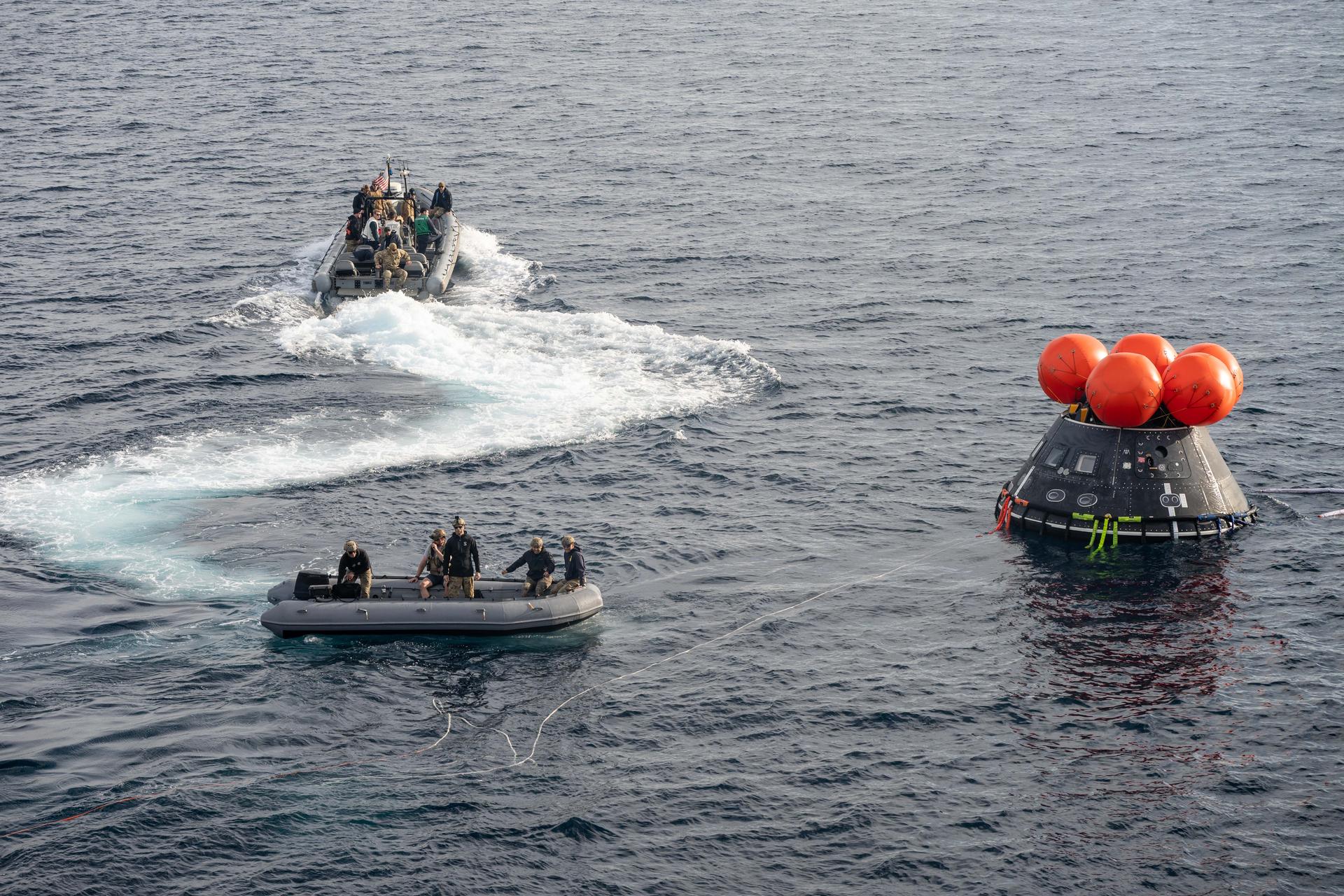
NASA's Artemis Landing and Recovery team and the Department of War conducted a final joint simulation off the coast of California on Tuesday, January 27, 2026, rehearsing the retrieval of the Artemis II crew and Orion spacecraft following their planned Pacific Ocean splashdown. The exercise, designated a 'just-in-time training,' is the last full rehearsal before the actual mission recovery. The teams used the Crew Module Test Article — a full-scale mockup of the Orion spacecraft — to simulate conditions as close as possible to what they'll encounter during the real splashdown. This is standard practice for crewed spaceflight: you rehearse the recovery at sea because the ocean doesn't care about your timeline. Currents, swells, wind, and the bobbing capsule all create variables that can only be trained for in the actual environment. The source material here is minimal — a photo caption and brief description from NASA. No details on the specific recovery procedures rehearsed, the ships involved, sea conditions, crew identities, or how this training differed from previous recovery exercises. No timeline for the Artemis II mission itself is provided in this release. What's worth noting is the framing: 'just-in-time training' suggests this is timed close to the actual mission, meaning Artemis II's return is approaching operational readiness. The collaboration between NASA and the Department of War for ocean recovery operations continues a pattern dating back to the Apollo programme, when the US Navy recovered every crewed capsule from the Pacific.
Worth reading?
SKIP
Score
35
/100
What Is What to Watch?
What to Watch highlights the specific signals, decisions, or events that will determine which direction this story goes next.
About GRINARTEMIS II LAUNCH DATE
This training's 'just-in-time' designation implies the mission is approaching. Watch for NASA's official Artemis II launch date confirmation — the recovery rehearsal timeline is a leading indicator of schedule confidence.
RECOVERY SHIP DETAILS
Apollo used aircraft carriers; Artemis I used USS Portland (LPD-27). Watch for which vessel is assigned to Artemis II recovery — it signals the operational footprint and capability requirements.
CREW READINESS
Artemis II crew — Reid Wiseman, Victor Glover, Christina Koch, Jeremy Hansen — will be the first humans to fly Orion. Watch for crew-specific training updates as the mission approaches.
Verified Facts (2)
NASA's Artemis Landing and Recovery team and the Department of War that will work together to retrieve the Artemis II crew and Orion spacecraft following their return to Earth and splashdown in the Pacific Ocean are performing a final simulation of their activities, called a just-in-time training, at sea on Tuesday, Jan. 27, 2026
teams use the Crew Module Test Article, a full-scale mockup of the Orion spacecraft, to simulate as close as possible the conditions they can expect to encounter during splashdown of the Artemis II mission
Solution Focus (3)
Final 'just-in-time training' simulation completed January 27, 2026, off the California coast — signals Artemis II recovery operations are approaching mission-ready status
Full-scale Crew Module Test Article (Orion mockup) used to simulate real splashdown conditions at sea
Joint NASA and Department of War operation continues the Apollo-era pattern of military naval support for civilian crewed spaceflight recovery
Community Actions (3)
This training's 'just-in-time' designation implies the mission is approaching. Watch for NASA's official Artemis II launch date confirmation — the recovery rehearsal timeline is a leading indicator of schedule confidence.
Apollo used aircraft carriers; Artemis I used USS Portland (LPD-27). Watch for which vessel is assigned to Artemis II recovery — it signals the operational footprint and capability requirements.
Artemis II crew — Reid Wiseman, Victor Glover, Christina Koch, Jeremy Hansen — will be the first humans to fly Orion. Watch for crew-specific training updates as the mission approaches.
More latest news
Read all