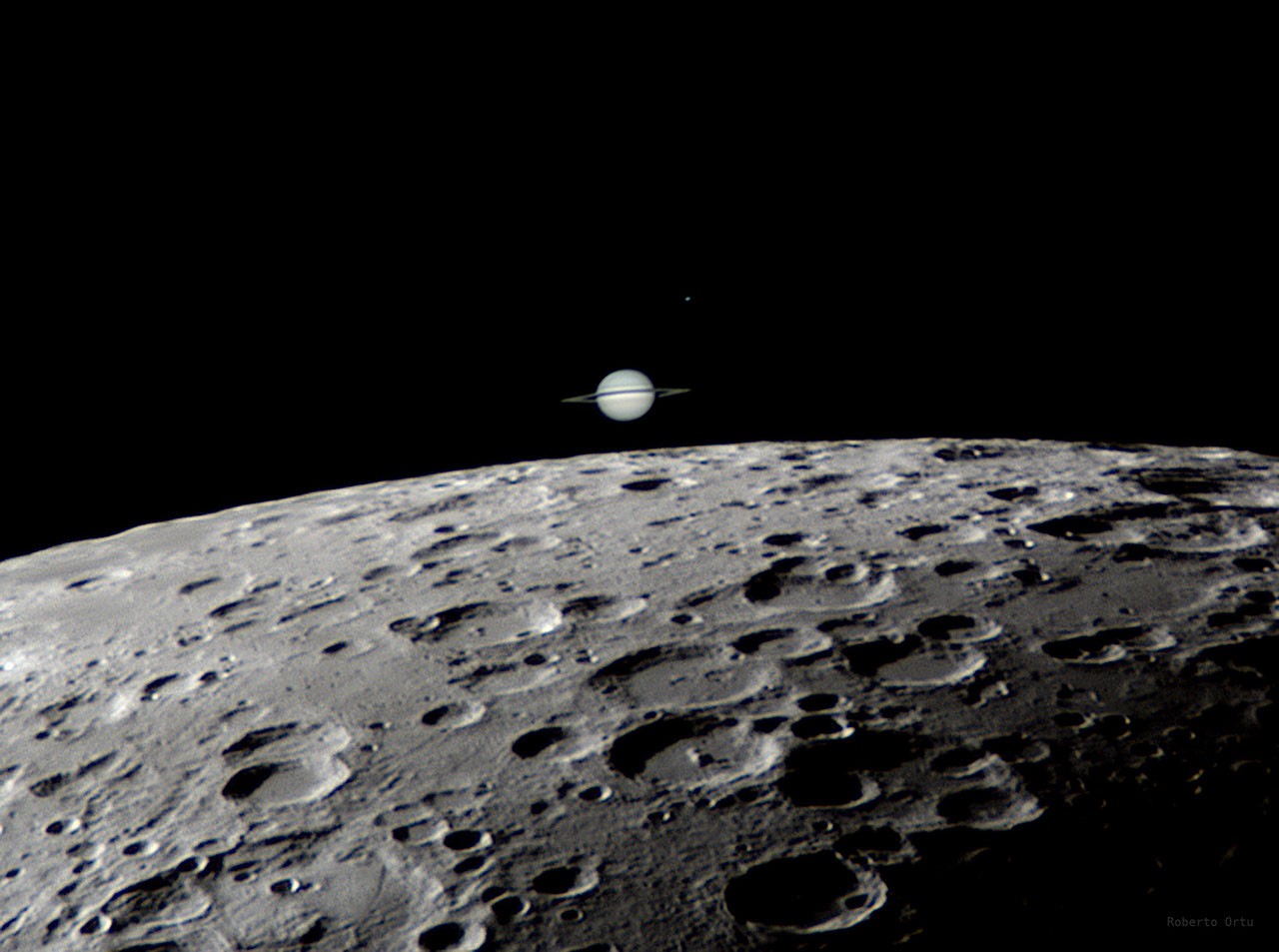
Lunar occultations of Saturn are not rare in the astronomical sense — they happen in clusters every few years — but they are rare in the human sense. You have to be standing in the right strip of Earth, at the right time, with clear skies. Roberto Ortu was standing in Sardinia in early 2025, and he got his shot. The image is a digital composite of three frames: one of Saturn alone before it slipped behind the lunar limb, and two of the Moon at different exposure lengths. This is standard practice in astrophotography — the Moon is so much brighter than Saturn that a single exposure cannot render both faithfully. The craft is in the fusion: making it look like one moment when it's actually three. The bright dot near Saturn is not one of its moons but the star 85 Aquarii, a background object vastly more distant than either Saturn or the Moon. This kind of accidental alignment — foreground, middle ground, deep background stacked along a single line of sight — is what makes occultation photography compelling. You're seeing depth rendered flat, and knowing it's depth is what makes it beautiful. Ortu's composition leans into the geometry rather than the spectacle. The Moon dominates the frame as a crescent, Saturn sits small and sharp against the dark limb, and 85 Aquarii is a pinprick. There is no false color, no dramatic post-processing. The image trusts the event. APOD (Astronomy Picture of the Day) has been running since 1995, curated by Robert Nemiroff and Jerry Bonnell, now joined by Cecilia Chirenti and Keighley Rockcliffe. It remains one of the internet's most durable editorial projects — a single image, a brief explanation, every day for over 30 years. The format is the voice: unhurried, precise, quietly astonished. The next lunar occultation of Saturn visible from somewhere on Earth won't occur until 2031. This image is the record of a specific alignment that required a specific place, a specific moment, and a photographer who understood that three careful exposures could hold what one could not.
Worth reading?
RECOMMENDED
Score
56
/100
Amateur astronomers, astrophotography enthusiasts, and anyone who finds satisfaction in seeing a rare geometric alignment rendered with technical care and editorial restraint.
Cultural Placement
Like the best of Thierry Legault's ISS-transit composites but quieter, with the editorial patience of APOD's three-decade curatorial voice. Where Legault engineers millisecond-precision captures, Ortu's image is about patience and geometry — closer to Michael Benson's book 'Planetfall' in its trust that the event speaks for itself, filtered through the composite-exposure tradition that defines modern amateur planetary imaging.
Honest assessment
This is a well-executed example of a recognized astrophotography form — the lunar occultation composite — presented within APOD's characteristically understated editorial frame. It won't redefine the genre, but it's a clean, honest record of an event that won't repeat until 2031, and the restraint in processing is its own kind of craft statement.
What Is NOVEL?
56
/ 100
BedrockNews applies a structured analytical framework called NOVEL to cultural works — games, books, film, music, and more.
How NOVEL worksNerve
2/5
Originality
2/5
Voice
3/5
Endurance
3/5
Lineage
4/5
What did the artist risk? What could have failed?
Low risk within a well-understood form. Multi-exposure lunar composites are standard technique; the risk here was weather and timing, not artistic. Competent execution of a known playbook.
Lineage tree
Thierry Legault's ISS transits
extends the form of
Michael Benson's Planetfall
tonal influence
APOD 30-year archive
direct ancestor
Multi-exposure lunar composite tradition
extends the form of
Verified Facts (6)
Occultation visible in early 2025 along a swath from Greenland through central Europe into northern Africa
Image is a digital fusion of three images taken from Sardinia, Italy, after sunset
Bright dot near Saturn is the star 85 Aquarii, not a moon of Saturn
Next lunar occultation of Saturn visible from Earth will be in 2031
Credit: Roberto Ortu
Authors & editors: Robert Nemiroff, Jerry Bonnell, Cecilia Chirenti, Keighley Rockcliffe
More latest news
Read all