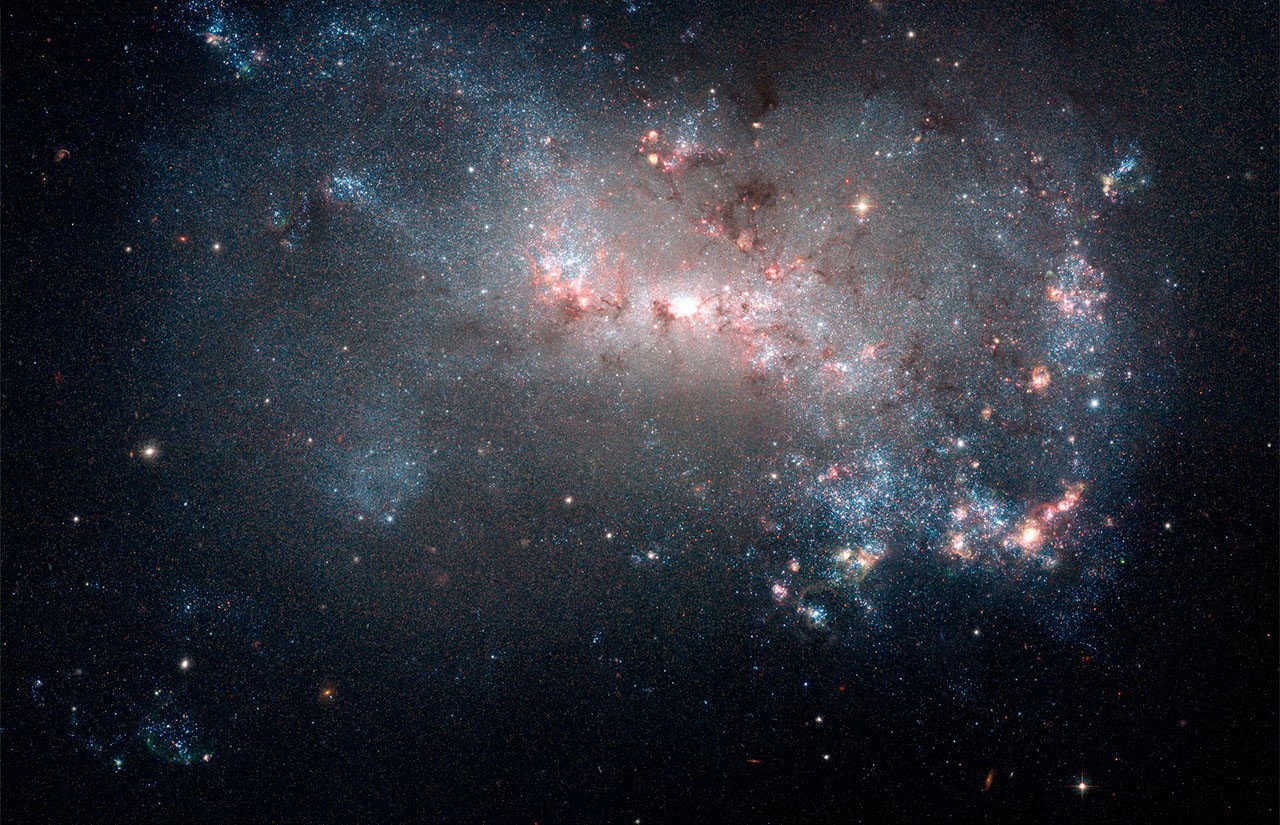
The Astronomy Picture of the Day program has been doing the same thing since 1995: one image, one explanation, every day. It is the longest-running single-format science communication project on the internet, and on its best days it delivers a genuine jolt of perspective recalibration in under 200 words. November 11, 2026 is one of those days. The image is NGC 4449, a dwarf irregular galaxy roughly 12.5 million light-years away in the constellation Canes Venatici, captured by the Hubble Space Telescope. Visually it's a riot — blue star-forming regions, pink hydrogen clouds, dark dust lanes — packed into a frame about one-tenth the diameter of the Milky Way. The Hubble Heritage team's processing (credited to A. Aloisi at STScI/ESA) pulls structure out of every corner. It looks chaotic and alive in a way that tidy spiral galaxies do not. The science hook is sharper than the image. Dwarf galaxies like NGC 4449 are missing more oxygen than astrophysical models predict. The explanation offered is that their stellar winds and supernovae are "surprisingly effective" at blowing heavy elements — metals, in astronomer shorthand — out of the galaxy entirely. This is not a minor bookkeeping error. If dwarf galaxies are better element-dispersal engines than we thought, and dwarf galaxies are the most common type of galaxy in the universe, then the chemical enrichment of the intergalactic medium has a different primary driver than standard models assume. The APOD text frames this gently — "these tiny galaxies may play a big role in spreading heavy elements" — but the implication is significant. The building blocks of rocky planets, water, organic chemistry, and life itself may owe their cosmic distribution more to billions of small galaxies than to a few large ones. It's a satisfying inversion: the smallest, most common galaxies doing the heaviest lifting. As science communication, this entry does what APOD does best. It takes a genuinely beautiful image, attaches a real scientific result, and trusts the reader to feel the scale without melodrama. The authorship credits — Keighley Rockcliffe, Robert Nemiroff, Jerry Bonnell, and Cecilia Chirenti — represent the current stewardship of a project that has maintained a remarkably consistent quality bar across three decades. The format's constraint is also its power. You get one image, a few sentences, and a credit line. No video, no interactive, no sidebar. The discipline forces clarity. On a day like this, where the image is spectacular and the science is genuinely interesting, the format earns its longevity.
Worth reading?
RECOMMENDED
Score
52
/100
Anyone who wants a 90-second dose of genuine cosmic perspective — especially readers who respond to astronomical imagery and want the actual science, not just pretty pictures.
Cultural Placement
Like the best entries in Randall Munroe's What If? series but compressed to a single image and a paragraph, with the visual ambition of the old Life magazine astronomy spreads. APOD operates in the tradition of Carl Sagan's 'Pale Blue Dot' reframing — using a single image to shift the reader's sense of cosmic scale — but in a daily micro-format closer to a haiku than an essay. The nearest living relative is probably the Hubble Heritage Project's own image releases, but APOD adds the editorial voice and the daily rhythm that turns isolated images into a sustained relationship with the reader.
Honest assessment
This is a strong daily entry in a format that has earned its audience over 30 years. The science is real and the image is spectacular, but this is a micro-format piece, not a deep investigation. It does exactly what APOD promises — one image, one insight, delivered cleanly — and if that's what you want, this is a good day to show up.
What Is NOVEL?
52
/ 100
BedrockNews applies a structured analytical framework called NOVEL to cultural works — games, books, film, music, and more.
How NOVEL worksNerve
1/5
Originality
2/5
Voice
3/5
Endurance
3/5
Lineage
4/5
What did the artist risk? What could have failed?
Zero structural risk. APOD has published daily since 1995 in an identical format. This entry executes the template perfectly but bets nothing new.
Lineage tree
Pale Blue Dot (Sagan, 1990)
tonal influence — single image as perspective-shifting device
Hubble Heritage Project
direct ancestor — supplies the imagery and processing pipeline
Life Magazine astronomy spreads
extends the form of — single-image science storytelling for general audiences
Powers of Ten (Eames, 1977)
tonal influence — scale as the core emotional mechanism
Verified Facts (8)
The Milky Way is about 100,000 light years across
Dwarf galaxies are about 1/10th the size of the Milky Way and only contain a few billion stars
Dwarf galaxies are the most common type of galaxy in the whole universe
NGC 4449 and similar dwarf galaxies are missing more oxygen than models predict
Their stellar winds and supernovae are surprisingly effective at blowing away oxygen and other heavy elements
Credit: NASA, ESA, A. Aloisi (STScI/ESA), and the Hubble Heritage (STScI/AURA)-ESA/Hubble Collaboration
Authors & editors: Keighley Rockcliffe, Robert Nemiroff, Jerry Bonnell, Cecilia Chirenti
Date: November 11, 2026
More latest news
Read all