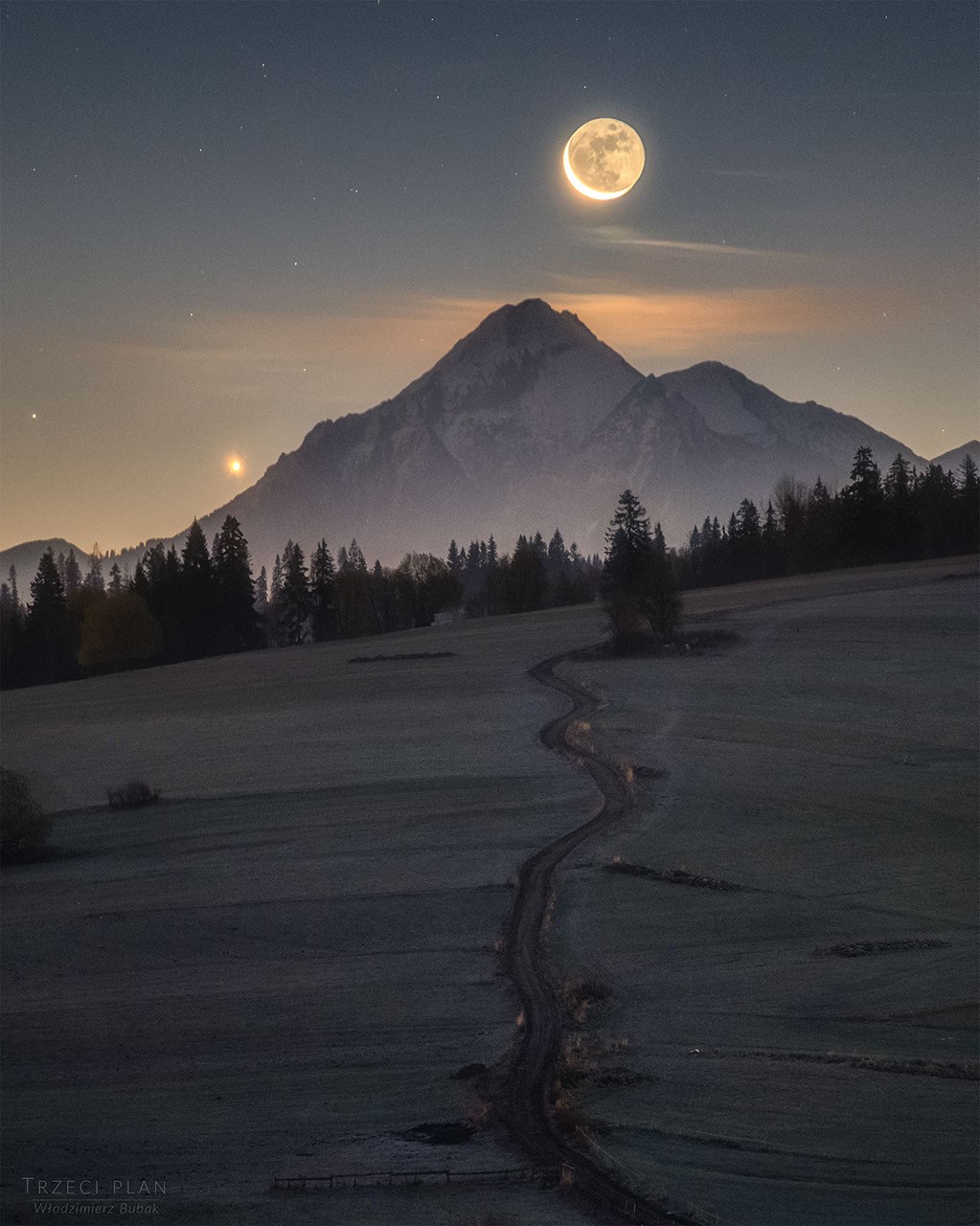
The Astronomy Picture of the Day project has been running since 1995, and its best entries work like a good haiku — a single image carrying more weight than its frame suggests. Włodzimierz Bubak's photograph of the crescent Moon and Venus above the Tatra Mountains is one of those entries. It's a simple composition: dark ridgeline, twilight gradient, two bright objects and one slightly dimmer one. The craft is in the timing and placement, not post-processing fireworks. The real payload is in the caption, not the pixels. The APOD team buries a genuine science update in what reads like a stargazing postcard: Spica — one of the 20 brightest stars in our sky, roughly 250 light-years away — was identified as a binary star in 1890. Two massive blue stars whipping around each other every four days. That classification held for over 130 years. Earlier this year, it was reported that Spica is actually a triple system. That's the kind of quiet revision that reshapes how we model stellar evolution and dynamics. The etymological thread running through the caption is the other piece worth noting. "Planet" from the Greek for "wandering star" — the APOD writers use this not as trivia but as a framing device. Conjunctions aren't chance encounters; they're the visible surface of celestial mechanics. It's a compact lesson in how apparent randomness in the sky is actually clockwork, delivered without condescension. Bubak's image works because it doesn't try to be a Hubble shot. The Tatra Mountains give the composition a human anchor — you can imagine standing there, cold air, looking up. Venus and the Moon are bright enough to identify without annotation. Spica sits to the left, fainter but present. The three objects form a loose triangle that the eye traces naturally. It's astrophotography as landscape photography, which is APOD at its best. The conjunction itself — Moon, Venus, Spica — is the kind of event that happens on predictable schedules but still catches people off guard. The APOD format turns that catch into a teaching moment. You came for a pretty picture; you leave knowing that a star you thought was two stars is actually three, and that the word "planet" is older than you thought. This is APOD doing what it's done for three decades: making the sky legible to anyone willing to look up for 90 seconds. No gear requirements, no prerequisites. Just a photograph, a paragraph, and one fact you didn't know before.
Worth reading?
RECOMMENDED
Score
52
/100
Anyone who looks up at the sky occasionally and wants to know what they're seeing. Especially rewarding if you didn't know Spica was reclassified as a triple system — this is where you find out.
Cultural Placement
Like a Nature Briefing item crossed with the compositional restraint of a Sebastião Salgado landscape, delivered in the format of a daily desk calendar. APOD occupies a unique niche — it's not long-form science journalism, not a photo essay, not a blog post. It's closer to what would happen if Randall Munroe wrote fortune cookies for astronomers. This particular entry sits in the tradition of conjunction photography (a well-worn astrophotography genre) but earns its place with the Spica triple-system reveal buried in the explanatory text.
Honest assessment
A solid, unremarkable APOD entry elevated by one genuinely interesting science fact: Spica's reclassification from binary to triple star. The photograph is competent landscape astrophotography, not exceptional. You'll spend 90 seconds on it, learn one thing you didn't know, and that's exactly the contract APOD has kept for 30 years.
What Is NOVEL?
52
/ 100
BedrockNews applies a structured analytical framework called NOVEL to cultural works — games, books, film, music, and more.
How NOVEL worksNerve
1/5
Originality
2/5
Voice
3/5
Endurance
3/5
Lineage
4/5
What did the artist risk? What could have failed?
Almost zero risk. Conjunction photography over mountains is the safest possible APOD entry. The only nerve is burying a genuine science update in a postcard format, trusting readers to notice.
Lineage tree
APOD (1995–present)
direct ancestor — this is an entry in the series
Conjunction photography tradition
genre ancestor — Moon-planet pairings over landscapes
Carl Sagan's Cosmos
tonal influence — making the sky personal and legible
Spica binary discovery (1890)
scientific predecessor — the 136-year classification this entry updates
Verified Facts (8)
The word 'planet' comes from 'wandering star' in Greek
Spica is one of the brightest stars in the sky, only about 250 light-years away
It was found in 1890 that Spica is a binary star: two massive blue stars orbiting each other every 4 days
Earlier this year it was reported that Spica is actually a triple system
Image captured in Poland, shows the crescent Moon above the Tatra Mountains
Credit: Włodzimierz Bubak
Authors & editors: Cecilia Chirenti, Robert Nemiroff, Jerry Bonnell, Keighley Rockcliffe
Date: November 12, 2026
More latest news
Read all