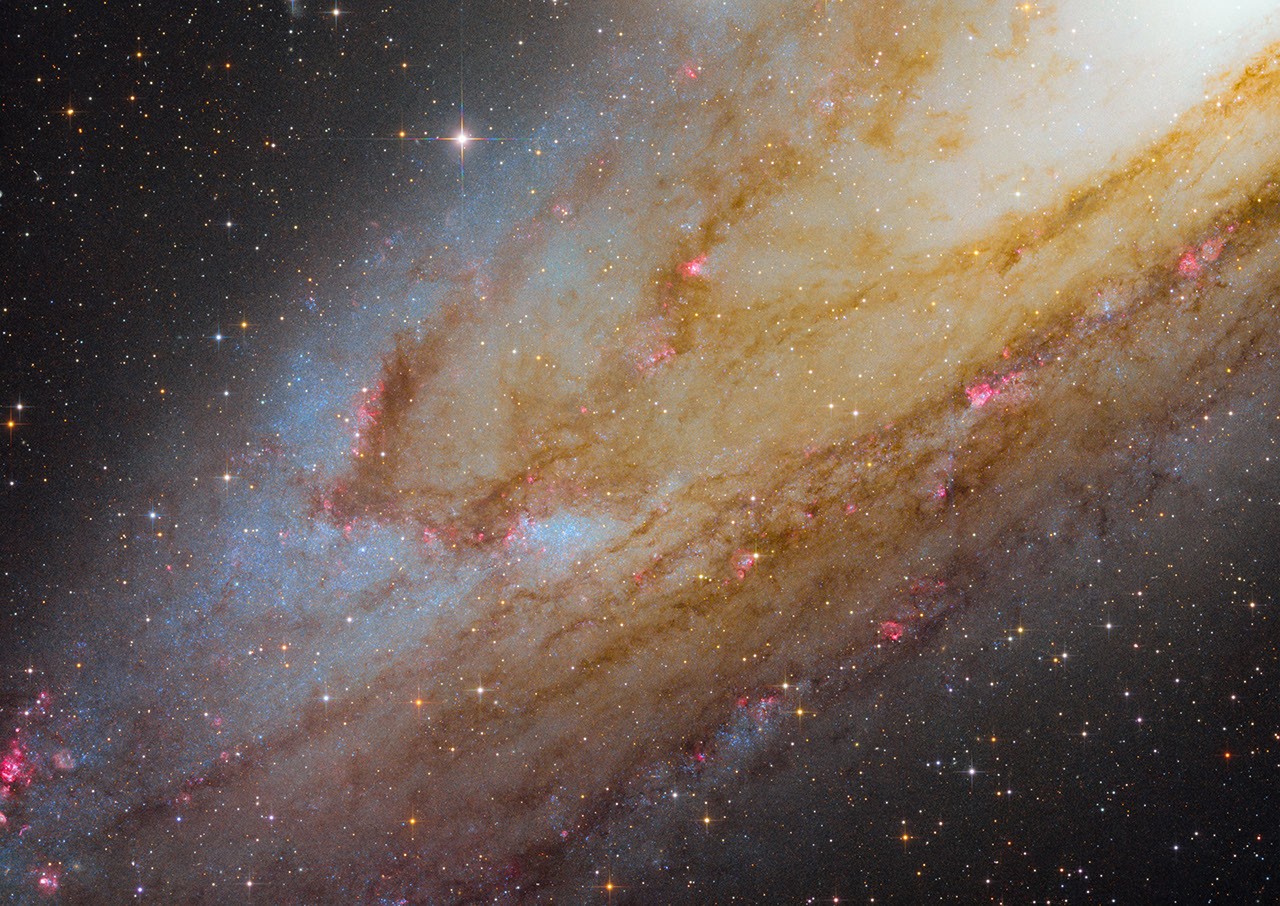
NGC 206 is not a nebula you stumble into by accident. It sits in the southwestern arm of Andromeda — M31, the nearest large spiral galaxy — and to isolate it at this level of detail requires deliberate framing, serious integration time, and the kind of processing discipline that separates astrophotography hobbyists from the ones producing science-adjacent work. David Cruz's image, selected for NASA's Astronomy Picture of the Day on November 13, 2026, does all three. What makes the target interesting is scale. NGC 206 spans roughly 4,000 light-years, which puts it in the same weight class as the Tarantula Nebula in the Large Magellanic Cloud and NGC 604 in M33. These are not modest open clusters. They are giant stellar nurseries, and NGC 206's youngest massive stars clock in at under 10 million years old — infants by galactic standards. The blue luminosity in Cruz's image is not artistic choice; it is the physical signature of youth and mass. The APOD description rightly contextualizes NGC 206 against Milky Way open clusters, which are dramatically smaller. The comparison matters because it underscores a selection bias in how we think about star formation: our own galaxy's clusters are easier to study but not representative of the largest-scale stellar birth happening in spirals. Andromeda's disk gives us a face-on laboratory. Cruz's composition earns attention for what it excludes as much as what it includes. This is a close-up of M31's arm, not the whole galaxy. The pink H-alpha regions dotting the frame are star-forming zones rendered in their emission-line signature. The dust lanes are resolved enough to trace structure. The blue population of NGC 206 sits at center, anchoring the frame. As an APOD entry, this image sits in a long tradition of amateur and semi-professional astrophotographers contributing genuinely useful resolved views of extragalactic targets. The editorial team — Jerry Bonnell, Cecilia Chirenti, Robert Nemiroff, and Keighley Rockcliffe — have curated APOD since its inception, and their selection standards remain one of the more reliable quality filters in public astronomy communication. The underlying science is well-established. NGC 206 has been studied since the mid-20th century as a benchmark for understanding OB associations in external galaxies. What Cruz adds is not new data but new accessibility — a rendered view that makes the physical scale and stellar population legible to anyone willing to look closely. This is what APOD does at its best: it takes an object with real astrophysical significance, pairs it with an image good enough to reward scrutiny, and trusts the reader to meet it halfway. No hype, no overreach. A 4,000-light-year stellar nursery in another galaxy, photographed from Earth, explained in a paragraph.
Worth reading?
RECOMMENDED
Score
56
/100
Anyone who looks at galaxy images and wants to understand what they're actually seeing — amateur astronomers, space-curious readers, educators looking for a clean NGC 206 reference.
Cultural Placement
Like Robert Gendler's mosaic work on M31 but tighter in framing, with the editorial curatorial sensibility of the early Hubble Heritage Project releases. Cruz's image belongs to the tradition of deep amateur astrophotography that blurs the line between public outreach and observational science — think the work that populates Astrobin's top-rated extragalactic gallery, filtered through APOD's three-decade editorial voice. The mechanism is portraiture, not survey: isolate a single structure, resolve it, let the physics speak through color and scale.
Honest assessment
A well-executed, well-curated APOD entry that does exactly what the format promises: a striking image of a real astrophysical object with a concise, accurate explanation. It won't redefine astrophotography, but it's a clean, honest piece of science communication that rewards the 90 seconds it asks for.
What Is NOVEL?
56
/ 100
BedrockNews applies a structured analytical framework called NOVEL to cultural works — games, books, film, music, and more.
How NOVEL worksNerve
2/5
Originality
2/5
Voice
3/5
Endurance
3/5
Lineage
4/5
What did the artist risk? What could have failed?
Moderate risk in target selection — NGC 206 is faint and demands long exposures — but the form itself (APOD deep-field close-up) is well-established. No formal risk taken.
Lineage tree
Robert Gendler's M31 mosaics
direct ancestor
Hubble Heritage Project
tonal influence
APOD (1995–present)
extends the form of
CCD amateur deep-sky revolution
technological ancestor
Verified Facts (7)
NGC 206 is nestled within the dusty arms of the neighboring Andromeda galaxy
Also known as M31, the spiral galaxy is a mere 2.5 million light-years away
Its youngest massive stars are less than 10 million years old
NGC 206 spans about 4,000 light-years
Comparable in size to the giant stellar nurseries NGC 604 in nearby spiral M33 and the Tarantula Nebula in the Large Magellanic Cloud
Credit & Copyright: David Cruz
Authors & editors: Jerry Bonnell, Cecilia Chirenti, Robert Nemiroff, Keighley Rockcliffe
More latest news
Read all