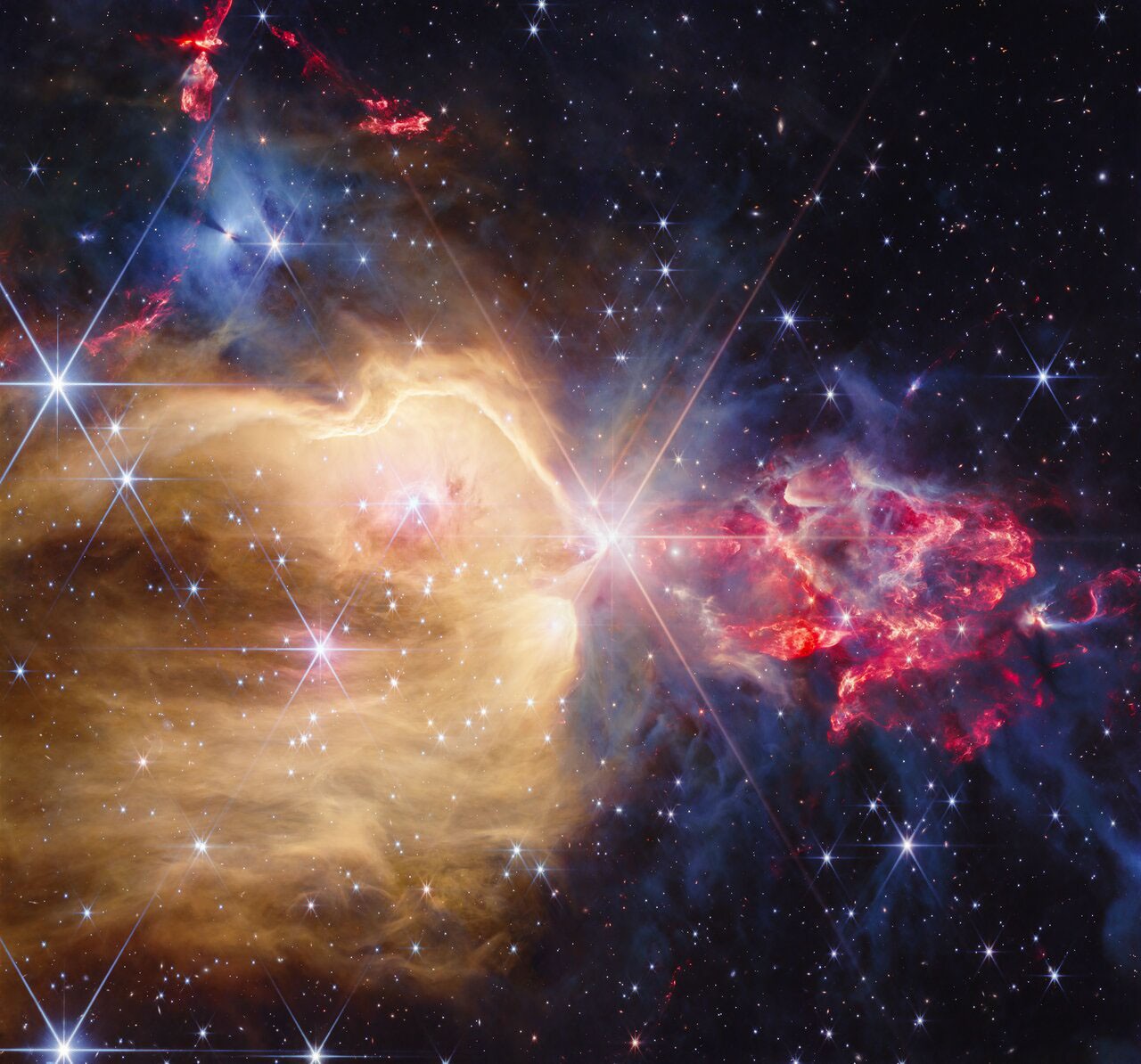
NASA's Astronomy Picture of the Day for November 16, 2026 features a James Webb Space Telescope infrared image of NGC 7129, a star-forming region where gravity, jets, winds, and dust are all fighting for control of the same gas. The image is not decorative — it is a developmental timeline laid out spatially, with stellar age readable left to right across the frame. The gold-colored gas on the left side of the image contains more mature young stars. The red region on the right holds younger ones. This color gradient is not artistic license — it maps to real physical differences in the surrounding gas, shaped by the jets and winds that young stars throw off as they accrete material. The filamentary structure of the red gas is likely carved by those outflows, making the chaos legible. Processed by Alyssa Pagan at STScI, the image uses Webb's infrared capability to see through the opaque dust that blocks visible-light telescopes. Dust forms in the cool atmospheres of stars and, once dispersed into the surrounding medium, acts as a curtain. Webb's instruments pull back that curtain. What Hubble would show as a murky blob, Webb resolves into individual protostars, jet structures, and layered gas chemistry. The scientific question driving the observation is foundational: how do stars form? The answer is messy. Gravity initiates collapse, but feedback from already-formed stars — jets, radiation, winds, eventual explosions — disrupts the process for their neighbors. NGC 7129 is valuable precisely because it contains stars at multiple developmental stages in one field of view, letting astronomers compare phases side by side rather than stitching together observations of different regions. The image credits list NASA, ESA, CSA, STScI, and JWST, with the APOD curated by Robert Nemiroff, Jerry Bonnell, Cecilia Chirenti, and Keighley Rockcliffe. APOD has been running since 1995, and entries like this one demonstrate why the format endures: one image, one explanation, one question made visual. No noise. As a piece of science communication, this is Webb doing exactly what it was built to do — not chasing headlines but methodically documenting processes that unfold over millions of years, frozen in a single infrared snapshot. The filamentary red gas alone is worth the scroll.
Worth reading?
RECOMMENDED
Score
68
/100
Anyone who wants to understand what JWST actually does with its time, and readers who enjoy science images that reward close looking rather than just awe.
Cultural Placement
Like Hubble's Pillars of Creation but with the lights on — Webb's infrared penetration strips away the romantic fog and replaces it with structural clarity. Think of it as the difference between a Turner seascape and a NOAA bathymetric chart: both beautiful, but one tells you what's actually under the surface. In the lineage of great observatory images (Hubble Deep Field, Pale Blue Dot), this trades iconic simplicity for informational density. It sits closer to the scientific illustration tradition of Maria Sibylla Merian — organisms caught mid-process — than to the sublime-emptiness school of space photography.
Honest assessment
This is a superb example of Webb operating within its core mission — not a splashy discovery image but a methodical, information-rich capture of star formation at multiple stages. It won't break the internet the way the first Webb deep field did, but it's a better teaching tool. For the reader who cares about how stars actually form, this single image communicates more than most popular science articles.
What Is NOVEL?
68
/ 100
BedrockNews applies a structured analytical framework called NOVEL to cultural works — games, books, film, music, and more.
How NOVEL worksNerve
2/5
Originality
3/5
Voice
4/5
Endurance
4/5
Lineage
4/5
What did the artist risk? What could have failed?
Low structural risk. JWST was built for exactly this observation; the instrument, target, and processing pipeline are all within the telescope's design envelope. The risk was in the $10B telescope working — it did.
Lineage tree
Hubble Pillars of Creation
direct ancestor — the iconic star-formation image Webb is implicitly answering
Hubble Deep Field (1995)
established the observatory keynote image as a public communication genre
Spitzer Space Telescope IR surveys
infrared predecessor — proved the science case Webb now executes at higher resolution
APOD (1995–present)
the format itself — 30 years of one-image-one-explanation science communication
Verified Facts (6)
Image is of star-forming region NGC 7129 taken by the James Webb Space Telescope in infrared light
Young stars on the left, in gold-colored gas, are typically more mature than the young stars on the right in the red region
Jets and winds likely cause the filamentary nature of the red-colored gas
Credit: NASA, ESA, CSA, STScI, JWST; Processing: A. Pagan (STScI)
Authors & editors: Robert Nemiroff, Jerry Bonnell, Cecilia Chirenti, Keighley Rockcliffe
Date: November 16, 2026
More latest news
Read all