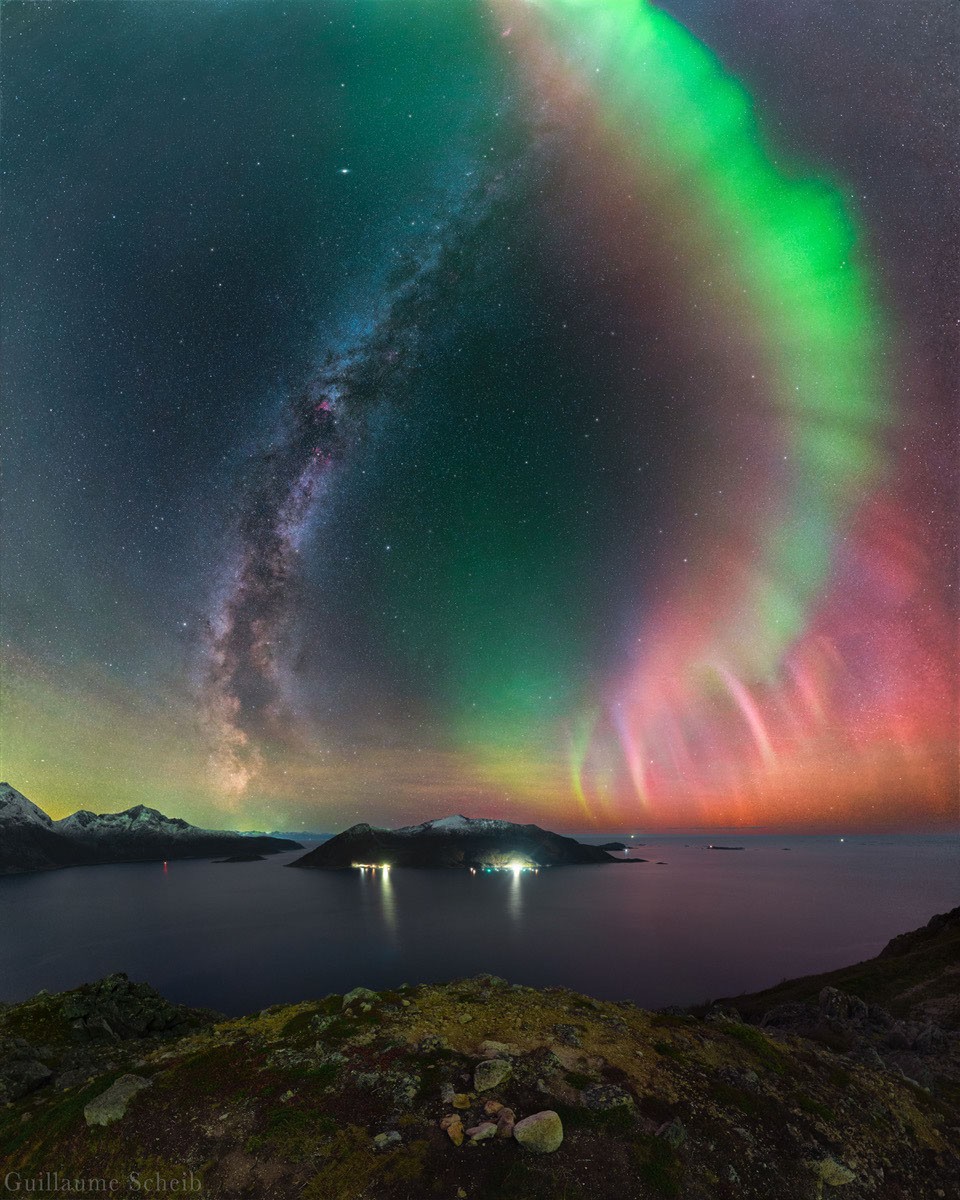
This is an astrophotography image that earns its keep by composition alone. Guillaume Scheib set up on Kvaløya, an island in northern Norway, and caught two luminous arcs — the Milky Way's central band and an auroral ribbon — framing the sky in what looks like a cosmic territorial dispute. The image ran as NASA's Astronomy Picture of the Day on November 17, 2026. The structural trick here is the dual-arch framing. Most aurora shots feature a single spectacle against a dark sky or a horizon. Most Milky Way shots isolate the band. Getting both arcs in a single wide-field composition, with neither overwhelming the other, requires timing, latitude, solar activity, and clear skies to cooperate simultaneously. Kvaløya, at roughly 69°N, is one of the few places on Earth where this alignment is even plausible. What the APOD text does well is strip the mysticism. The Milky Way is ancient, far away, made of stars and dust. The aurora is hours old, local, made of energized atoms in Earth's upper atmosphere. The Sun connects them — a stellar member of the galaxy that also ejects the particles powering the aurora. That shared cause, stated plainly, is more interesting than any breathless caption could be. Tucked into the frame are two bonus objects: the Big Dipper sitting behind the auroral arch, and the Andromeda galaxy appearing as a bright spot near the top-left of center. These are easy to miss on first viewing, and the annotated version of the image (linked on the APOD page) helps locate them. The photograph belongs to a specific Northern European astrophotography tradition — wide-field, single-exposure or carefully composited panoramas from Arctic latitudes where aurora and galactic features can share the frame during dark-sky season. It's a technically demanding subgenre that rewards patience over post-processing trickery. As a daily APOD entry, it does exactly what the program has done since 1995: present one image of the cosmos with a brief, accurate explanation by professional astronomers. No hype, no clickbait, just a photograph and the science behind it. Thirty-one years into the project, the format still works.
Worth reading?
RECOMMENDED
Score
52
/100
Anyone who enjoys astrophotography, aurora chasers, or people who want a 90-second reminder that the sky is structurally interesting — especially if you've never thought about why the Sun connects both arches.
Cultural Placement
Like Babak Tafreshi's TWAN project but compressed into a single decisive frame, with the compositional instincts of a Royce Bair nightscape and the scientific annotation style that APOD has maintained since Robert Nemiroff and Jerry Bonnell launched it in 1995. The dual-arch structure recalls Tommy Eliassen's Arctic aurora work, but Scheib's image distinguishes itself by giving equal compositional weight to the galactic band — most aurora photographers subordinate the Milky Way to the light show. The result sits at the intersection of landscape astrophotography and science communication, a tradition where the caption matters as much as the exposure.
Honest assessment
A well-composed, scientifically annotated Arctic astrophotograph that earns its APOD slot through an uncommon dual-arch composition. It won't redefine the genre, but it rewards a close look — especially the annotated version where Andromeda and the Big Dipper reveal themselves. Best consumed with the caption, which does real explanatory work.
What Is NOVEL?
52
/ 100
BedrockNews applies a structured analytical framework called NOVEL to cultural works — games, books, film, music, and more.
How NOVEL worksNerve
2/5
Originality
3/5
Voice
3/5
Endurance
2/5
Lineage
3/5
What did the artist risk? What could have failed?
Moderate personal risk — Arctic winter shoots demand physical commitment and expensive travel — but the photographic form itself is established. No formal or career risk; this is excellent execution within known parameters.
Verified Facts (8)
The arch on the left is the central band of our Milky Way Galaxy
The arch on the right is an auroral ribbon
Far behind the middle of the auroral arch is the Big Dipper
Even farther in the distance is the Andromeda galaxy — the bright spot near the top of the frame, just left of center
The featured image was taken about a month ago from Kvaløya in northern Norway
Credit & Copyright: Guillaume Scheib
Authors & editors: Robert Nemiroff, Jerry Bonnell, Cecilia Chirenti, Keighley Rockcliffe
November 17, 2026
More latest news
Read all