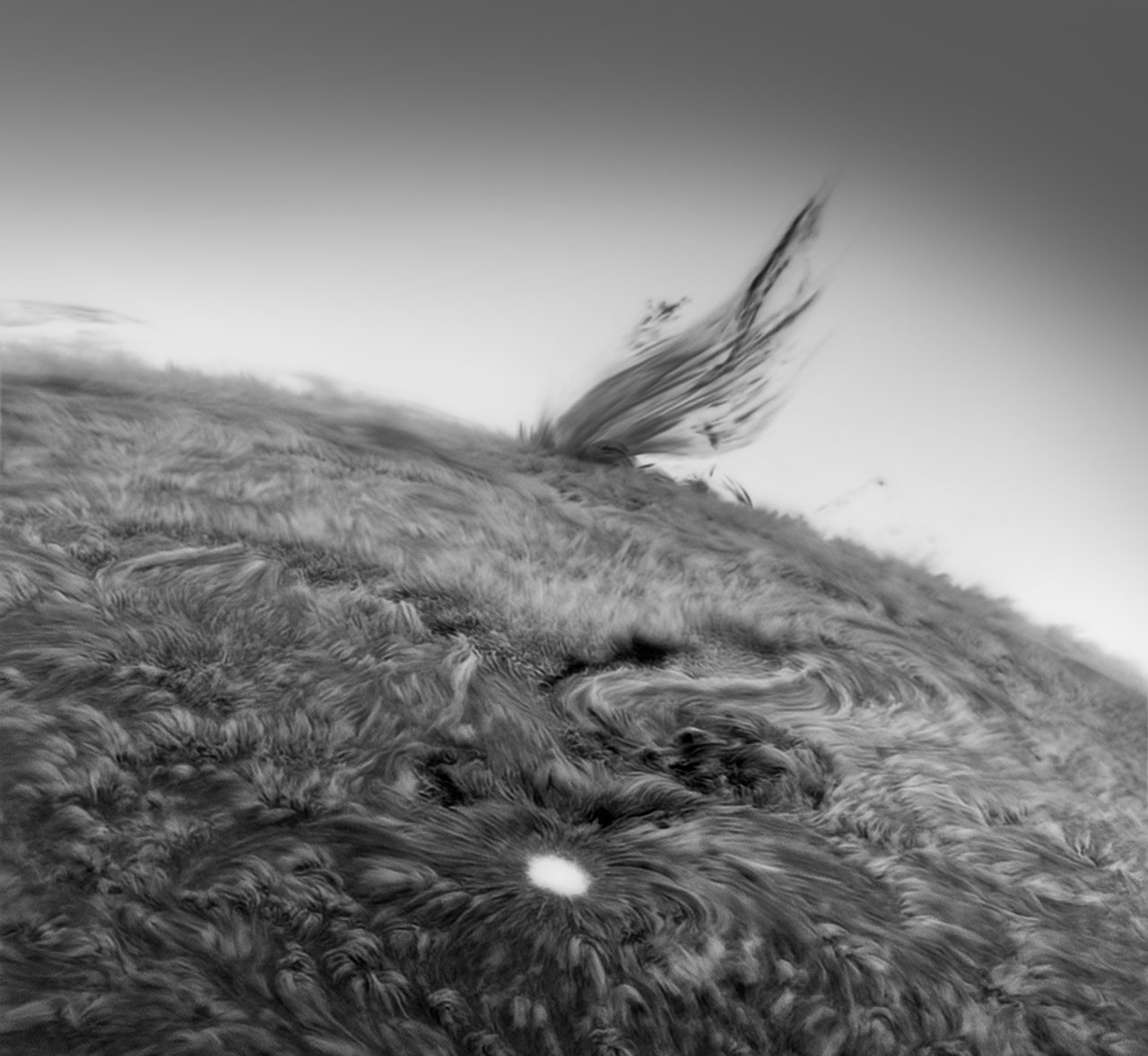
The Astronomy Picture of the Day program has been doing the same thing since 1995: one image, one explanation, every day. That consistency is itself a kind of achievement. Today's entry is a chromospheric portrait of an M-class solar flare captured on May 14, 2025, by astrophotographer Mario Cogo using an H-alpha filter — the narrow-band technique that isolates the red emission line of excited hydrogen atoms, revealing structure invisible in broadband light. The image shows the Sun's chromosphere, the atmospheric layer above the photosphere where temperatures paradoxically rise with altitude. The explanation correctly identifies swirling magnetic fields as the likely energy source for this heating — a mechanism still not fully resolved in solar physics, though magnetohydrodynamic models have narrowed the candidates considerably. The flare itself was classified M1 on the GOES X-ray scale, placing it in the moderate tier: bright enough to cause polar radio blackouts and minor radiation storms, but well below the X-class events that can disrupt power grids and satellite operations. Cogo's work here is skilled amateur astrophotography at its best. H-alpha solar imaging requires precise filtration (typically a sub-angstrom etalon or dedicated solar telescope), careful tracking, and stacking of many frames to pull detail from atmospheric seeing. The result reveals filaments, prominences, and the flare's bright ribbon structure with clarity that would have been impossible for amateurs two decades ago. The democratization of solar imaging equipment — particularly from manufacturers like Lunt and DayStar — has opened this field wide. The APOD text does its usual competent job of translating solar physics for a general audience. The explanation of why the chromosphere is hotter than the surface is appropriately hedged ('potentially due to'), and the note about M-class flares causing polar radio blackouts and astronaut radiation hazards gives the reader concrete stakes. The mention of NASA and NOAA monitoring programs adds institutional context without overselling. What this entry does not do is push boundaries. It is a well-executed example of a format that has been running for over 11,000 consecutive days. The image is beautiful. The science is accurate. The writing is clear. That is exactly what APOD is for — daily science communication that meets people where they are. Not every entry needs to be revelatory; the cumulative effect of showing up every day for three decades is the actual achievement. The credit structure is worth noting: Cogo as photographer, with Keighley Rockcliffe listed among the authors and editors alongside APOD veterans Robert Nemiroff and Jerry Bonnell, plus Cecilia Chirenti. This editorial continuity — Nemiroff and Bonnell have run the program since its founding — is itself a form of institutional craft that rarely gets recognized. If you are already an APOD reader, this is a solid Tuesday. If you are not, it is as good an entry point as any into the longest-running astronomy outreach project on the internet.
Worth reading?
OPTIONAL
Score
48
/100
Space-curious readers who want a daily dose of well-explained astrophotography; anyone interested in solar physics or amateur solar imaging techniques.
Cultural Placement
Like a National Geographic photo essay compressed to a single frame with a Physics Today sidebar — the visual ambition of fine-art astrophotography married to the explanatory clarity of Carl Sagan's Cosmos segments. APOD occupies the same niche as Attenborough narration: reliable, beautiful, educational, rarely surprising. This particular entry sits in the H-alpha solar imaging tradition that exploded after affordable etalon filters hit the amateur market circa 2005, inheriting from the visual language of Big Bear Solar Observatory and the Sacramento Peak facility.
Honest assessment
A reliable, well-executed entry in a 30-year daily series. The image is beautiful, the science is accurate, and the writing is clear. It does not push any boundary — it maintains a standard, which after 11,000+ consecutive days is itself an underrated form of craft. Worth a minute of your morning if you care about the Sun.
What Is NOVEL?
48
/ 100
BedrockNews applies a structured analytical framework called NOVEL to cultural works — games, books, film, music, and more.
How NOVEL worksNerve
1/5
Originality
2/5
Voice
3/5
Endurance
3/5
Lineage
3/5
What did the artist risk? What could have failed?
Zero risk taken. APOD's format is fixed — one image, one explanation, one day. Cogo's H-alpha capture is technically skilled but squarely within established amateur solar imaging practice. Nothing could fail here.
Verified Facts (7)
The flare was classified as an M1 based on GOES observations
The flare occurred on May 14, 2025
M-class flares can cause radio blackouts at Earth's poles and minor radiation storms that can harm astronauts
Credit: Mario Cogo
Authors & editors: Keighley Rockcliffe, Robert Nemiroff, Jerry Bonnell, Cecilia Chirenti
H-alpha filter used to capture light from energized hydrogen atoms
Date: November 18, 2026
More latest news
Read all