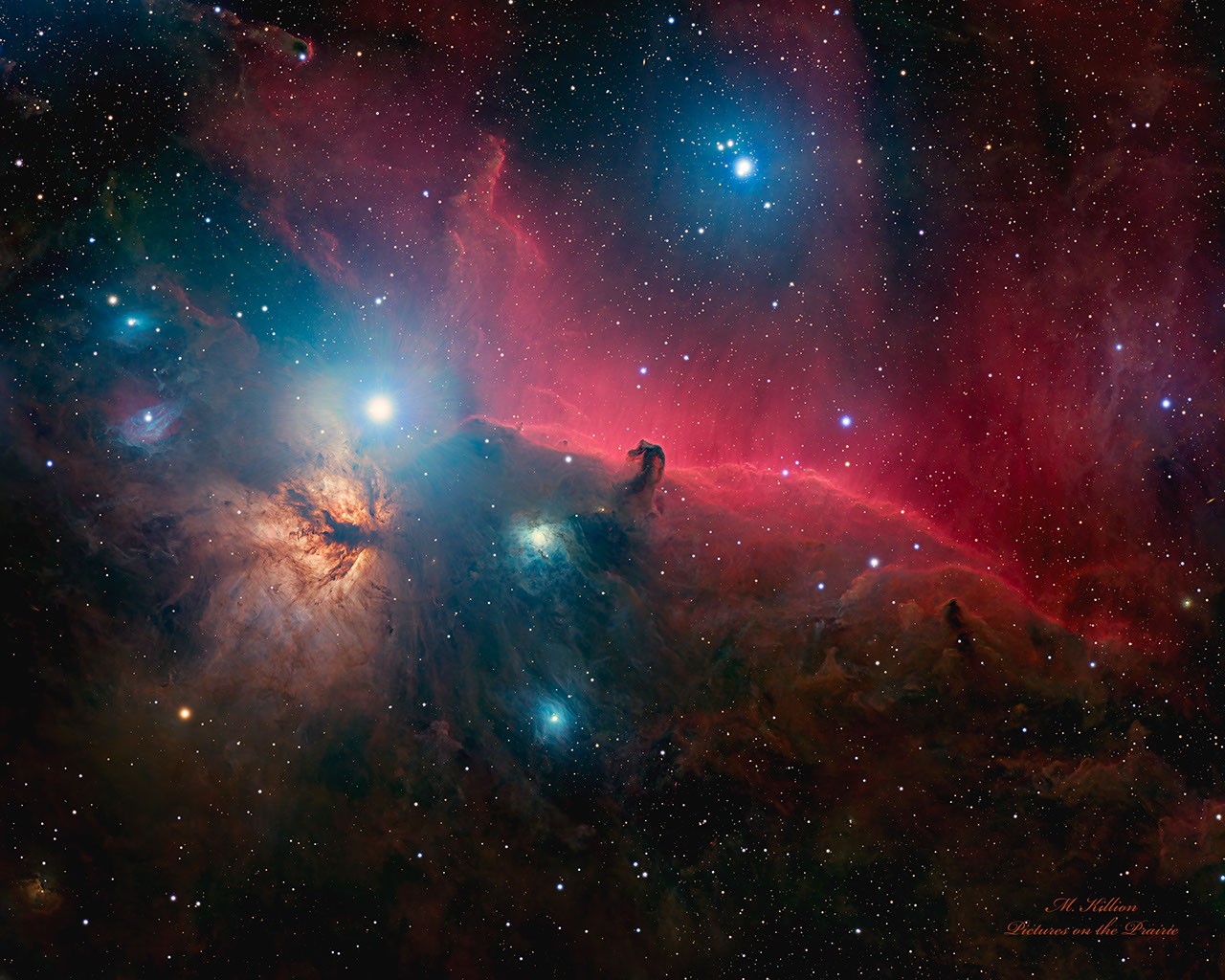
The first thing to get straight: this is not a painting, though your eyes will insist otherwise. Mark E. Killion's image of the Horsehead and Flame Nebulas is a nearly six-hour photographic exposure captured at the Utah Desert Remote Observatories — with Killion himself sitting in Illinois, over 2,000 kilometers away, piloting the equipment remotely. The result is an image that sits in the uncomfortable gap between documentation and art, where the colors are real but curated, the composition is dictated by physics but framed by a human eye. The Horsehead Nebula dominates the center — five light-years tall, 1,500 light-years distant, a column of dust and gas silhouetted against the red glow of ionized hydrogen. That red comes from Sigma Orionis energizing the gas behind the dark column. To the left, the Flame Nebula burns orange with dark filamentary structure threading through it. The blue reflection nebula NGC 2023 sits closer to the Horsehead, actively forming stars. And anchoring the composition, blue Alnitak — a triple star system and the easternmost star in Orion's Belt — blazes left of center. What makes this APOD entry interesting as craft rather than just pretty wallpaper is the tension between automation and authorship. Killion chose the target, the framing, the exposure parameters, the processing pipeline. The telescope did the rest, unattended in the Utah desert. This is the astrophotography equivalent of a photographer who develops their own film but uses a tripod and timer — the hand is present in every decision except the moment of capture. The annotated version (available via toggle on the APOD page) is worth examining for what it reveals about the image's information density. Every glowing region, every dark lane, every named star is a physical object with known distance, composition, and energy source. The beauty is not abstract; it is explanatory. The red means hydrogen ionization. The blue means reflected starlight. The dark means dust blocking what's behind it. Color here is data. APOD has been running since 1995, curated by professional astronomers — currently Cecilia Chirenti, Robert Nemiroff, Jerry Bonnell, and Keighley Rockcliffe — through NASA's Goddard Space Flight Center and Michigan Tech. It remains one of the internet's most durable institutions of daily visual science communication. No algorithms, no engagement optimization, just one image a day with a paragraph of expert explanation. Killion's image earns its spot in that tradition. It is technically accomplished, scientifically literate, and visually arresting. It does not pretend to be more than what it is — a carefully assembled composite of real photons from real objects — and it does not need to. The cosmos, it turns out, does not require a filter.
Worth reading?
RECOMMENDED
Score
52
/100
Anyone who finds the night sky interesting and wants a two-minute reminder that real photons from 1,500 light-years away can look like a Renaissance painting. Especially good for space-curious readers who don't follow astrophotography but appreciate craft.
Cultural Placement
Like Ansel Adams' large-format landscape work but mediated through robotic telescopes and narrowband filters, with the compositional instincts of a painter and the data obsession of a spectroscopist. Sits in the same tradition as Robert Gendler's deep-field mosaics and Rogelio Bernal Andreo's wide-field Orion composites, but distinguished by the remote-operation workflow — the photographer never touched the telescope. The APOD platform itself functions like a daily salon hang: one image, expert wall text, no curation by engagement metrics.
Honest assessment
This is a well-executed, scientifically annotated astrophotograph of one of the sky's most iconic targets, presented through the internet's longest-running daily science image platform. It won't redefine the form, but it delivers exactly what APOD has delivered for three decades: real data, real beauty, expert context, no filler. Worth the two minutes.
What Is NOVEL?
52
/ 100
BedrockNews applies a structured analytical framework called NOVEL to cultural works — games, books, film, music, and more.
How NOVEL worksNerve
2/5
Originality
2/5
Voice
3/5
Endurance
3/5
Lineage
3/5
What did the artist risk? What could have failed?
Low structural risk. The Horsehead is one of astrophotography's most-imaged targets. The remote workflow adds a process wrinkle, but collapse was never on the table — competent execution of a well-understood challenge.
Verified Facts (8)
The Horsehead Nebula is about five light-years tall and lies approximately 1,500 light-years away
Alnitak is a triple star system and the easternmost star in Orion's Belt
Hydrogen gas being ionized by the bright star Sigma Orionis
Data collected for almost six hours at the Utah Desert Remote Observatories
Remotely controlled by the astrophotographer from his home, over 2,000 km away in Illinois
NGC 2023 is actively forming stars
Credit: Mark E. Killion
Authors & editors: Cecilia Chirenti, Robert Nemiroff, Jerry Bonnell, Keighley Rockcliffe
More latest news
Read all