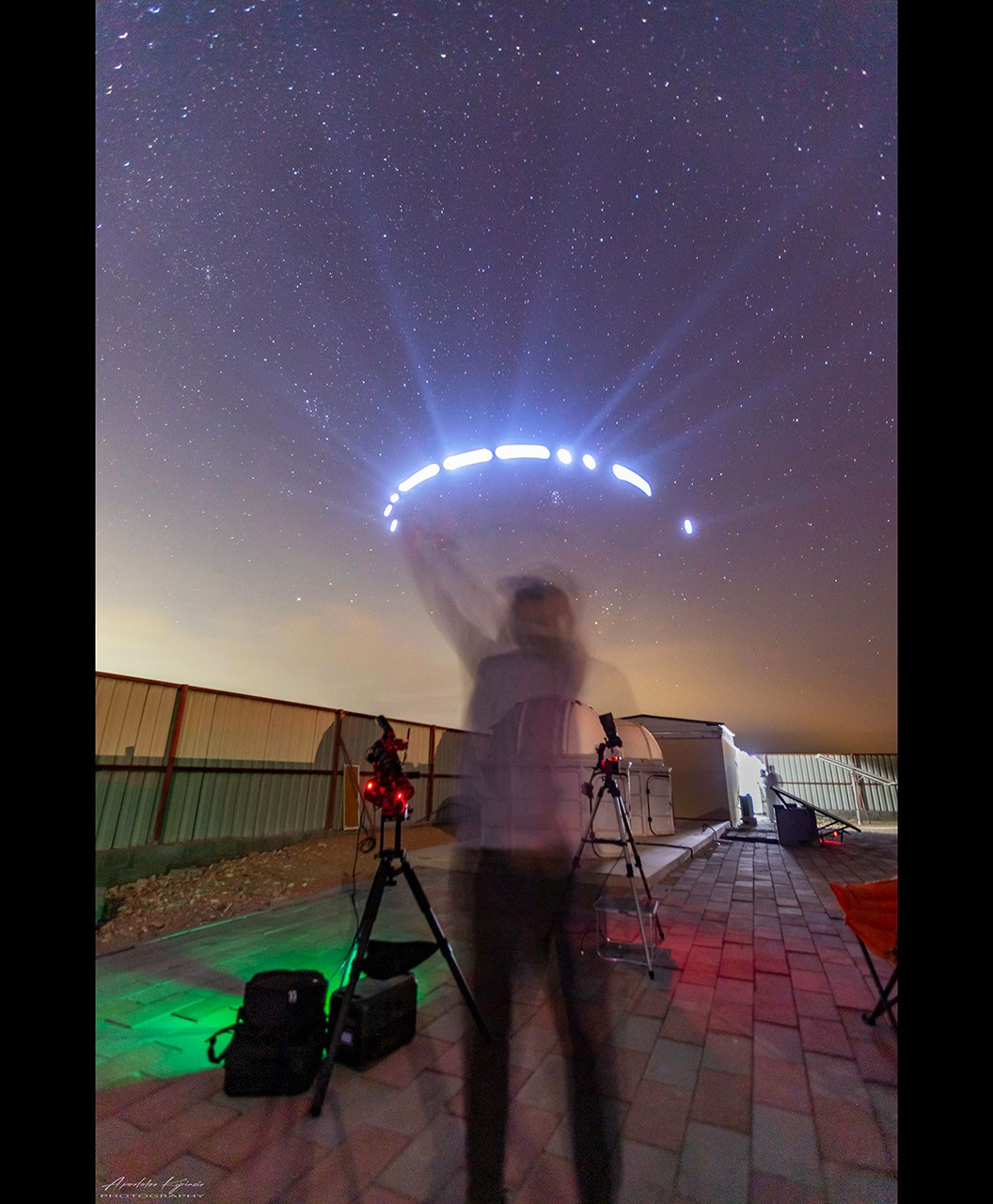
On November 17, 2026, people across the planet pointed flashlights at the sky and blinked out V-G-R in Morse code — a call sign for Voyager 1, the most distant human-made object in existence. The next day, the spacecraft officially crossed a milestone that makes the math viscerally clear: it is now so far away that light itself needs a full day to reach it. The image, a time exposure by Apostolos Kyriazis from the Emirates Astronomical Observatory, traces the dashes and dots of the Morse message against the night sky. It's a photograph of a gesture that could never actually be received — Voyager's antenna isn't listening for flashlights — but that's not the point. The point is the act of calling out. The numbers deserve a moment. Voyager 1 launched in 1977. It has been traveling for nearly 50 years and has covered approximately 26 billion kilometers. That distance equals one light-day. At this rate — one light-day per 50 years — the spacecraft will reach one light-year (365 light-days) in roughly 18,250 years. The nearest star system, Alpha Centauri, is about 4.37 light-years away. Voyager is not going to get there. Nobody alive will see it arrive anywhere. What makes APOD entries like this work is their refusal to overstate. The explanation is factual, the math is left as an exercise, and the emotional weight comes from the numbers themselves, not from rhetoric. The gap between human ambition and cosmic scale does all the heavy lifting. The community ritual — fans of interstellar spaceflight invited to shine a message — sits in a tradition of participatory space gestures that goes back to Carl Sagan's Golden Record, itself bolted to the Voyager spacecraft. The flashlight salute is the Golden Record's inverse: instead of sending culture outward, people on Earth send acknowledgment toward an object that already carries their culture. Kyriazis's photograph is beautiful in a specific, austere way. Long-exposure astrophotography is a mature form, and this image earns its place not through technical novelty but through conceptual framing — the message isn't aimed at stars but at a spacecraft that will never detect it. The melancholy is baked into the physics. This is an APOD entry doing exactly what APOD has done since 1995: delivering one image, one explanation, one set of facts, and trusting the reader to feel the scale. It's a small artifact, but a good one.
Worth reading?
RECOMMENDED
Score
60
/100
Anyone who finds the scale of space genuinely moving, fans of Voyager's ongoing journey, readers who prefer their wonder delivered through math rather than rhetoric.
Cultural Placement
Like Carl Sagan's 'Pale Blue Dot' passage but compressed into a single photograph and a paragraph of math. Sits in the tradition of participatory astronomy events (Messier Marathons, globe-at-night campaigns) crossed with the long-exposure astrophotography of Thierry Legault. The emotional mechanism is the same as the Powers of Ten film — scale itself as the payload, not narrative or spectacle. APOD as a platform is closer to a curated daily haiku than to science journalism.
Honest assessment
This is a small artifact — one image, one paragraph — doing exactly what it should. It won't change how you think about photography or science communication, but the milestone is real, the image is well-framed, and the emotional payload lands because APOD trusts numbers over adjectives. Worth the two minutes.
What Is NOVEL?
60
/ 100
BedrockNews applies a structured analytical framework called NOVEL to cultural works — games, books, film, music, and more.
How NOVEL worksNerve
2/5
Originality
3/5
Voice
3/5
Endurance
3/5
Lineage
4/5
What did the artist risk? What could have failed?
Low structural risk. APOD is a 30-year format; this entry executes within it cleanly. The community flashlight ritual adds participatory warmth but doesn't risk failure.
Lineage tree
Sagan's Golden Record (1977)
direct ancestor — the original outward gesture bolted to this same spacecraft
Pale Blue Dot (1990)
tonal influence — scale as emotional mechanism
Powers of Ten (Eames, 1977)
extends the form of — using orders of magnitude to generate awe
APOD archive (1995–present)
direct ancestor — 30 years of daily single-image science curation
Verified Facts (7)
Voyager 1 confirmed to reach its one light-day distance milestone on November 18, at 10:16:07 UTC
Voyager 1 currently approximately 26 billion kilometers away
Launched in 1977
At one light-day per 50 years, Voyager 1 will reach one light-year in about 18,250 years
Image captured from the Emirates Astronomical Observatory by Apostolos Kyriazis
Morse code message captured reads V-G-R
Fans of interstellar spaceflight invited to shine a message on November 17
More latest news
Read all