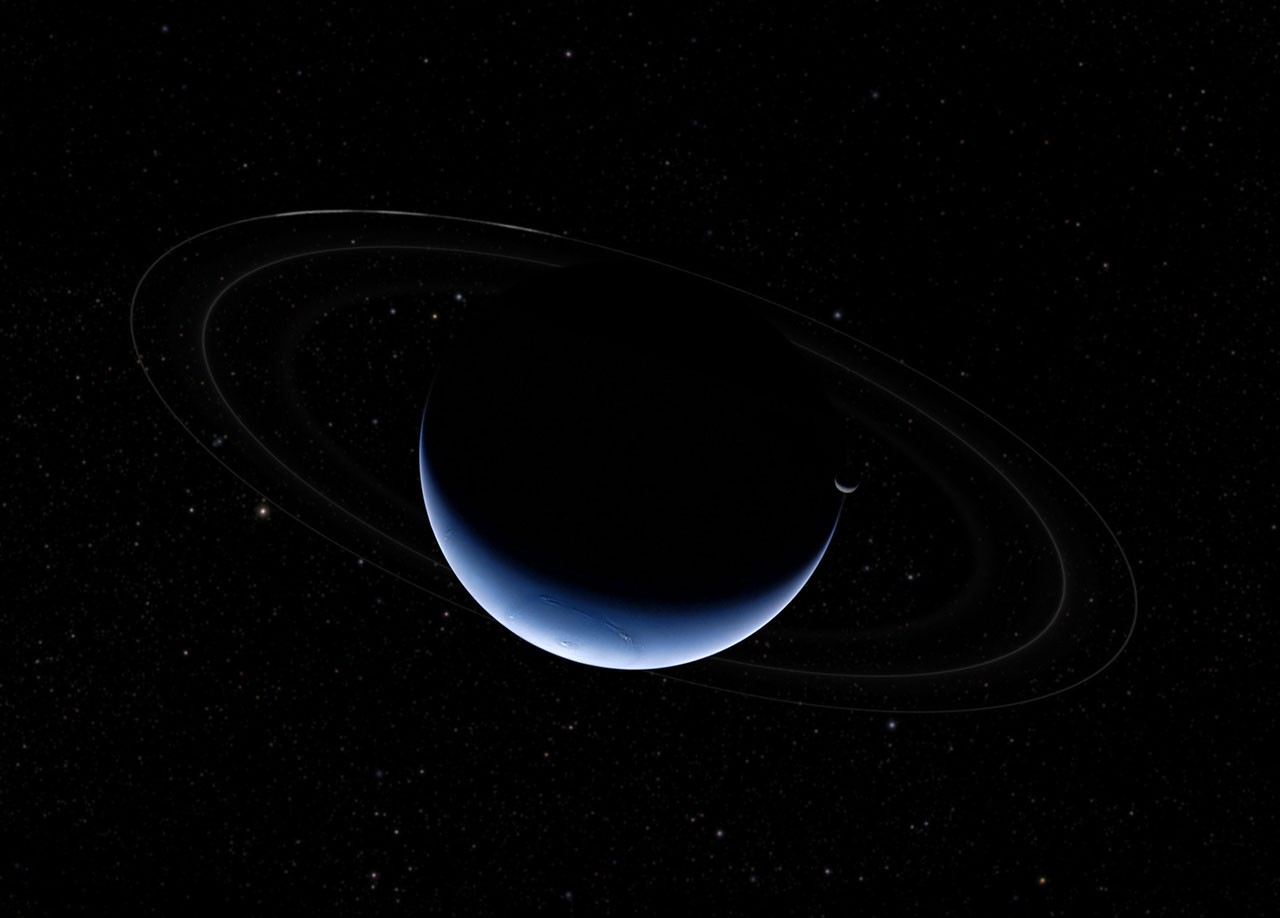
In August 1989, Voyager 2 threaded past Neptune at 17 kilometers per second, capturing the only close-up images humanity has ever taken of the outermost ice giant. No spacecraft has returned since. The raw data — scattered across hundreds of individual frames in NASA's Planetary Data System — has sat largely unprocessed for the general public. Rolf Olsen's composite takes that data and builds the view Voyager never actually saw in a single frame: Neptune and Triton as thin sunlit crescents, the faint ring arcs, and the south polar vortex, all set against a real starfield from sky survey data centered on the constellation Camelopardalis. The image is honest about what it is. Parts of the ring system are modeled rather than directly photographed — the faintest segments were below Voyager's detection threshold, and the composite says so. The background stars are real but sourced separately. This is assembly, not fabrication. The distinction matters because the entire value of the image rests on its fidelity to Voyager's actual encounter data, and Olsen maintains that fidelity while constructing a perspective that communicates the geometry of the scene — outbound, looking back toward the Sun — in a way no single raw frame could. What makes this APOD entry worth attention is the tension between the image's beauty and its loneliness. Neptune has been visited exactly once. Voyager 2 is now in interstellar space, still transmitting in 2026 but never coming back. There is no follow-up mission en route. Every piece of close-range Neptune data we have came from a few days in 1989. Olsen's composite is not just an aesthetic exercise — it is, practically speaking, the best view of Neptune's crescent phase that will exist for decades. The technical craft is strong. Cirrus clouds and a dark band circling the south polar region are visible, along with a cloudy vortex above the pole. The three bright ring arcs — Adams, Le Verrier, and Galle, first confirmed by Voyager during this flyby — are rendered from actual detection data. The 7.5-degree field of view gives the scene breathing room without losing the planet in a sea of stars. The credit line is clean: assembly and processing by Olsen, data sourced from Voyager 2 via the NASA Planetary Data System. The APOD editors — Bonnell, Chirenti, Nemiroff, Rockcliffe — selected this as a reminder that some of our best planetary science is decades old and still being mined. The image argues, without saying so, that the raw data from flagship missions has a second life when skilled processors return to it with modern tools and compositional ambition. Voyager 2 launched in 1977, reached Neptune twelve years later, and is now roughly 20 billion kilometers from Earth. It remains the only human-made object to have visited both Uranus and Neptune. The fact that a single flyby from 37 years ago still produces images this striking is a testament to the mission's instrument design — and an indictment of the gap in outer solar system exploration that has followed.
Worth reading?
RECOMMENDED
Score
68
/100
Anyone who cares about planetary exploration, space photography, or the craft of turning raw mission data into images that communicate what it felt like to be there. Especially for readers who didn't know Voyager 2's Neptune data was still being worked.
Cultural Placement
Like Bjork Lomborg's Mars panorama stitching or the Hubble Heritage Project's approach to deep-field composites, but applied to a single flyby's worth of data from the most remote encounter in spaceflight history. The closest analog in spirit is Michael Benson's 'Beyond' — reconstructions of planetary encounters from raw mission data that treat the archive as raw material for visual storytelling. Olsen's Neptune sits in the tradition of 'faithful composites' — images that never existed as a single exposure but contain no invented data.
Honest assessment
This is a beautifully executed composite that earns its impact through fidelity rather than fabrication. It won't reshape the field of astronomical image processing, but it creates what may be the definitive popular view of Neptune's crescent phase for a generation. Its real power is as a reminder: our best Neptune data is 37 years old, and no replacement is coming soon.
What Is NOVEL?
68
/ 100
BedrockNews applies a structured analytical framework called NOVEL to cultural works — games, books, film, music, and more.
How NOVEL worksNerve
2/5
Originality
3/5
Voice
4/5
Endurance
4/5
Lineage
4/5
What did the artist risk? What could have failed?
Modest formal risk. The composite acknowledges its modeled segments, but the core technique — stitching PDS data into panoramic views — is established practice. The risk is reputational: get the data wrong, and the planetary science community notices.
Lineage tree
Voyager 2 raw PDS data (1989)
direct source material
Michael Benson's 'Beyond' (2003)
established the form of faithful mission-data composites as art
Hubble Heritage Project
institutional precedent for reprocessing archival data into public-facing images
Björn Jónsson's planetary composites
peer practitioner in the same tradition of PDS-data reconstruction
Verified Facts (8)
Voyager 2 spacecraft made its closest approach to Neptune on August 25, 1989
Only spacecraft to visit the most distant ice giant planet
Parts of the very faint ring system along with the three bright ring arcs were first imaged by Voyager during the fly-by
The faintest segments are modeled in this composited picture
Background starfield is composed from sky survey data centered on the constellation Camelopardalis
Spanning 7.5 degrees
The Voyager 2 spacecraft is now in interstellar space
Assembly/Processing – Rolf Olsen, Data – Voyager 2, NASA Planetary Data System
More latest news
Read all