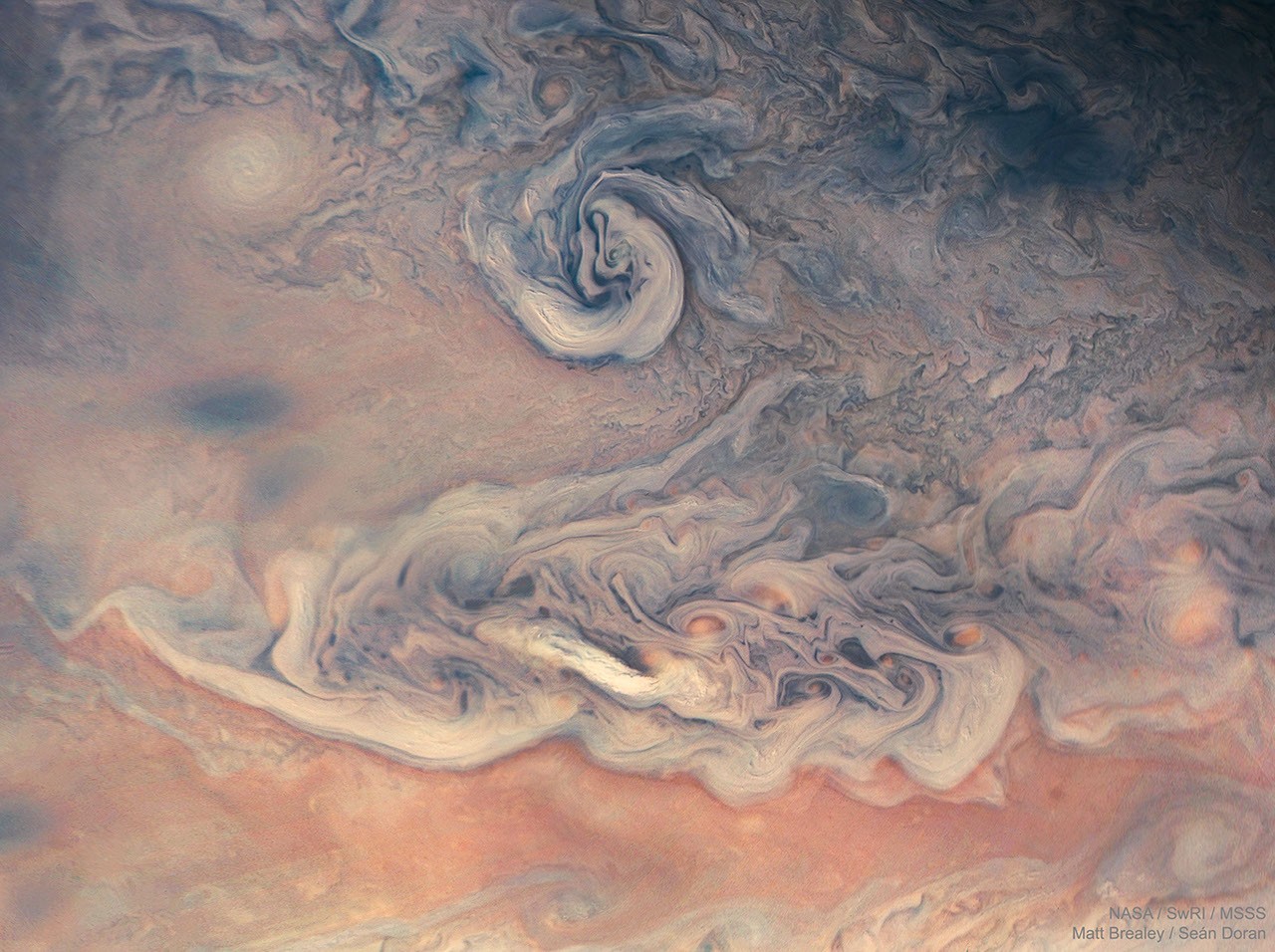
This is a photograph of a question mark. The Juno spacecraft's 14th perijove pass in 2018 captured Jupiter's cloud tops in enough detail to make out individual storm systems, layered atmospheric bands, and the interplay between light high-altitude clouds and darker low-lying domains. The image has been color-enhanced to push those contrasts into visibility. What it cannot tell you — what nobody can tell you — is why Jupiter's clouds look the way they do. The thick Jovian atmosphere is overwhelmingly hydrogen and helium, both colorless at cloud-top temperatures. The reds, oranges, and tawny browns that define Jupiter's visual identity come from trace molecules that remain unidentified with certainty. Ammonium hydrosulfide is the leading candidate, but "leading candidate" in planetary science means "best guess with incomplete data." The color problem is one of the longest-running open questions in solar system science. What the image does confirm is the vertical structure: lighter clouds sit higher, darker clouds sit lower. You can see this in the composition — bright white swirls wrapping around reddish regions in the lower right, while in the upper right, lighter material appears to drape over darker domains like fog settling into valleys. The dynamics are real even if the chemistry is uncertain. Juno itself is a remarkable instrument platform. The spacecraft loops around Jupiter in an elliptical orbit with a 33-day period, each pass exploring a slightly different sector of the planet. This design means Juno doesn't stare at one spot — it slowly builds a mosaic of the entire planet over years. The 14th pass that produced this image is one tile in that mosaic. The processing work by Matt Brealey and Seán Doran took raw data and turned it into something that communicates the planet's turbulence at a glance. APOD — Astronomy Picture of the Day — has been running since 1995, curated by Robert Nemiroff and Jerry Bonnell (now joined by Cecilia Chirenti and Keighley Rockcliffe). It is one of the longest-running daily content features on the internet, and its editorial model is deceptively simple: one image, one explanation, every day. No slideshows, no algorithmic feed, no engagement optimization. The constraint is the product. The honest thing to say about this particular entry is that the image is gorgeous and the science is humble. "No one is sure" is not a phrase you see often enough in science communication. Jupiter's color mystery is a reminder that some of the most visually dramatic phenomena in the solar system remain unexplained at a basic chemical level. We can photograph it in extraordinary detail. We cannot yet explain what we're looking at.
Worth reading?
RECOMMENDED
Score
60
/100
Anyone who wants three minutes of genuine wonder paired with honest scientific humility — especially readers tired of science communication that pretends every question is answered.
Cultural Placement
Like Ansel Adams' landscape work but pointed at a gas giant, with the curatorial minimalism of Brain Pickings' early era. The APOD format — one image, one paragraph, one day — is closer to a daily haiku practice than to modern science media. The color-enhancement processing by Brealey and Doran sits in the tradition of astronomical image processing that goes back to David Malin's photographic composites, where the craft is making invisible data legible to the human eye without fabricating what isn't there.
Honest assessment
This is not a groundbreaking entry in APOD's 30-year run — it's a solid one. The image is striking, the science is honestly framed, and the admission that Jupiter's colors remain unexplained is quietly radical for public science communication. It rewards a slow look more than a quick scroll.
What Is NOVEL?
60
/ 100
BedrockNews applies a structured analytical framework called NOVEL to cultural works — games, books, film, music, and more.
How NOVEL worksNerve
2/5
Originality
3/5
Voice
3/5
Endurance
3/5
Lineage
4/5
What did the artist risk? What could have failed?
Low structural risk. APOD's format is proven over three decades. The image processors enhanced rather than invented. The science text's admission of ignorance is the boldest move here — honest uncertainty in a field that rewards confident claims.
Lineage tree
Voyager Jupiter imagery
direct ancestor
David Malin photographic composites
extends the form of
Cassini Saturn processing community
tonal influence
APOD (1995–present)
direct ancestor — curatorial format
Verified Facts (7)
The thick atmosphere of Jupiter is mostly hydrogen and helium
Small amounts of ammonium hydrosulfide are one leading candidate
Lighter clouds are typically higher up than darker ones
Image taken by the robotic Juno spacecraft in 2018 during its 14th low pass over Jupiter
Juno continues in its looping elliptical orbit, swooping near the huge planet every 33 days
Processing & License: Matt Brealey, Seán Doran
Authors & editors: Robert Nemiroff, Jerry Bonnell, Cecilia Chirenti, Keighley Rockcliffe
More latest news
Read all