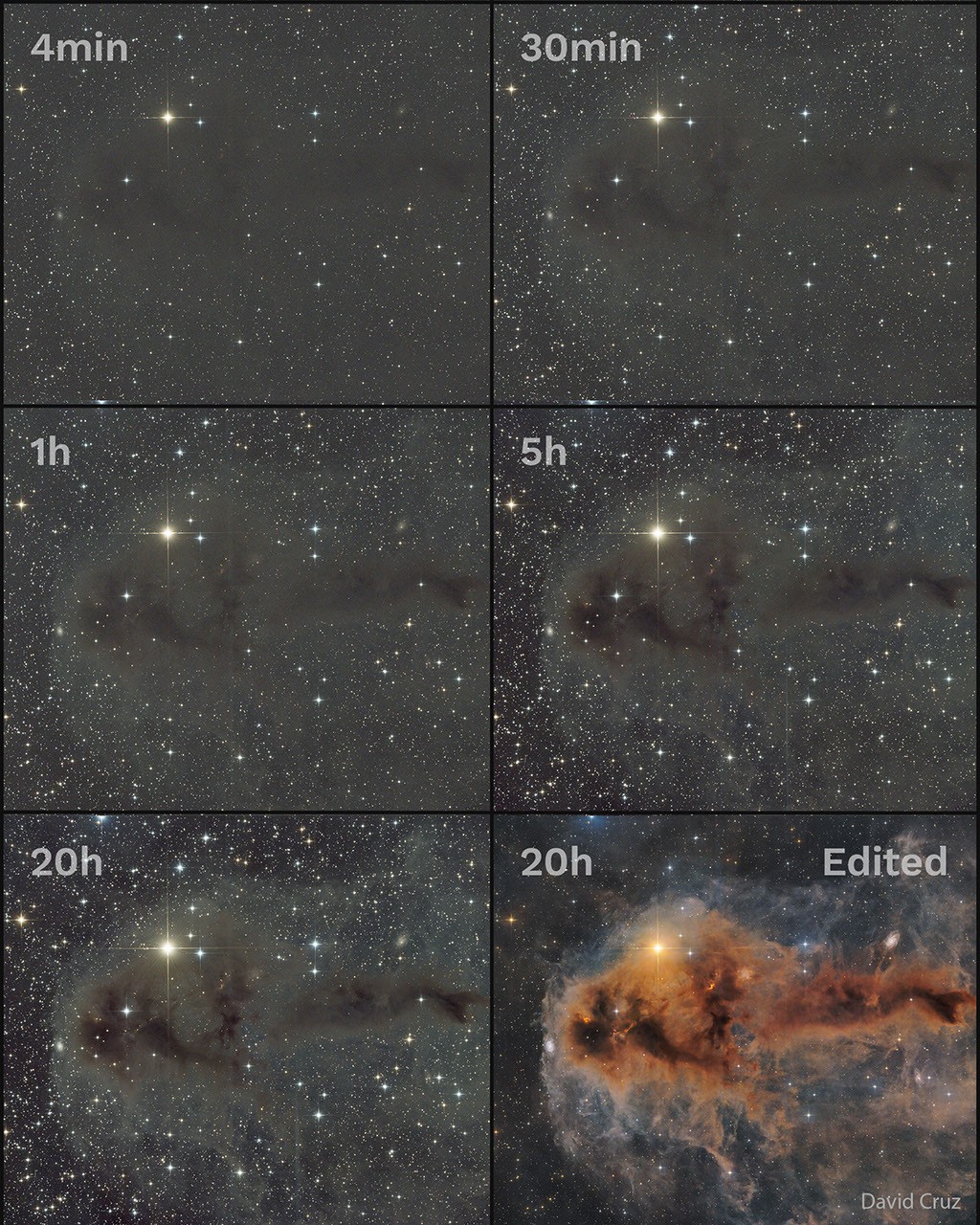
The Astronomy Picture of the Day for November 23, 2026 is a deep-exposure photograph of dark nebula Lynds 1251 (LDN 1251) by astrophotographer David Cruz. The image required approximately 20 hours of cumulative light collection and subsequent digital processing to reveal what the naked eye — and even a quick camera exposure — would register as an empty void. LDN 1251, also known as the Rotten Fish Nebula, sits in the constellation Cepheus. It is a star-forming region: a cold, dense cloud of interstellar dust so opaque it blocks virtually all background starlight. What makes Cruz's image distinctive is not the target — LDN 1251 appears in catalogs dating to Beverly Lynds' 1962 survey — but the rendering. The 20-hour integration time pulls structure out of apparent nothingness, revealing brown-tinted dust lanes, embedded young stellar objects, and the visual signatures of energetic shock waves, fast stellar winds, and collimated jets from protostars. The APOD text frames the image as a thought experiment in perception: what would you see if you could stare at one patch of sky indefinitely? The answer is that darkness becomes structure. Regions that appear star-free are not empty but occluded — the dust itself is the subject. This is the central tension of dark nebula photography: you are imaging an absence that turns out to be a presence. As astrophotography, the technical demands are real. Twenty hours of integration means multiple nights of tracking, careful calibration, and significant post-processing to stack sub-exposures, remove noise, and enhance color information that the raw frames barely contain. The result is a kind of portraiture of a molecular cloud — a subject that will, over millions of years, collapse into new stellar systems. The image was selected for APOD by the editorial team of Robert Nemiroff, Jerry Bonnell, Cecilia Chirenti, and Keighley Rockcliffe, operating under NASA's Goddard Space Flight Center and the NASA Science Activation program in collaboration with Michigan Tech. APOD remains one of the longest-running curated image series on the internet, and selection carries real weight in the amateur astrophotography community. What Cruz has produced is not a discovery but a demonstration of craft applied to a known but difficult target. The Rotten Fish Nebula does not lack for prior imaging, but the depth and color fidelity here — the way the dust grades from near-black through warm browns against the dense star field — make this a strong entry in the tradition of deep dark-nebula portraiture.
Worth reading?
RECOMMENDED
Score
52
/100
Anyone who photographs the night sky, studies star formation, or finds beauty in the idea that cosmic emptiness is actually dense structure blocking the light behind it.
Cultural Placement
Like Barnard's pioneering dark nebula photography crossed with the extreme-integration-time ethos of the Hubble Deep Field, but executed by a solo amateur with consumer-grade equipment and patience as the primary instrument. The closest living tradition is the work of deep-sky imagers like Rogelio Bernal Andreo or the narrowband mosaicists on Astrobin, where the image is as much about the accumulated hours as the optics. Cruz's image sits in the specific sub-tradition of dark nebula portraiture — imaging what blocks light rather than what emits it — which runs from E.E. Barnard's 1919 catalog plates through modern LRGB mosaics of the Pipe Nebula and Lupus clouds.
Honest assessment
This is excellent craft within a well-defined tradition — a 20-hour portrait of a dark nebula that reveals dust, jets, and shock waves where the eye sees nothing. It won't reshape astrophotography, but it's a genuinely rewarding image that earns its APOD slot through patience and processing skill. Best appreciated by people who understand what 20 hours of integration time actually means.
What Is NOVEL?
52
/ 100
BedrockNews applies a structured analytical framework called NOVEL to cultural works — games, books, film, music, and more.
How NOVEL worksNerve
2/5
Originality
2/5
Voice
3/5
Endurance
3/5
Lineage
3/5
What did the artist risk? What could have failed?
Moderate personal investment — 20 hours of integration is real commitment — but the target and technique are well-established. No formal or reputational risk. The craft is demanding, not daring.
Verified Facts (7)
Lynds 1251 (LDN 1251), also known as the Rotten Fish Nebula
20 hours of cumulative light collection
Star-forming region laced with opaque brown-appearing interstellar dust
Home to young stars, dust, energetic shock waves, fast stellar winds, and powerfully beamed jets
Credit: David Cruz
Authors & editors: Robert Nemiroff, Jerry Bonnell, Cecilia Chirenti, Keighley Rockcliffe
Date: November 23, 2026
More latest news
Read all