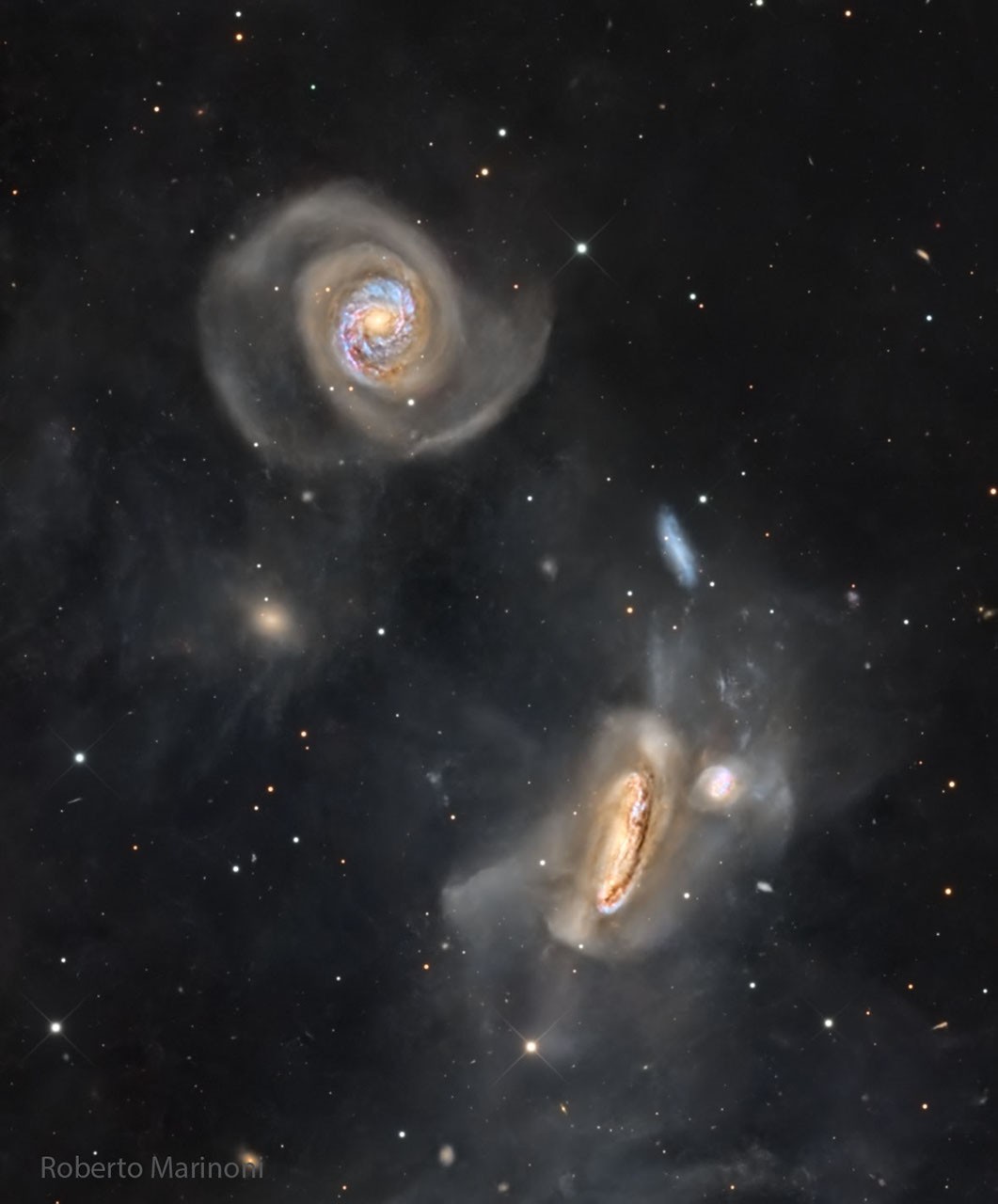
Roberto Marinoni's image of the NGC 7771 Group is the kind of astrophotography that earns the word "document" — not because it's dry, but because it records something real that no human will ever witness in full. What you're looking at is a gravitational battle between at least two major spiral galaxies and several smaller companions, playing out over billions of years in the constellation Pegasus, roughly 200 million light-years from Earth. The largest combatant is NGC 7771, a barred spiral about 75,000 light-years across — roughly three-quarters the diameter of the Milky Way. Its partner NGC 7769, sitting upper-left in the frame, is nearly the same size. Between and around them, the image reveals the forensic evidence of previous encounters: tidal rings, faint stellar streams, gravitational distortions that pull stars out of their home galaxies like taffy. These aren't artistic embellishments. They're the physical scars of close passages that have already occurred. APOD's explanatory text does something quietly effective here: it connects the NGC 7771 Group to the predicted Milky Way–Andromeda merger, which will begin in roughly 4.5 billion years. This is not a hypothetical comparison. The physics governing the NGC 7771 interaction is the same physics that will eventually reshape our own galaxy. Marinoni's image is a preview, taken from a safe distance. As astrophotography, the image sits in the tradition of deep-field work where exposure time and processing discipline matter more than aperture. The challenge with galaxy groups at this distance isn't getting the bright cores — it's pulling the faint tidal features out of the sky background without introducing artifacts. The rings and streams visible here represent real photometric achievement. They're the difference between a pretty picture and a useful one. The APOD platform itself deserves a note. Running since 1995, curated by Robert Nemiroff and Jerry Bonnell (now joined by Cecilia Chirenti and Keighley Rockcliffe), it remains one of the most durable science-communication projects on the internet. It has never chased engagement metrics. It publishes one image per day with a short, precise explanation written by working astronomers. The NGC 7771 Group entry is characteristic: no hype, no clickbait framing, just the image, the numbers, and the physics. What makes this particular APOD selection worth pausing on is the timescale problem it poses. The "battle" metaphor in the title is accurate but misleading in one respect — this fight has no spectators. The merger will take longer than complex life has existed on Earth. The image compresses billions of years of gravitational interaction into a single frame. That compression is both the power and the limit of the medium. For the viewer, the honest question is whether you've looked at enough galaxy-interaction images to register what's distinctive here. If you haven't, start here — the tidal features are unusually clear and the framing includes both major galaxies with enough context to read the interaction geometry. If you have, the value is in Marinoni's processing of the faint structures, which is where the real craft lives.
Worth reading?
RECOMMENDED
Score
56
/100
Anyone who looks at night-sky photos and wants to understand what they're actually seeing. Especially useful if you've never registered what tidal features look like in an interacting galaxy group.
Cultural Placement
Like the best Hubble Heritage Project releases but from a ground-based amateur setup, with the science-communication discipline of Quanta Magazine compressed into a single captioned image. Sits in the lineage of APOD's 30-year curatorial tradition, which itself descends from the Palomar Sky Survey's ethos of systematic cosmic documentation. The closest analog isn't other pretty space photos — it's the tradition of nature photography where technical achievement serves scientific legibility, like the deep-ocean work of David Shale or Emory Kristof's Titanic documentation.
Honest assessment
A well-executed entry in a 30-year curatorial project, featuring strong processing of faint galactic tidal features and characteristically precise scientific explanation. It won't change how you think about astrophotography, but it's an honest, high-quality document of a process no human will ever witness in real time. Best appreciated by viewers who want to learn to read galaxy interactions, not just admire them.
What Is NOVEL?
56
/ 100
BedrockNews applies a structured analytical framework called NOVEL to cultural works — games, books, film, music, and more.
How NOVEL worksNerve
2/5
Originality
2/5
Voice
3/5
Endurance
3/5
Lineage
4/5
What did the artist risk? What could have failed?
Low structural risk. Galaxy-group imaging is established territory, and APOD's editorial format hasn't changed in three decades. The risk is in the processing — pulling faint tidal features is technically demanding but not formally daring.
Lineage tree
APOD (1995–present)
direct ancestor — curatorial format and editorial voice
Palomar Sky Survey
extends the form of systematic sky documentation
Arp Atlas of Peculiar Galaxies
direct ancestor — cataloguing interacting galaxies as objects of study
Hubble Heritage Project
tonal influence — science-serving aesthetics in galaxy imaging
Verified Facts (8)
NGC 7771 Group lies almost 200 million light-years away toward the constellation Pegasus
NGC 7771 is a barred spiral about 75,000 light-years across
NGC 7769 is a spiral galaxy almost as large as NGC 7771
Credit & Copyright: Roberto Marinoni
Authors & editors: Robert Nemiroff, Jerry Bonnell, Cecilia Chirenti, Keighley Rockcliffe
Date: November 24, 2026
Merger process is understood to be a normal part of the evolution of galaxies
Studying galaxy clashes helps understand the possible merger between the Milky Way and Andromeda galaxies
More latest news
Read all