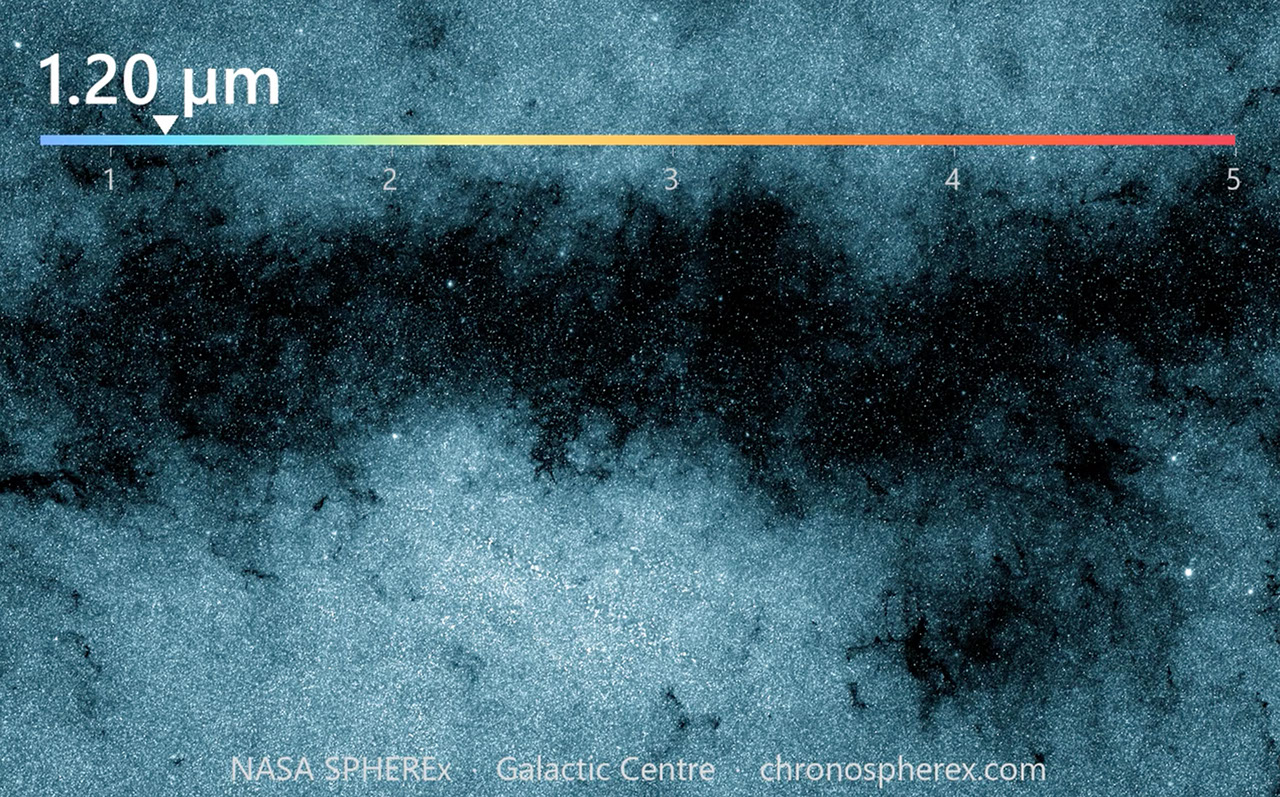
The center of the Milky Way is buried under 13 billion years of accumulated debris. Not the kind behind your couch — cosmic dust is hundreds of times smaller, built from oxygen, carbon, and other elements shed by dying stars. It forms vast opaque clouds that block visible and near-infrared light from reaching us, turning the heart of our own galaxy into a blind spot. NASA's SPHEREx satellite addresses this by scanning across a range of infrared wavelengths and showing what happens as you shift from near-infrared to mid-infrared. The APOD video maps this progression using false color, with each frame corresponding to a different wavelength shown in the top left corner. At 1.2 microns, the Galactic Center is almost entirely occluded — light scatters off and gets absorbed by dust particles. Push further into mid-infrared wavelengths, and the dust becomes increasingly transparent. The core emerges. The mechanism is structurally analogous to why sunsets are red — shorter wavelengths scatter more readily off particles, leaving longer wavelengths to pass through — though the APOD text is careful to note the analogy is imprecise. Rayleigh scattering in Earth's atmosphere and dust extinction in the interstellar medium share a family resemblance, not an identity. What makes this particular visualization effective is its simplicity. Rather than a single dramatic image, SPHEREx gives you the full spectral sweep, letting you watch the obstruction dissolve in real time. It's a teaching tool disguised as eye candy: you see the physics happening frame by frame instead of being told about it. The processing credit goes to The Bright Nobles (Muhammet Mücahit Soylu, Serdar Aydın, Furkan Küpeli) and ChronosphereX, working from data hosted at NASA/IPAC IRSA. The raw data is from SPHEREx itself, a mission designed to survey the entire sky in 102 spectral bands from 0.75 to 5 microns. This video is a small slice of what that instrument is built to do — map the infrared universe at a spectral resolution that lets you discriminate between dust, stars, galaxies, and ices. For the casual viewer, this is a satisfying two-minute demonstration of why infrared astronomy matters. For anyone following SPHEREx's mission, it's a reminder that the survey is now actively producing science-grade data and that the community processing pipeline is generating genuinely useful visualizations from it. The APOD entry was written and edited by Keighley Rockcliffe, Robert Nemiroff, Jerry Bonnell, and Cecilia Chirenti, and is dated November 25, 2026.
Worth reading?
OPTIONAL
Score
44
/100
Anyone curious about infrared astronomy or following the SPHEREx mission. Best for readers who learn visually and want to see dust extinction demonstrated rather than described.
Cultural Placement
Like the best Hubble Deep Field images crossed with the pedagogical instinct of a Powers of Ten film, but compressed into a single spectral sweep. Where Hubble's iconic shots traded on awe through sheer depth, this SPHEREx visualization trades on revelation through wavelength progression — closer in spirit to Carl Sagan's Cosmos demonstrations or the false-color thermal imaging in nature documentaries than to traditional astrophotography. The lineage is science communication as visual storytelling, not fine art.
Honest assessment
A clean, well-processed visualization that does exactly what APOD does best: take real mission data and make it legible to a general audience. It's not a landmark image or a career-defining visualization — it's a solid daily entry that teaches one concept clearly. Worth the two minutes if you're interested in why infrared telescopes exist.
What Is NOVEL?
44
/ 100
BedrockNews applies a structured analytical framework called NOVEL to cultural works — games, books, film, music, and more.
How NOVEL worksNerve
1/5
Originality
2/5
Voice
3/5
Endurance
2/5
Lineage
3/5
What did the artist risk? What could have failed?
Low risk. APOD is a trusted daily format with a built-in audience. The visualization is well-executed but doesn't push into territory where failure was possible.
Verified Facts (8)
Cosmic dust is hundreds of times smaller than household dust and made of tiny compounds of oxygen, carbon, and other elements released into space when a star dies
SPHEREx satellite gathered infrared light from the Milky Way's center
In the near-infrared, like 1.2 microns, light gets absorbed and scatters off of dust particles
In the mid-infrared, light is able to pierce through the dust and reach SPHEREx
Credit: NASA/JPL-Caltech SPHEREx; data from NASA/IPAC IRSA
Processing: The Bright Nobles (Muhammet Mücahit Soylu, Serdar Aydın, Furkan Küpeli), ChronosphereX
Authors & editors: Keighley Rockcliffe, Robert Nemiroff, Jerry Bonnell, Cecilia Chirenti
Date: November 25, 2026
More latest news
Read all