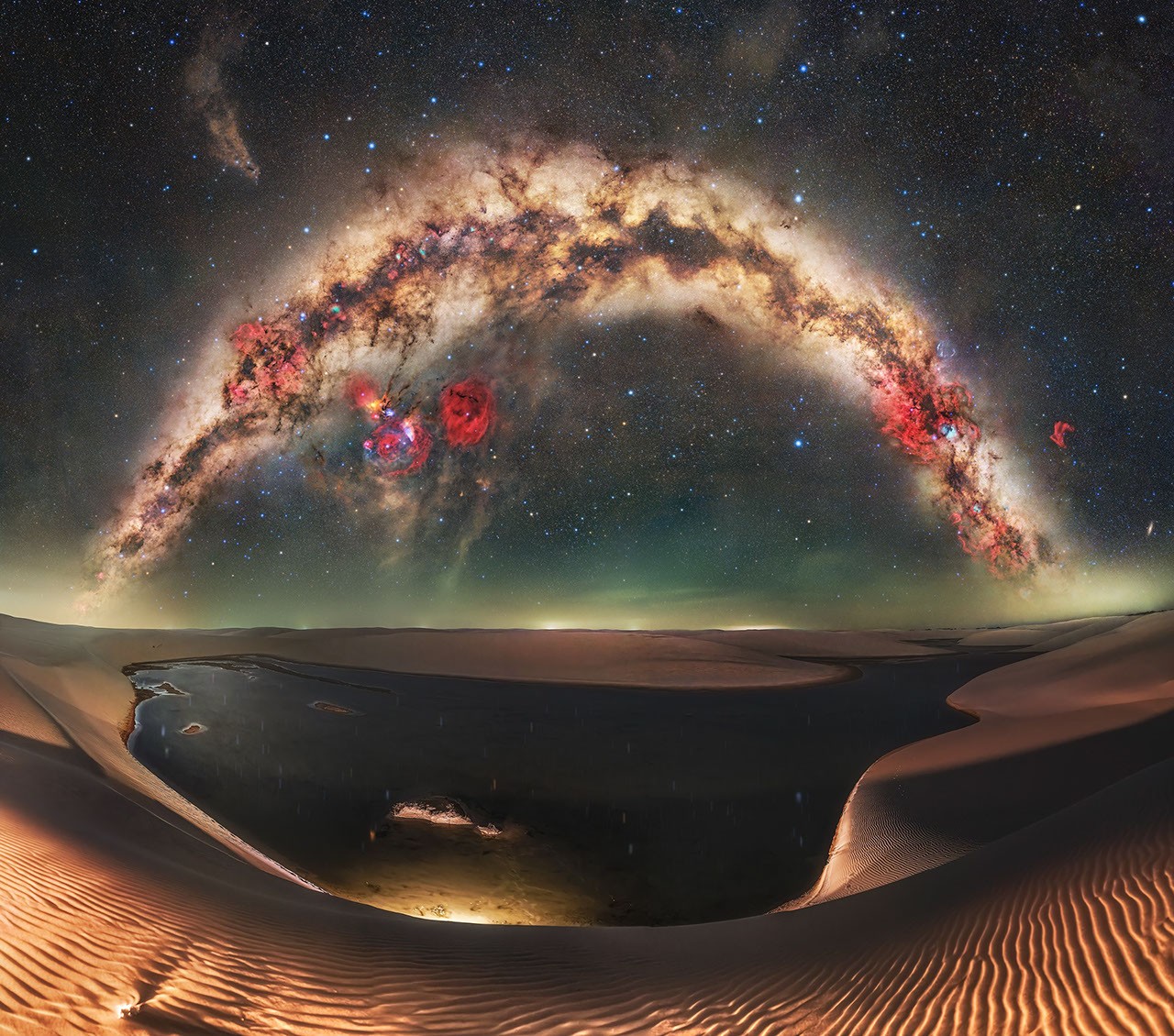
This is an astrophotography composite that works as visual sleight of hand. Photographer Ignacio Fernández shot the Milky Way from roughly 2° south latitude in July, over the white sand dunes and dark rain-fed lagoons of Lençóis Maranhenses National Park in northeastern Brazil. The resulting image creates the illusion of a giant eye — the dark lagoon as pupil, the arching Galaxy as iris, the dunes as sclera. The honest thing the APOD caption does — and it's worth noting because astrophotography captions often don't — is tell you exactly what's fake. The Milky Way does not arch like a rainbow across the sky. That curvature is an artifact of wide-angle lens distortion. The photographer composed the shot so the Galaxy's apparent arc matched the lagoon's contour, creating the eye effect. It's a composite taken later in the night, meaning multiple exposures were stacked for the sky and possibly the foreground. What's genuinely there: dark dust lanes threading through the galactic plane, colorful emission nebulae, and the dense star fields of the southern Milky Way visible from near-equatorial latitudes. Lençóis Maranhenses is one of the stranger landscapes on Earth — flat white quartz-sand dunes that fill with freshwater lagoons during the rainy season, creating dark pools that reflect almost nothing. As a foreground for astrophotography, it's ideal: no light pollution, geometric contrast, and those ink-black pools. The image succeeds as composition more than as documentation. The eye metaphor is deliberate and effective — it inverts the usual relationship between observer and sky. The APOD text leans into this with "Is this eye in the sky looking back at you?" which is corny but earns its keep because the image actually delivers on the conceit. As a piece of astrophotography craft, this sits in the well-established tradition of landscape-astro composites that prioritize visual narrative over scientific fidelity. The wide-angle distortion is a creative choice, not a mistake, but it means the astronomical content is secondary to the aesthetic. You're looking at an art photograph that happens to contain real nebulae, not an astronomical image that happens to be beautiful. The APOD program itself — running daily since June 16, 1995 — remains one of NASA's most durable public science assets. Curated by professional astronomers (here Cecilia Chirenti, Robert Nemiroff, Jerry Bonnell, and Keighley Rockcliffe), it treats each image as a teaching moment. This entry teaches lens distortion and composite technique while also delivering genuine wonder, which is the program at its best. Fernández earned the shot. Getting to Lençóis Maranhenses with astrophotography gear, timing the lagoon season against galactic visibility, and nailing the composition so the eye reads immediately — that's real work for a single arresting image.
Worth reading?
RECOMMENDED
Score
52
/100
Anyone who enjoys astrophotography as visual art, especially if you appreciate when a photographer tells you honestly what's real and what's the lens. Also useful for photography students studying wide-angle distortion as creative tool.
Cultural Placement
Like the best of Babak Tafreshi's TWAN (The World At Night) project but with more compositional audacity, channeling the deliberate visual paradoxes of M.C. Escher through the medium of landscape astrophotography. The eye-illusion concept sits in the same tradition as Thierry Cohen's 'Darkened Cities' composites — images that use real astronomical data to create something that's more visual argument than document. Where most APOD landscape-astro entries are competent sky-over-pretty-place compositions, this one commits to a single optical conceit and builds the entire frame around it.
Honest assessment
A well-executed single-concept astrophotography composite that succeeds because the photographer committed fully to one visual metaphor and the APOD curators were honest about the optics. It's a beautiful image, not a groundbreaking one — but the craft is real and the teaching moment about lens distortion is worth your 90 seconds.
What Is NOVEL?
52
/ 100
BedrockNews applies a structured analytical framework called NOVEL to cultural works — games, books, film, music, and more.
How NOVEL worksNerve
2/5
Originality
3/5
Voice
3/5
Endurance
2/5
Lineage
3/5
What did the artist risk? What could have failed?
Moderate logistical risk — remote location, timing-dependent conditions — but the compositional form is proven territory. The eye conceit could have failed as gimmick; it lands, but the genre is safe.
Verified Facts (6)
Composite image taken later in the night in July from a latitude of approximately 2º south
Lençóis Maranhenses National Park, Brazil
Wide-angle lens creates the arching artifact — the Galaxy does not really appear arched like a rainbow
Credit: Ignacio Fernández
Authors & editors: Cecilia Chirenti, Robert Nemiroff, Jerry Bonnell, Keighley Rockcliffe
Date: November 26, 2026
More latest news
Read all