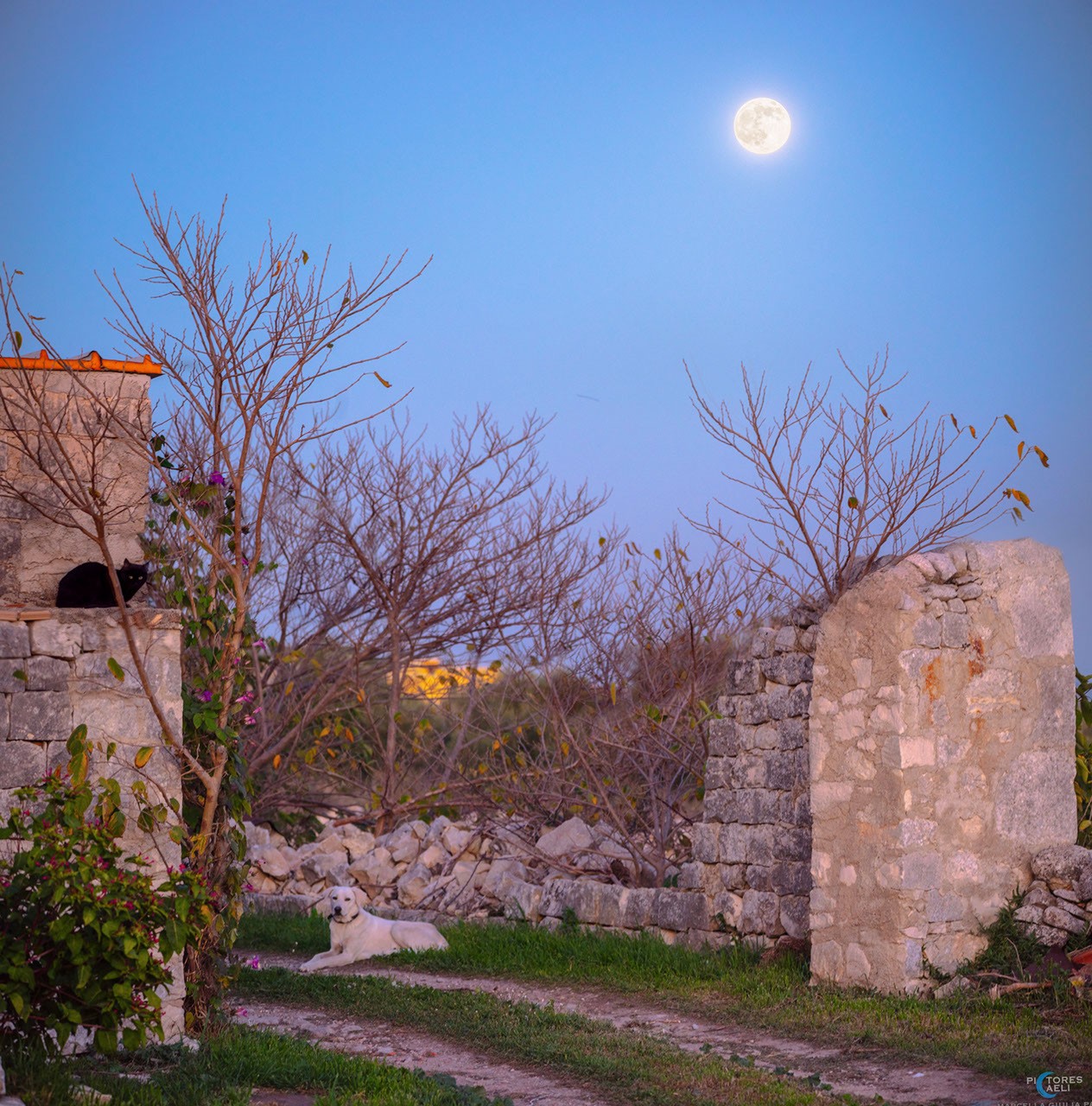
The Astronomy Picture of the Day for November 27, 2026, features Marcella Pace's photograph of the November 24 full Moon — a supermoon near perigee — rising opposite the setting Sun. The image places watchers against the lunar disc in silhouette, turning a celestial event into a human-scale composition. What makes this work is what Pace didn't do. No composite stacking, no HDR fireworks, no Milky Way arc bending impossibly over a foreground. It's a telephoto compression shot: distant subjects flattened against a massive moon, the kind of image that rewards scouting a location and knowing exactly when and where to stand. The craft is in the planning, not the post-processing. The APOD caption does its usual efficient work explaining the astronomy: November's Beaver Moon was near perigee, making it one of the year's biggest and brightest full moons. It's the first of four consecutive supermoons, with the next — the Cold Moon — arriving December 23. These are the facts that make the image timely rather than arbitrary. Pace is a known quantity in the astrophotography world, particularly for lunar work. Her images consistently demonstrate the same discipline: precise timing, clean framing, minimal intervention. She's not pushing the form forward so much as executing it at a very high level, repeatedly, with a specific visual signature — warm tones, human or landscape elements scaled against the Moon. The APOD platform itself remains one of NASA's quietly brilliant public-science vehicles. Running since 1995, curated by Jerry Bonnell, Cecilia Chirenti, Robert Nemiroff, and Keighley Rockcliffe, it delivers one image per day with a brief professional explanation. No algorithm, no engagement optimization, no infinite scroll. It's an editorial product that respects the reader's attention. As a photograph, this is skilled genre work. It delivers exactly what you came for — a big, beautiful Moon with human context — and it does so with discipline and taste. It won't redefine how you think about astrophotography, but it doesn't need to. Sometimes the right image at the right moment is enough.
Worth reading?
RECOMMENDED
Score
44
/100
Anyone who enjoys astrophotography as a craft, wants to understand what separates a good supermoon shot from the thousands of mediocre ones, or simply wants 30 seconds of genuine beauty in their feed.
Cultural Placement
Like the best of Thierry Legault's precision astro-silhouettes but warmer and more earthbound, with the populist accessibility of a National Geographic cover and the compositional economy of a Michael Kenna landscape. This is telephoto-compression lunar photography — a genre with deep roots in the Flickr and 500px era — executed at a level that earns its APOD slot without pretending to be something it isn't. Think of it as the astrophotography equivalent of a perfectly played jazz standard: the pleasure is in the phrasing, not the novelty.
Honest assessment
This is a well-executed genre piece by a photographer with a recognizable eye for lunar compositions. It won't change how you think about photography or astronomy, but it delivers a clean, human-scale moment against a celestial backdrop with real discipline. Worth your 30 seconds; worth studying if you're learning to shoot the Moon.
What Is NOVEL?
44
/ 100
BedrockNews applies a structured analytical framework called NOVEL to cultural works — games, books, film, music, and more.
How NOVEL worksNerve
1/5
Originality
2/5
Voice
3/5
Endurance
2/5
Lineage
3/5
What did the artist risk? What could have failed?
Minimal risk. Telephoto moon-rise silhouettes are a proven genre. The execution is precise but the form is well-mapped territory where failure modes are low and payoff is predictable.
Verified Facts (7)
On November 24, all denizens of our fair planet could watch the Moon rise opposite the setting Sun
Known to some as a Beaver Moon
November's Full Moon was also near perigee, the closest point in its elliptical orbit around planet Earth
November's Full Moon was the first in a series of four consecutive Full Moon's near perigee
Your next chance to watch a supermoon rise will be when the Cold Moon rises on December 23
Credit and Copyright: Marcella Pace
Authors & editors: Jerry Bonnell, Cecilia Chirenti, Robert Nemiroff, Keighley Rockcliffe
More latest news
Read all