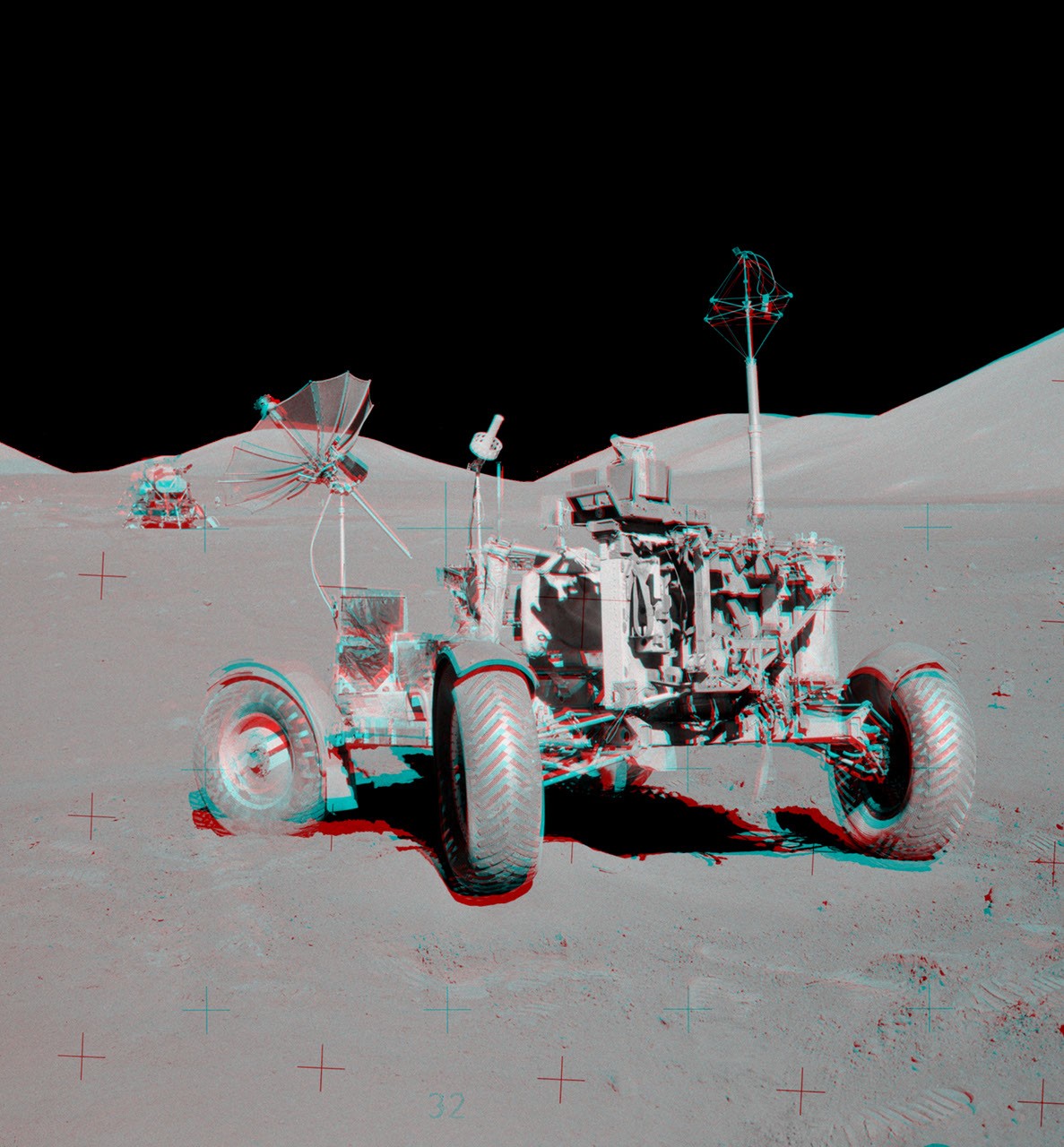
This is a stereo photograph of a parking spot. That sentence should be boring, and the fact that it isn't tells you everything about why APOD keeps running after three decades. The image is a red/blue anaglyph — meaning you need old-school 3D glasses — composited from photographs taken at the Taurus-Littrow valley during the Apollo 17 mission in December 1972. The Lunar Rover sits in the foreground. Behind it, the Lunar Module. Behind that, lunar hills that no human has touched since. The parking spot has a name: the VIP Site. The name is functional, not ceremonial. The rover's TV camera was positioned here specifically so it could broadcast the Lunar Module's ascent stage liftoff back to Earth. The whole world was the VIP. This is mission planning as visual storytelling — engineers choosing a camera angle for a planetary audience, then driving a car to the right mark on the surface of another world. The anaglyph was assembled by Erik van Meijgaarden from Gene Cernan's original Apollo 17 photography. The stereo effect works because Cernan took overlapping shots from slightly different positions as he moved, giving van Meijgaarden the parallax needed to construct depth. It's a technique as old as the stereoscope — Victorian technology applied to Space Age source material. The result is genuinely striking: the rover pops out of the frame, and the hills recede with a depth that flat photographs of the Moon rarely convey. The numbers from the mission remain remarkable. Eugene Cernan and Harrison Schmitt spent approximately 75 hours on the lunar surface while Ronald Evans orbited above. They returned with 110 kilograms of rock and soil samples — more than any other Apollo landing. These are facts that have not been superseded. No subsequent mission has matched them because no subsequent mission has occurred. That last detail is the structural fact that gives this image its weight. Cernan and Schmitt are still the last humans to walk or drive on the Moon. The anaglyph isn't nostalgic — it's a document of a capability that existed and then stopped existing. The VIP Site was built for a global audience that watched live, then moved on. Artemis is in progress, but as of this APOD's publication date in November 2026, the record stands. APOD itself is worth noting as a form. It has run daily since June 16, 1995 — one of the longest-running single-format web publications in existence. Each entry pairs an image with a brief expert explanation. The format is radically simple and has never needed updating. This particular entry, credited to editors Jerry Bonnell, Cecilia Chirenti, Robert Nemiroff, and Keighley Rockcliffe, does exactly what the form always does: presents one image, tells you what you're looking at, and trusts you to feel the weight yourself.
Worth reading?
RECOMMENDED
Score
64
/100
Anyone with a pair of red/blue 3D glasses and even passing interest in spaceflight. Especially rewarding for readers who've only seen Apollo imagery as flat photographs and want to feel the depth of the lunar surface for the first time.
Cultural Placement
Like the best entries in the Hubble Heritage Project but grounded in human-scale hardware — a car, a camera, a parking spot. The anaglyph technique owes more to Victorian stereoscopy than to modern computational imaging. The curatorial act sits in the tradition of APOD itself: minimal framing, maximum image, trust the viewer. Think the photographic rigor of a Hasselblad field manual crossed with the quiet editorial voice of The Planetary Society's blog at its best.
Honest assessment
This is a small artifact doing a specific thing very well: making you perceive depth on the Moon using 54-year-old photographs and 170-year-old stereo technique. It won't change your life, but it will change how you see the Taurus-Littrow valley. The unstated subtext — that the parking spot remains the last one — does the heaviest lifting.
What Is NOVEL?
64
/ 100
BedrockNews applies a structured analytical framework called NOVEL to cultural works — games, books, film, music, and more.
How NOVEL worksNerve
2/5
Originality
3/5
Voice
3/5
Endurance
4/5
Lineage
4/5
What did the artist risk? What could have failed?
Low formal risk — APOD's format is proven and van Meijgaarden's anaglyph technique is established. The nerve here is curatorial: choosing to foreground a parking spot, not a moonscape glamour shot.
Lineage tree
Apollo 17 Hasselblad archive
direct source material
Victorian stereoscopy
extends the form of
APOD (1995–present)
curatorial tradition
Hubble Heritage Project
tonal influence
Verified Facts (8)
Apollo 17 astronauts Eugene Cernan and Harrison Schmitt spent about 75 hours on the Moon
Colleague Ronald Evans orbited overhead
The crew returned with 110 kilograms of rock and soil samples, more than from any of the other lunar landing sites
December of 1972
Cernan and Schmitt are still the last to walk (or drive) on the Moon
Anaglyph by Erik van Meijgaarden
Credit: Gene Cernan, Apollo 17, NASA
Authors & editors: Jerry Bonnell, Cecilia Chirenti, Robert Nemiroff, Keighley Rockcliffe
More latest news
Read all