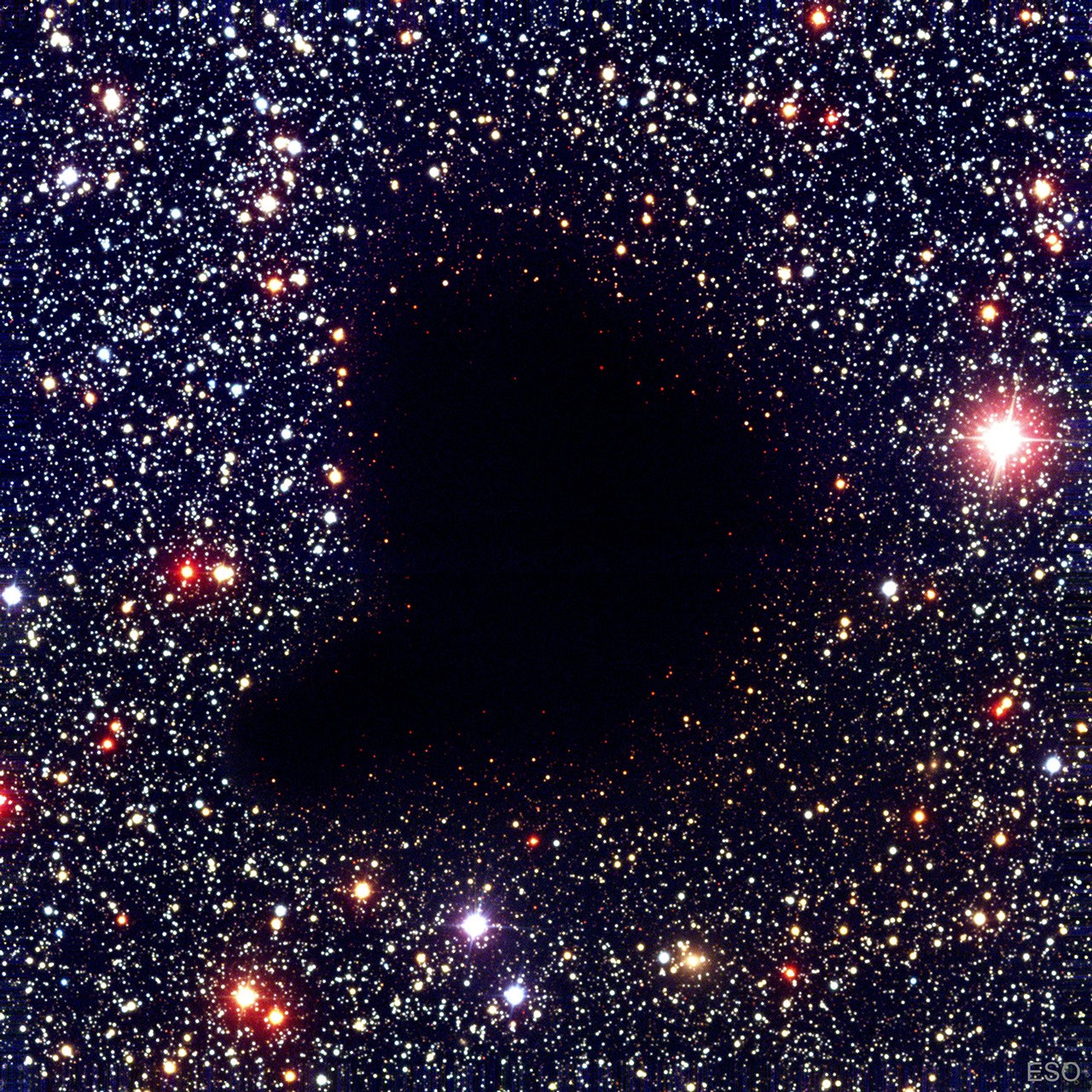
Barnard 68 is a molecular cloud in the constellation Ophiuchus — the Snake Carrier — and this image from ESO's 8.2-meter VLT Antu telescope is one of the most striking demonstrations of absence as subject in astrophotography. The "hole in the sky" is not empty. It is so full of dust and molecular gas that it blocks virtually all visible light from the stars behind it. The result is an inkblot of pure black punched into a dense starfield, unsettling in the way that silence in a crowded room is unsettling. What makes the APOD presentation work is the economy of the explanation. The text walks you from the naive read ("where did all the stars go?") through the corrected understanding (dark molecular cloud, not a hole) to the payoff: Barnard 68 is likely collapsing under its own gravity and will form a new star system. The object that looks like death is actually pre-birth. That inversion is the entire aesthetic and scientific engine of this image. The cloud sits about 500 light-years away and spans roughly half a light-year across. Its relative proximity is what makes the blackout so total — if it were farther away, background stars would peek around it. The fact that none do tells astronomers this cloud is close and dense. Infrared observations can see right through it, revealing the stars hiding behind the curtain, which only deepens the visual drama of the visible-light image. The FORS Team's photograph, taken with the VLT at Paranal Observatory in Chile, is doing something that the best science photography always does: it makes the data beautiful without lying about what the data means. There is no false color here inventing drama. The drama is structural — the contrast between the crowded starfield and the absolute void at center. The composition is almost too perfect, the cloud's irregular edges giving it an organic, biological quality against the geometric scatter of stars. APOD itself, now running for over three decades under Robert Nemiroff and Jerry Bonnell (with Cecilia Chirenti and Keighley Rockcliffe), remains one of the internet's most quietly durable institutions. One image per day, one paragraph of explanation, no algorithmic feed, no engagement optimization. The format is the message: the cosmos is interesting enough that it only needs a single daily frame and a few honest sentences. Barnard 68, as a subject, is a perfect match for this philosophy — an image whose power comes from what it doesn't show. The scientific content here is well-established. Barnard 68 has been studied extensively since E.E. Barnard cataloged it in the early 20th century. The formation mechanisms of molecular clouds remain an open question, but the cloud's likely gravitational collapse toward star formation is supported by multiple studies. This is science communication at its best: a known object, presented with clarity, inviting the viewer to look at darkness and see potential. For anyone encountering this image for the first time, the experience is genuinely arresting. It belongs to a small category of astronomical images — alongside the Hubble Deep Field and Pale Blue Dot — where the emotional impact scales with understanding. The more you know about what you're looking at, the more the image rewards you.
Worth reading?
RECOMMENDED
Score
68
/100
Anyone who wants to feel the right kind of small — people who liked Cosmos, the Hubble Deep Field poster on their wall, or who just want one good reason to look up today.
Cultural Placement
Like the Hubble Deep Field's existential gut-punch but working in reverse — using absence instead of abundance. Closest kin is Sugimoto's 'Theaters' series, where long exposures of movie screens produce pure white rectangles that erase the content to reveal the container. Barnard 68's APOD presentation sits in the tradition of Ansel Adams' zone-system photography crossed with Carl Sagan's gift for making scale legible to non-specialists. The VLT image does what the best science photography always does: makes you feel dumb and exhilarated at the same time.
Honest assessment
This is APOD doing what it has done superbly for thirty years: pairing a world-class image with clean explanatory prose and trusting the cosmos to do the heavy lifting. It is not pushing boundaries — it is demonstrating why the existing format works so well when the subject earns it. Barnard 68 earns it.
What Is NOVEL?
68
/ 100
BedrockNews applies a structured analytical framework called NOVEL to cultural works — games, books, film, music, and more.
How NOVEL worksNerve
2/5
Originality
3/5
Voice
4/5
Endurance
4/5
Lineage
4/5
What did the artist risk? What could have failed?
Low risk — APOD is a proven format, Barnard 68 is a well-known target, and the VLT is reliable hardware. The courage here is editorial: trusting that darkness is enough.
Lineage tree
E.E. Barnard's dark nebula catalog (1919)
direct ancestor — the original identification and naming
Ansel Adams zone-system photography
tonal influence — the craft of making darkness legible
Carl Sagan's Cosmos
extends the form of — translating scale into feeling for a public audience
Hubble Deep Field (1995)
argues against — HDF overwhelms with abundance, B68 overwhelms with absence
Verified Facts (8)
Barnard 68 is located about 500 light-years away and half a light-year across
A high concentration of dust and molecular gas absorbs practically all the visible light emitted from background stars
Barnard 68 itself has been found likely to collapse and form a new star system
It is possible to look right through the cloud in infrared light
Credit: FORS Team, 8.2-meter VLT Antu, ESO
Constellation: Ophiuchus (the Snake Carrier)
Authors: Robert Nemiroff, Jerry Bonnell, Cecilia Chirenti, Keighley Rockcliffe
Date: November 29, 2026
More latest news
Read all