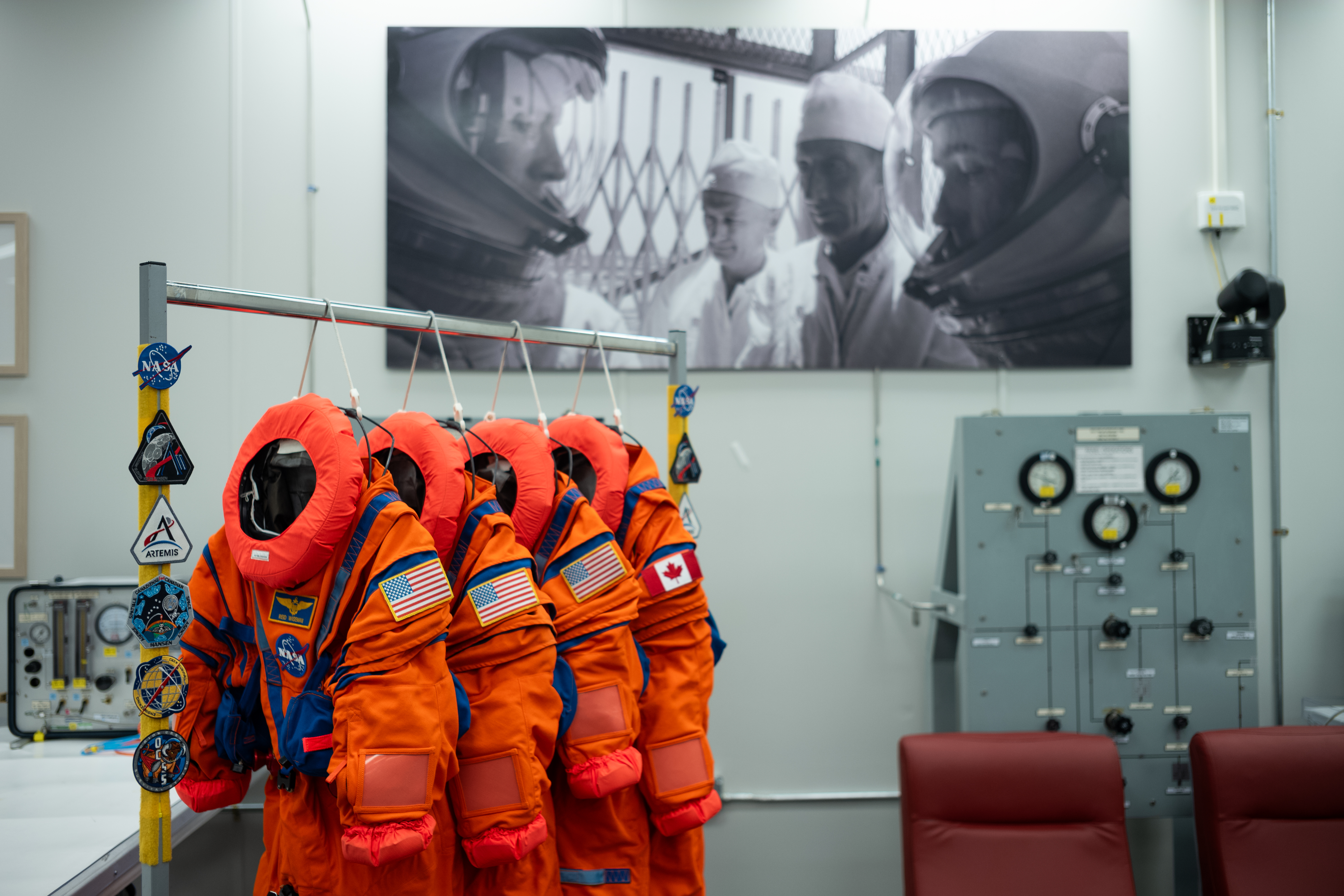
Four Orion Crew Survival System suits sit in the suit-up room of the Neil A. Armstrong Operations and Checkout Building at NASA's Kennedy Space Center in Florida, photographed on Saturday, January 17, 2026. These are the suits that Commander Reid Wiseman, Pilot Victor Glover, and Mission Specialist Christina Koch from NASA, and Mission Specialist Jeremy Hansen from the Canadian Space Agency, will wear on the Artemis II test flight. The suits are not spacesuits in the way most people picture them. The Orion Crew Survival System — OCSS — is a launch-and-entry suit, not an EVA suit. It's the flight hardware equivalent of a fighter pilot's pressure suit: designed to keep you alive if the cabin depressurizes, not to walk on the Moon. The distinction matters because it tells you what Artemis II actually is — a test flight, not a landing mission. The crew will orbit the Moon and return. The suits they need are the ones that protect them during the most dangerous phases: launch, reentry, and any emergency in between. The OCSS is a descendant of the orange "pumpkin suits" worn during shuttle-era launches, but redesigned for deep space. The key engineering differences: these suits must function during missions that last days to weeks rather than hours, must interface with Orion's life support rather than the shuttle's, and must accommodate the higher radiation environment and longer emergency scenarios possible on a lunar trajectory. If something goes wrong near the Moon, you can't come home in eight minutes. The suit-up room itself carries weight. It's in the building named for Neil Armstrong — the Operations and Checkout Building where Apollo crews also prepared. The physical continuity is deliberate: the same facility, a different generation of hardware, a half-century gap in between. The last time suits for a lunar mission were laid out in this complex, it was 1972. Four suits for four crew members. The specificity is worth noting: Wiseman commands, Glover pilots, Koch and Hansen serve as mission specialists. Each suit is individually fitted. The suits photographed here aren't prototypes or display models — they're the flight articles, the actual hardware that will be worn during the mission. In spaceflight, seeing the flight hardware staged and ready is the signal that a mission has moved from planning to execution.
Worth reading?
OPTIONAL
Score
55
/100
What Is What to Watch?
What to Watch highlights the specific signals, decisions, or events that will determine which direction this story goes next.
About GRINARTEMIS II LAUNCH
Artemis II launch timeline — the suits being staged at KSC in January 2026 is a pre-launch readiness milestone worth tracking against the mission schedule
ORION SPACECRAFT INTEGRATION
Orion spacecraft integration — whether the suits' life-support interfaces with Orion complete qualification testing without issues
ARTEMIS III EVA
Artemis III EVA suit development — the xEMU/Axiom Space suits for the actual lunar surface walks are a separate and more complex engineering challenge
CSA CREW EQUIPMENT
CSA crew equipment — Jeremy Hansen's suit represents Canadian integration into US deep-space flight hardware, a template for future international missions
Verified Facts (1)
The Orion Crew Survival System suits that Commander Reid Wiseman, Pilot Victor Glover, and Mission Specialist Christina Koch from NASA, and Mission Specialist Jeremy Hansen from the CSA (Canadian Space Agency) will wear on the Artemis II test flight are seen in the suit-up room of the Neil A. Armstrong Operations and Checkout Building, Saturday, Jan. 17, 2026, at NASA's Kennedy Space Center in Florida
Solution Focus (4)
These are flight articles — the actual suits the crew will wear, not prototypes or display models, staged in the suit-up room at Kennedy Space Center
The OCSS is a launch-and-entry survival suit, not a moonwalk suit — its design tells you Artemis II is a test flight, not a landing mission
The suits must handle deep-space-specific scenarios: longer missions, higher radiation, and emergency timelines measured in days rather than minutes
Four individually fitted suits for a named crew — Wiseman, Glover, Koch, Hansen — signal the mission has moved from planning to execution phase
Community Actions (4)
Artemis II launch timeline — the suits being staged at KSC in January 2026 is a pre-launch readiness milestone worth tracking against the mission schedule
Orion spacecraft integration — whether the suits' life-support interfaces with Orion complete qualification testing without issues
Artemis III EVA suit development — the xEMU/Axiom Space suits for the actual lunar surface walks are a separate and more complex engineering challenge
CSA crew equipment — Jeremy Hansen's suit represents Canadian integration into US deep-space flight hardware, a template for future international missions
More latest news
Read all