Get it
Cold Atom Lab
on Official site
TEMP · NEAR ZERO
-459°F
CAL LAUNCH YEAR
2018
ORBITAL BECs
1st
STATE OF MATTER
5th
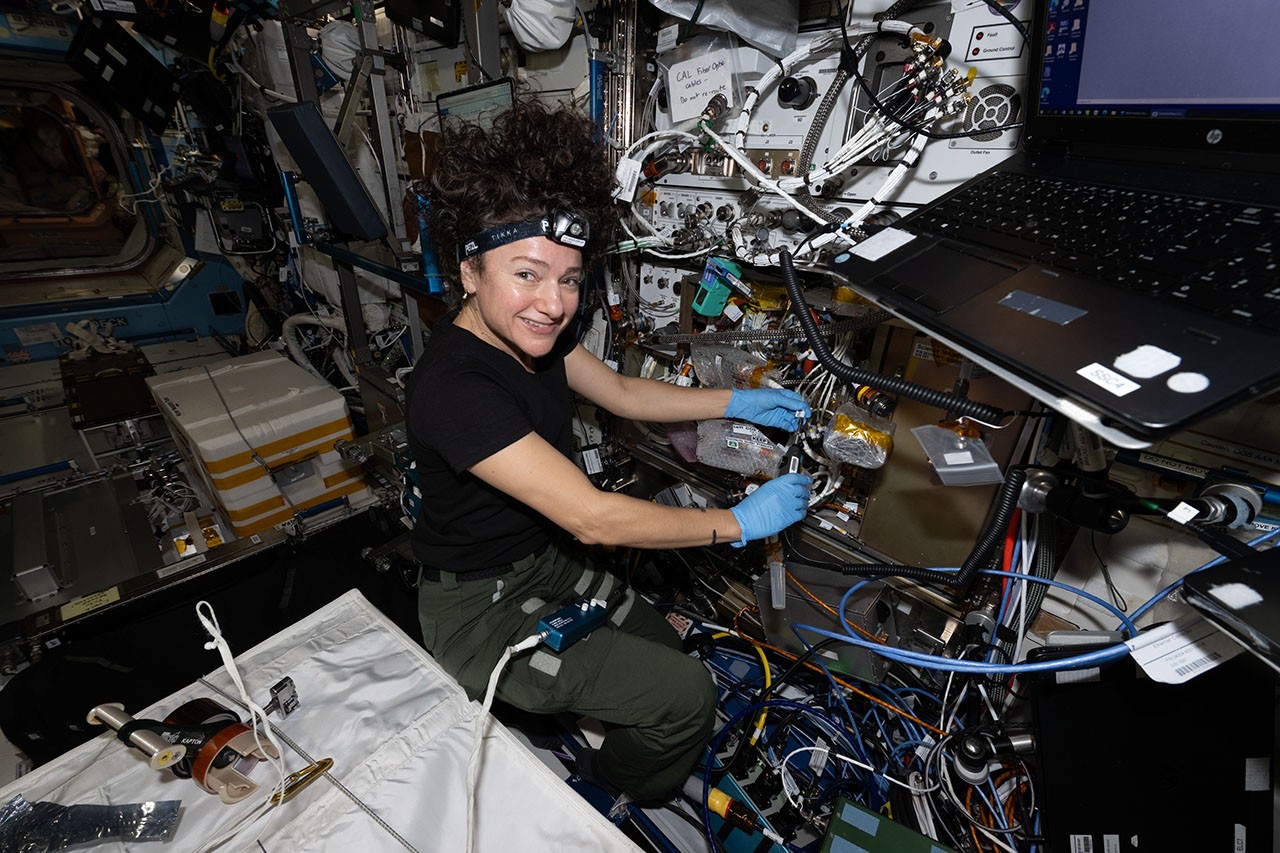
NASA astronaut Jessica Meir installed hardware updates to the Cold Atom Lab (CAL) aboard the International Space Station on May 8, 2026. The upgrade involved inspecting and replacing optical fibers — the precision light-delivery system that underpins the lab's ability to cool atoms using lasers. CAL is operated entirely from Earth, making Meir's hands-on intervention a notable moment: the hardware needed a human touch that remote operations couldn't provide.
Extraction Map
CAL chills atoms to temperatures below minus 459 degrees Fahrenheit (minus 273.15 degrees Celsius), approaching absolute zero closely enough to produce Bose-Einstein condensates (BECs) — a fifth state of matter distinct from solids, liquids, gases, and plasma. In a BEC, quantum properties of atoms become observable at macroscopic scales, allowing researchers to study phenomena like wave-particle duality directly. CAL produced the first BECs ever created in Earth orbit after its 2018 launch. The facility is about the size of a minifridge. That constraint matters: it means the entire quantum-physics apparatus — lasers, vacuum chambers, magnetic traps, optical systems — fits within the tight volume and power budgets of the ISS. The engineering discipline required to miniaturize this setup has downstream applications for compact quantum sensors and clocks. Multiple research groups conduct experiments inside CAL remotely from NASA's Jet Propulsion Laboratory, which designed, built, and operates the facility. JPL is managed by Caltech in Pasadena. The sponsoring body is the Biological and Physical Sciences (BPS) division of NASA's Science Mission Directorate. BPS focuses specifically on investigations impossible to conduct on Earth — microgravity eliminates gravitational sag that limits how long and how cold atom clouds can be observed in terrestrial labs. The generative logic here is straightforward: microgravity extends observation times for ultra-cold atoms from milliseconds to seconds, opening measurement regimes that ground-based labs physically cannot access. This isn't redistribution of existing capability — it creates new experimental territory. The hardware refresh keeps that territory open. The investment profile is modest relative to flagship missions. CAL is a facility instrument, not a billion-dollar spacecraft. But its continued operation and upgrade signal that NASA values fundamental physics research on the ISS alongside the higher-profile biological and materials-science work. The quantum-technology pipeline — atomic clocks, inertial sensors, gravity gradiometers — gives CAL a dual identity as both pure science and technology maturation. The structural question is whether ISS-based quantum science survives the station's planned decommissioning. CAL's scientific value depends on sustained microgravity access. If that access migrates to commercial stations or a dedicated free-flyer, the transition costs and timeline become the real constraint on this research program's future.
Worth reading?
RECOMMENDED
Score
64
/100
Generative. CAL creates experimental conditions impossible on Earth, enabling new physics measurements and quantum-technology development that expand the knowledge frontier rather than redistributing existing value.
What Is GRIN?
GRIN stands for Generativity, Resilience, Innovation efficiency, and Novelty openness. These four dimensions capture the essential characteristics of any memetic intelligence — whether a nation, a corporation, a religion, or a movement.
About GRINGenerativity
4/5
Resilience
2/5
Efficiency
3/5
Novelty
3/5
Extractive
1/5
Inverted
Does this create new capability or just redistribute existing value?
Genuinely generative. Microgravity extends BEC observation from milliseconds to seconds — a regime no ground lab can access. New physics territory, not reshuffled funding.
Verified Facts (6)
NASA astronaut Jessica Meir inspects optical fibers while installing hardware updates to the agency's Cold Atom Lab, or CAL, aboard the International Space Station on May 8, 2026.
CAL chills atoms to temperatures below minus 459 degrees Fahrenheit (minus 273.15 degrees Celsius), so close to absolute zero that they form a large quantum object called a Bose-Einstein condensate (BEC) — a fifth state of matter distinct from solids, liquids, gases, and plasma.
About the size of a minifridge and operated from Earth.
Managed by Caltech in Pasadena, NASA's Jet Propulsion Laboratory designed, built, and operates Cold Atom Lab, which is sponsored by the Biological and Physical Sciences (BPS) division of NASA's Science Mission Directorate.
The Cold Atom Laboratory launched to the International Space Station in May 2018.
Cold Atom Lab produced the first BECs in Earth orbit.
More latest news
Read all