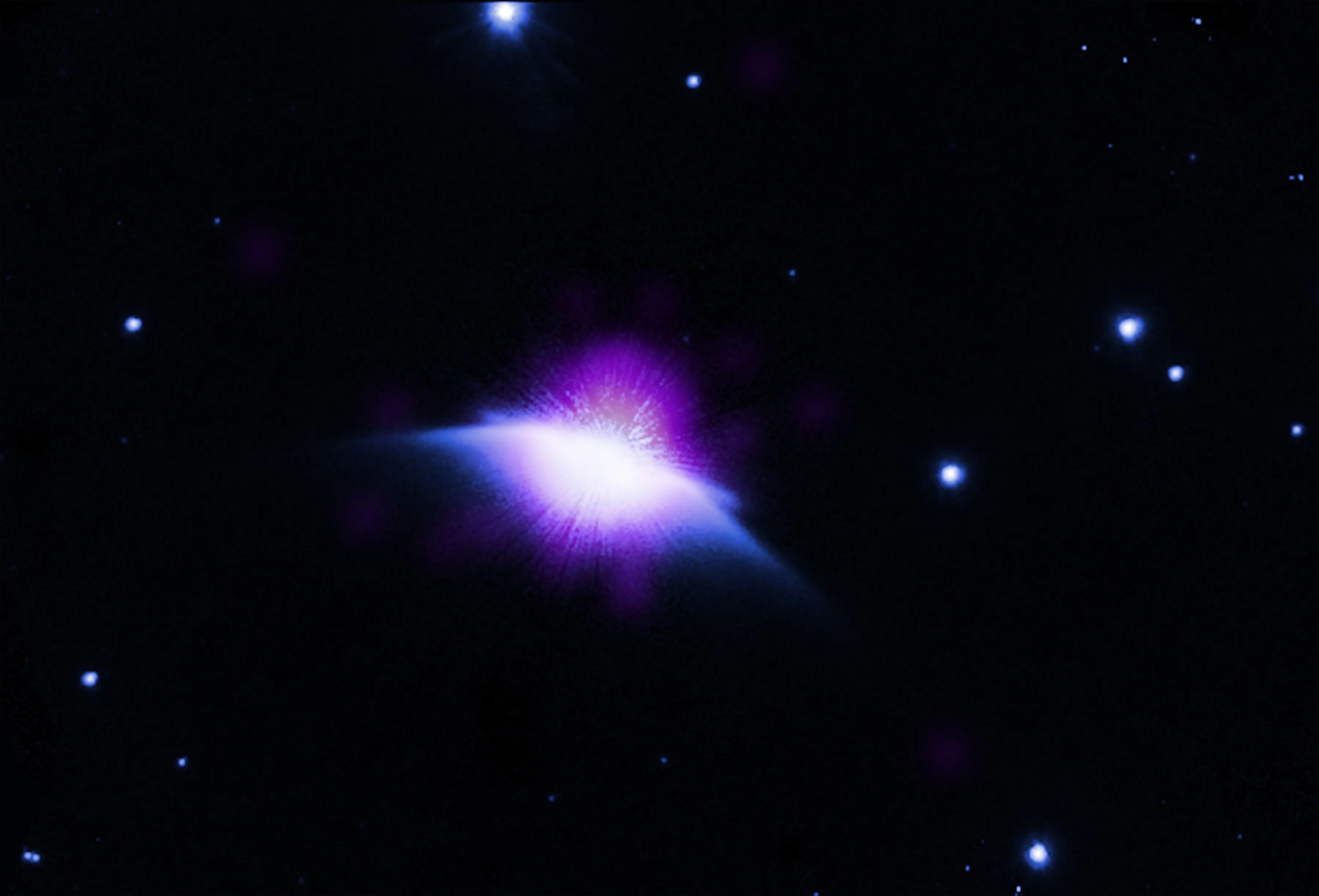
NASA's Chandra X-ray Observatory has caught a young Sun-like star in the act of blowing bubbles of hot gas into the galaxy — the first time this behavior has been directly observed in a star resembling a younger version of our Sun. The finding comes from X-ray observations, which can detect the superheated plasma that drives these stellar outflows. Stellar bubbles are regions where a star's intense radiation and particle winds push surrounding gas outward, creating expanding cavities in the interstellar medium. The phenomenon is well-documented in massive, short-lived stars — think the dramatic wind-blown bubbles around Wolf-Rayet stars or O-type supergiants. What's new here is catching a Sun-like star, at an earlier evolutionary stage, doing the same thing. Our own Sun drives a version of this: the heliosphere is effectively a bubble inflated by the solar wind into the local interstellar medium. But observing the process in a younger analog gives astronomers a direct look at what our solar system's environment might have looked like billions of years ago. Chandra is the right instrument for this. Launched in 1999, it remains the highest-resolution X-ray telescope in orbit, capable of resolving the fine structure of hot gas around individual stars. X-ray observations are essential because the bubble-blowing process involves plasma at millions of degrees — invisible at optical wavelengths but bright in X-rays. The observatory is now 26 years into a mission originally designed for five, and findings like this demonstrate why NASA has continued extending its operations despite ongoing budget pressure. The source material is a single sentence — NASA image captions are often terse to the point of haiku — so the detailed astrophysics (which star, what distance, bubble size, temperature) aren't available here. What we have is the headline claim: first direct observation of bubble-blowing by a young solar analog, via Chandra X-ray data. For anyone interested in solar system formation, stellar evolution, or the question of what environments young planetary systems develop in, this is a data point worth tracking. The bubbles a young star blows shape the gas and dust environment around it, which in turn influences how planets form and whether volatile materials survive to be incorporated into those planets. Understanding our Sun's youth is, indirectly, understanding why Earth has the chemistry it does.
Worth reading?
OPTIONAL
Score
55
/100
What Is What to Watch?
What to Watch highlights the specific signals, decisions, or events that will determine which direction this story goes next.
About GRINCHANDRA FULL PAPER
This is a one-sentence NASA caption. The full research paper will contain the star's identity, distance, bubble dimensions, plasma temperatures, and comparison to solar wind models. That's where the real science lives.
CHANDRA BUDGET
Chandra has faced repeated defunding threats. Each new discovery strengthens the case for continued operations, but NASA's astrophysics budget is under pressure. Watch the FY2026 appropriations.
JWST FOLLOW-UP
James Webb Space Telescope could observe the same young star in infrared, revealing the cooler dust and gas structures shaped by the hot bubble. A multi-wavelength picture would be significantly more informative.
Verified Facts (1)
For the first time, a much younger version of the Sun has been caught red-handed blowing bubbles in the galaxy, by astronomers using NASA's Chandra X-ray Observatory
Solution Focus (3)
First direct observation of a young Sun-like star blowing bubbles — a behavior previously documented only in massive, short-lived stars
Chandra X-ray Observatory, 26 years into a 5-year mission, remains the only instrument with the resolution to catch this
The finding connects directly to solar system formation: the bubbles a young star blows shape the environment in which planets develop
Community Actions (3)
This is a one-sentence NASA caption. The full research paper will contain the star's identity, distance, bubble dimensions, plasma temperatures, and comparison to solar wind models. That's where the real science lives.
Chandra has faced repeated defunding threats. Each new discovery strengthens the case for continued operations, but NASA's astrophysics budget is under pressure. Watch the FY2026 appropriations.
James Webb Space Telescope could observe the same young star in infrared, revealing the cooler dust and gas structures shaped by the hot bubble. A multi-wavelength picture would be significantly more informative.
More latest news
Read all