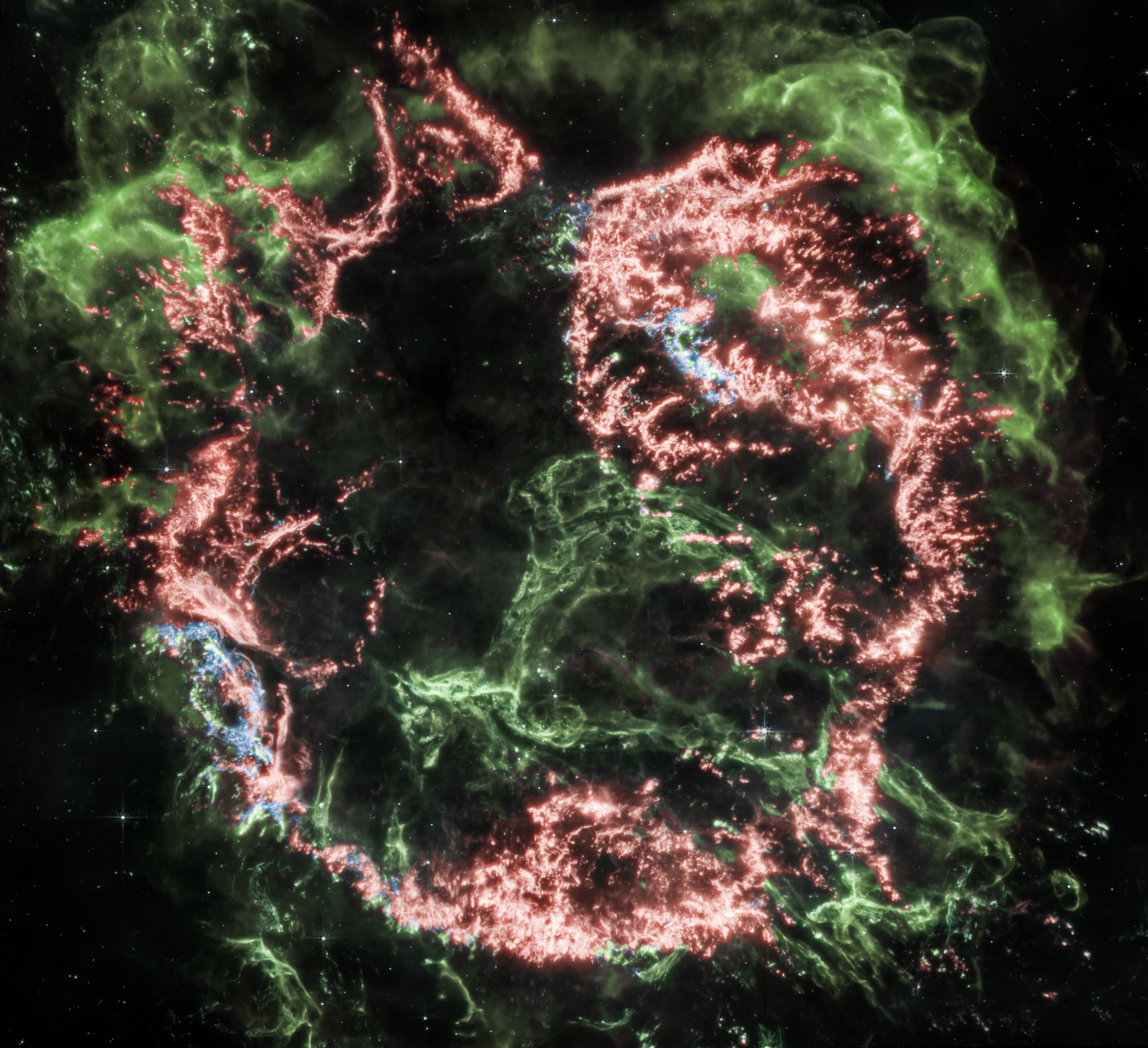
Imagine you find a smashed vase on the floor. You can't rewind time to watch it break, but by carefully cataloging every shard — its shape, its glaze, where it landed — you can reconstruct the original vessel and figure out exactly how it hit the ground. That's what Webb is doing with Cassiopeia A, except the vase is a star that exploded roughly 340 years ago, and the shards are clouds of hot dust radiating in the mid-infrared. The core observation: Webb's mid-infrared instruments resolve the composition and spatial distribution of hot dust within Cas A's expanding shell, revealing structure that traces back to the layers of the progenitor star. This isn't just a pretty picture — it's a chemical fingerprint that tells you what the star was made of, layer by layer, before it detonated. Previous telescopes (Spitzer, Chandra) could see that dust existed; Webb shows you what the dust IS and where specific compositions sit relative to the blast wave. Cassiopeia A is the youngest known supernova remnant in the Milky Way, sitting about 11,000 light-years away. Its youth is what makes it scientifically precious — the ejecta haven't had time to mix thoroughly with the interstellar medium, so the chemical stratification of the original star is still partially readable. Webb's infrared sensitivity cuts through the problem that plagued earlier observations: hot dust radiates most strongly at wavelengths Spitzer could see but couldn't resolve sharply, and that Hubble and Chandra couldn't see at all. The dust composition matters because supernovae are the universe's primary factories for heavy elements and dust grains. Understanding what kinds of dust survive the explosion — silicates, carbon compounds, metal oxides — directly constrains models of how galaxies build up their dust budgets over cosmic time. This is a live question in astrophysics: early JWST observations of high-redshift galaxies found more dust than models predicted, and detailed studies of nearby remnants like Cas A are one way to calibrate those models. What Webb adds to the existing picture is spatial resolution married to spectral sensitivity. You can now map WHERE specific dust species sit within the remnant and correlate that with the blast dynamics visible in X-ray (from Chandra) and optical (from Hubble). The multi-wavelength composite is what turns a single observation into a constraint on supernova physics. The limitation is straightforward: this is observational characterization, not a theoretical breakthrough. It provides data that modelers will use, but the paper itself is not proposing a new mechanism or overturning a prior result. It's a high-quality measurement — the kind of work that becomes a citation anchor for the next decade of supernova-remnant papers without itself making a single dramatic claim. That's not a criticism; it's a description of the category of result.
The analogy
Like forensic analysis of a smashed vase: you can't rewind the explosion, but by cataloging every shard's composition and position, you reconstruct the original object and the physics of its destruction.
Vase forensics
Catalog shard composition, glaze, and landing position to reconstruct the original vessel and impact dynamics
Cas A dust map
Map dust species composition and spatial distribution to reconstruct the progenitor star's layered structure
Honest assessment
This is a measurement, not a revolution. Webb does what Webb was built to do — see the mid-infrared universe at resolution no previous telescope could match — and applies it to the single most important nearby supernova remnant. The value is in the data it feeds to modelers working on the cosmic dust-budget problem, where current estimates disagree by factors of 3-10×. If you care about where the building blocks of planets come from, this is load-bearing calibration work. If you're looking for a paradigm shift, it's not here.
What Is CLAIMS?
63
/ 100
BedrockNews applies a structured analytical framework called CLAIMS to academic papers and technical research releases.
How CLAIMS worksClaim
2/5
Ladder
4/5
Architecture
3/5
Integrity
4/5
Milestone
3/5
Successor
3/5
What is this paper actually committing to?
Characterization, not discovery. Webb resolves Cas A's dust composition at unprecedented IR resolution, but the category of result is 'sharper measurement' rather than 'new phenomenon found.'
The field fight
Where does the dust in early galaxies come from — supernovae or AGB stars — and how much survives the blast?
Side A
Supernovae produce dust but the reverse shock destroys most of it; AGB stars dominate the cosmic dust budget
Held by: Dwek & Cherchneff 2011, classical ISM models
Side B
Supernovae can retain significant dust if clumping protects grains from the reverse shock; remnant observations support higher survival
Held by: Matsuura et al. (SN 1987A), Spitzer Cas A surveys, this observation
Milestone tracker
Unlocks: Dust survival fractions constrained to ~10%, resolving factor-of-3-10× disagreement in galaxy dust-budget models
Current
1
remnant (Cas A)
this observation
Next
4-6
remnants
systematic census
~2-4 years as JWST cycles allocate time to SN 1987A, Crab, Tycho
Verified Facts (2)
NASA's James Webb Space Telescope reveals the hot dust that makes up Cassiopeia A
The composition of its dust provides clues to the structure of Cassiopeia A's original star
Practical Implications (3)
Dust-budget modelers now have spatially resolved composition data for Cas A that can constrain grain survival fractions through the reverse shock
Multi-wavelength teams can overlay Webb's mid-IR maps with Chandra X-ray and Hubble optical data to build 3D ejecta models
JWST proposal writers targeting other young remnants (SN 1987A, Crab) now have a methodological template and comparison target
More latest news
Read all