YEARS AT GODDARD
20+
DIRECTIVE ANNOUNCED
Feb 2025
SWORN IN
Aug 2025
CASE STUDY OF N
1
Ashley Knight grew up at NASA Goddard. Her father was a mechanical engineer, her mother worked in human resources, and dinner-table conversation revolved around the agency. She remembers talking about the Challenger disaster as a child and visiting the test chambers where spacecraft were prepared for flight. The trajectory from childhood fascination to career was not a straight line, but it was always pointed at Greenbelt, Maryland.
Extraction Map
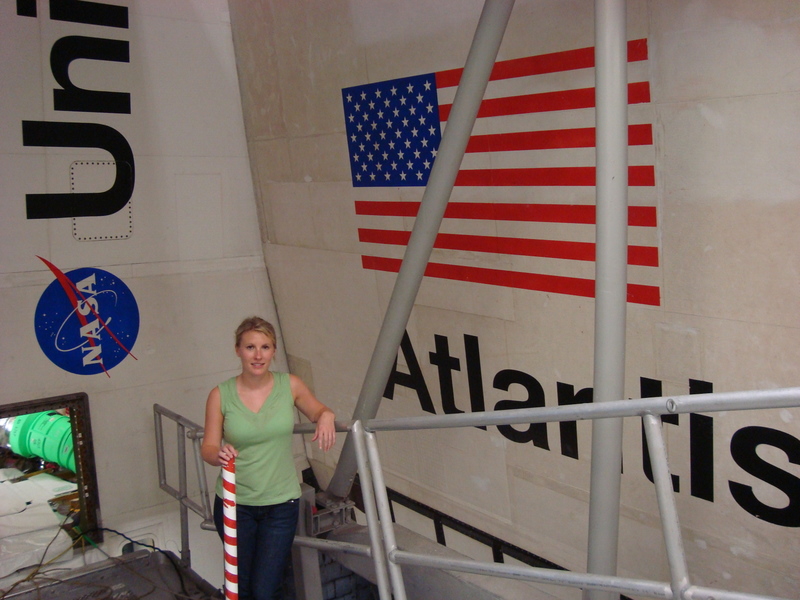
After graduating from the University of Maryland, Knight landed a contractor role supporting the Hubble Space Telescope team, assisting engineers with test plans, data gathering, and hardware procurement for Hubble's fifth and final shuttle servicing mission. She subsequently moved to the Robotic Refueling Mission in what is now NASA's In-Space Servicing, Assembly, and Manufacturing Capabilities Office, then briefly left for contracting work at the U.S. Naval Research Laboratory before returning to Goddard as a contractor program analyst in the Office of the Chief Financial Officer. In late August, Knight and a number of colleagues were sworn in as federal employees under a workforce directive announced by NASA Administrator Jared Isaacman in February, titled "Restoring NASA's Core Competencies." The directive is designed to bring mission-critical contractor positions into the civil service, expanding institutional knowledge, strengthening in-house capability, and reducing dependency on external labor for functions the agency considers essential. The logic is straightforward: contractor staff performing government-essential work face structural limitations. They lack the autonomy to execute certain government-related tasks directly, their training and advancement pathways differ, and institutional knowledge walks out the door when contracts change hands. Knight herself noted that transitioning to civil service "makes it easier for my colleagues and I to help keep NASA's missions going from the financial aspect" and provides "more autonomy to perform certain government-related tasks." Goddard's chief financial officer Lisa Kelleher framed the directive as an opportunity to "rebalance positions across the organization and remove limitations" previously imposed on non-government employees, specifically building in-house competencies in budget analysis and accounting. Knight's supervisor Linnette Morales described the conversion as unlocking "new avenues for her learning and development" and enabling integration into new roles. The broader context matters. NASA has long relied on a blended workforce where contractors handle significant operational work. Insourcing mission-critical roles is a deliberate institutional bet: trading the flexibility of contract labor for deeper knowledge retention and direct control. Whether this produces long-term resilience or bureaucratic overhead depends entirely on execution — on whether the agency uses the directive to genuinely build capability or simply reclassifies existing positions without changing workflows. Knight now carries the title of budget analyst in the Program Analysis Office, performing the financial bridge work between NASA Headquarters and Goddard programs as the agency pursues lunar surface missions, a Moon Base, and eventual crewed Mars missions. Two decades after first following her parents around center, the institutional continuity her story represents is precisely the asset the directive aims to protect.
Worth reading?
OPTIONAL
Score
52
/100
Mildly generative — the directive aims to retain institutional knowledge and reduce contractor dependency, but the article provides no evidence of scale, cost savings, or measurable capability gains beyond individual testimony.
What Is GRIN?
GRIN stands for Generativity, Resilience, Innovation efficiency, and Novelty openness. These four dimensions capture the essential characteristics of any memetic intelligence — whether a nation, a corporation, a religion, or a movement.
About GRINGenerativity
2/5
Resilience
3/5
Efficiency
2/5
Novelty
2/5
Extractive
1/5
Inverted
Does this create new capability or just redistribute existing value?
Modest generativity. Insourcing builds knowledge retention and training pathways, but the article shows reclassification of existing work, not creation of new capability. The pie stays the same size.
Verified Facts (9)
Ashley Knight's father Lyle Knight was a mechanical engineer; her mother Julia Knight worked in human resources at Goddard.
Knight graduated from the University of Maryland in College Park.
Knight worked as a project support analyst for Hubble's fifth and final shuttle servicing mission.
The final Hubble servicing mission was completed in 2009 using space shuttle Atlantis.
Knight worked with the Robotic Refueling Mission in what was then the Satellite Servicing Capabilities Office, now NASA's In-Space Servicing, Assembly, and Manufacturing Capabilities Office.
Knight performed contracting work for the U.S. Naval Research Laboratory in Washington.
The workforce directive is titled 'Restoring NASA's Core Competencies' and was announced by NASA Administrator Jared Isaacman in February.
Lisa Kelleher is Goddard's chief financial officer.
Linnette Morales is Knight's supervisor in the Program Analysis Office.
More latest news
Read all