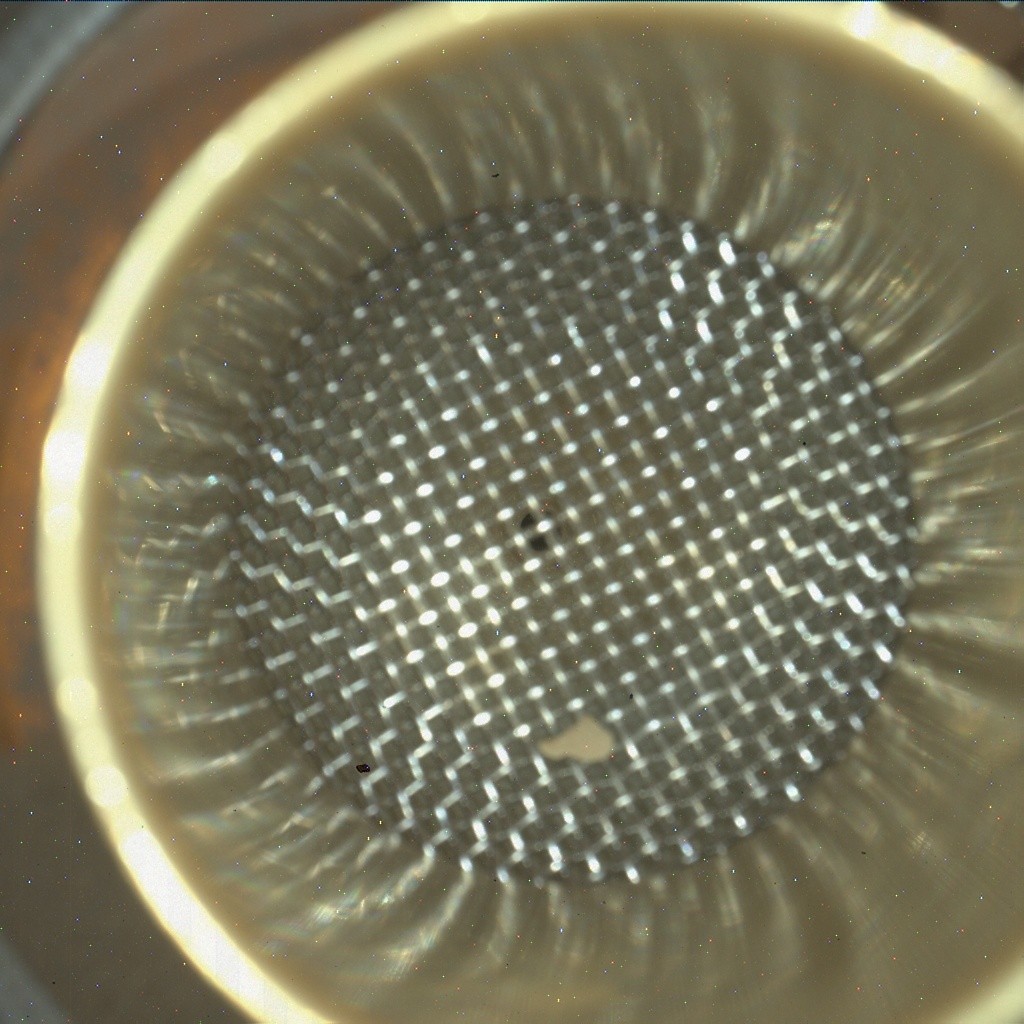
Curiosity's 47th successful drill — nicknamed "Campo Marte" — is done, and the rover is moving on. The week between Sols 4908 and 4912 was a concentrated burst of post-drill science: CheMin ran X-ray diffraction on the sample for mineralogy, SAM analyzed volatile releases, and APXS ran extended-duration measurements on the drill fines to push counting statistics beyond normal levels. ChemCam, MAHLI, and Mastcam documented everything from the drill hole itself to how much residual sample fell out when the drill stem was shaken clean. The precision work here is worth pausing on. ChemCam targeted two adjacent spots on finely laminated sediments — "Corcovado" and "Junakas" — aiming at millimeter-scale layers from 3 meters away. The question: are the layers chemically distinct (different formation conditions) or similar (stable conditions over time)? This is the kind of measurement that turns pretty geology into actual paleoenvironmental reconstruction. Additional targets "Palcaya" (layered bedrock) and "Alcamachi" (an intriguingly dark float rock) round out the chemistry campaign. The potential record-breaker is a 24-frame RMI mosaic — possibly the longest single strip of Remote Micro-Imager frames Curiosity has ever assembled. It captures a small ridge with sedimentary textures that could reveal depositional conditions from billions of years ago. Thirteen-plus years into a mission designed for two, and the rover is still setting personal bests. Mastcam spent the stop methodically imaging the entire surrounding region, including high-resolution mosaics of sample drop locations and the workspace post-drill. MAHLI documented the CheMin sample inlet — complete with a small rock that has taken up permanent residence and earned the nickname "our pet rock" from the CheMin team. APXS ran unusually long integration times on the Campo Marte drill fines across every plan this week, capped by a nighttime MAHLI session under LED illumination. The environmental monitoring team tracked atmospheric opacity, dust activity, and dust devils throughout. With the Campo Marte campaign wrapped, Curiosity is heading uphill on Mount Sharp toward an area selected for its cross-bedding — sedimentary structures that record the direction and energy of ancient water or wind flow. The author, planetary mineralogist Susanne Schwenzer of The Open University, notes she's itching for the CheMin results while deferring to sedimentologists on the next target selection. What makes this blog entry quietly remarkable is the texture of a 13-year-old mission operating at full scientific capacity. Five instruments coordinated across multiple planning cycles, millimeter-precision targeting from meters away, extended measurement protocols chosen opportunistically, and a team that still gets emotionally attached to their workspaces. The Curiosity mission blog is the longest-running field journal from another planet, written by rotating scientists who are doing the actual work.
Worth reading?
RECOMMENDED
Score
64
/100
Space enthusiasts who want ground-level operational detail, not press-release summaries. Geologists and planetary scientists who appreciate instrument-specific methodology. Anyone who finds the daily texture of a 13-year Mars mission more interesting than its highlight reel.
Cultural Placement
Like Oliver Sacks's clinical case studies but for rocks on another planet, with the field-notebook intimacy of John McPhee's geology writing and the collaborative authorship rhythm of a long-running group blog like Cosmic Variance or The Oil Drum. The Curiosity blog sits in a narrow tradition of working-scientist dispatches — closer to Antarctic expedition journals than to NASA press releases. Each entry is a single shift's perspective on a shared, decade-long project, giving it the accumulative texture of serialized nonfiction rather than standalone journalism.
Honest assessment
This is a working scientist's field notes from Mars, with all the charm and all the limitations that implies. It's not polished science communication — it's better than that for the right reader, and worse for the wrong one. If you want narrative arc, look elsewhere; if you want to know exactly what ChemCam did on Sol 4910 and why, this is the only source in existence.
What Is NOVEL?
64
/ 100
BedrockNews applies a structured analytical framework called NOVEL to cultural works — games, books, film, music, and more.
How NOVEL worksNerve
2/5
Originality
3/5
Voice
4/5
Endurance
4/5
Lineage
3/5
What did the artist risk? What could have failed?
Low individual risk — this is a rotating-author institutional blog with a proven format. But the mission itself is a 13-year bet that keeps paying, and the personal attachment Schwenzer shows is a small, honest vulnerability.
Verified Facts (12)
47th successful drill, named 'Campo Marte'
Sol 4908, May 28, 2026, at 11:14:14 UTC
By Susanne P. Schwenzer, Professor of Planetary Mineralogy at The Open University, UK
Earth planning date: Friday, May 29, 2026
ChemCam targeted 'Corcovado' and 'Junakas' — millimeter-sized targets about 3 meters away (about 10 feet)
Additional targets: 'Palcaya,' 'Alcamachi,' and 'Magallanas'
24-frame RMI mosaic — potentially the longest strip of RMI images taken in one mosaic
CheMin inlet has a small rock the team calls 'our pet rock'
Colleague Abigail Fraeman reported the drill success last week
Schwenzer was Science Operations Working Group chair three times during this stop
Next area features cross-bedding sedimentary structures
Nighttime MAHLI experiment under LED lights to document APXS extended measurements
More latest news
Read all