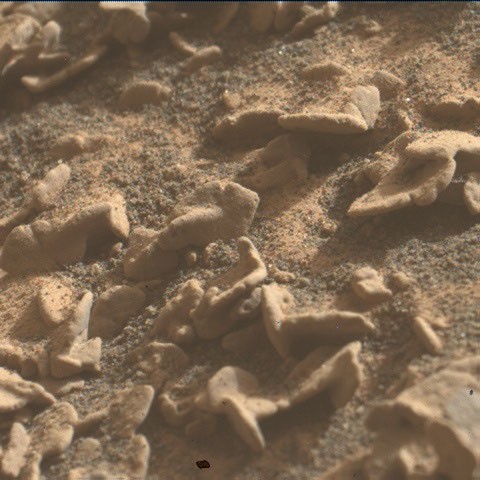
For sols 5063 through 5069, Curiosity worked the Nazca drill hole like a field geologist who refuses to leave until every last sample is bagged. The target: disk-shaped crystal forms embedded in bedrock — features the team cheerfully compares to potato chips. Drill cuttings went to the Sample Analysis for Mars (SAM) instrument for chemical breakdown while the rover's other instruments attacked the surrounding terrain from every angle. The crystal forms got the full treatment. ChemCam fired its LIBS laser at multiple individual crystals — "Ahi Veremos," "Colca," "Bermejo" — building depth profiles that reveal compositional layering within each formation. MAHLI, the hand-lens imager on the robotic arm, captured close-ups of the chip-shaped structures, and the team planned nighttime imaging using both white-light and ultraviolet LED lamps to see how the minerals fluoresce. That UV-at-night move is the kind of methodical thoroughness that separates a $2.5 billion rover from a geology field trip. Mastcam spent the week filling out a mosaic of the Nazca near-to-mid-field — building a panoramic map of the site's context so the crystal forms can be understood within their broader depositional environment. The Remote Micro-Imager (RMI) reached out to more distant targets: rock clusters below "Cordillera" ridge and dark lenses beneath a planar surface on "Mishe Mokwa" ridge. Long-distance geology, done from a robot on another planet. Environmental science ran in parallel. Multiple dust devil surveys, horizon movies, and atmospheric zenith movies were collected across the week. And Phobos — Mars' larger, potato-shaped moon — obliged by transiting the Sun. Imaging of the eclipse was prioritized, a dataset that helps refine Phobos' orbital parameters and Mars' rotational state. By Friday's plan, Curiosity was ready to leave Nazca behind. The final sol included a drive back toward its southerly route, resuming the long trek up Mount Sharp. The Nazca campaign — drill hole number 49 — is now in the books, its samples digested by SAM, its crystals zapped, photographed, and illuminated under alien UV light. What makes these chip-shaped crystals interesting is the question they pose about water. Disk-shaped crystal molds in sedimentary rock on Earth typically indicate minerals that precipitated from evaporating water — sulfates, chlorides, or other salts. Characterizing their chemistry through LIBS and SAM gives the team a window into the composition and behavior of ancient Martian water at this specific stratigraphic level of Mount Sharp. Curiosity is now over 5,000 sols into a 90-sol-class design heritage, driving a route up a mountain on Mars with instruments still delivering science. The Nazca stop was a single week in a campaign that has been running for nearly fourteen Earth years.
Worth reading?
OPTIONAL
Score
52
/100
Mars enthusiasts who follow Curiosity's traverse, planetary geologists, and anyone who finds procedural space science inherently compelling. Not for readers who need narrative tension.
Cultural Placement
Like Andy Weir's *The Martian* mission logs stripped of the protagonist's humor and survival stakes, crossed with the meticulous procedural voice of Apollo-era flight director transcripts. The Curiosity blog sits in a tradition of NASA public communication that stretches from the Voyager encounter press releases through the Spirit/Opportunity sol-by-sol updates — institutional science writing where the constraint is radical transparency about daily operations, not narrative drama. The closest tonal cousin is the Opportunity rover blog during its extended mission: plainspoken, instrument-by-instrument, trusting the reader to find the wonder in the procedure itself.
Honest assessment
This is a clean, competent mission blog post doing exactly what NASA rover blogs are supposed to do: document the week's science operations with enough specificity that an informed reader can follow the geology. It's not trying to be more than that, and within its form it delivers. The crystal-form investigation and Phobos eclipse imaging are genuinely interesting science buried in procedural language.
What Is NOVEL?
52
/ 100
BedrockNews applies a structured analytical framework called NOVEL to cultural works — games, books, film, music, and more.
How NOVEL worksNerve
1/5
Originality
2/5
Voice
3/5
Endurance
3/5
Lineage
4/5
What did the artist risk? What could have failed?
Near zero creative risk — this is institutional reporting within rigid NASA comms norms. The only nerve is trusting that daily rover operations are interesting enough without narrative packaging.
Lineage tree
Apollo mission transcripts
direct ancestor — established the procedural transparency norm
Voyager encounter press releases
tonal influence — instrument-by-instrument public reporting
Spirit/Opportunity sol blogs
direct ancestor — created the rover blog format Curiosity inherits
Cassini mission blogs
extends the form of — parallel outer-planet public communication
Verified Facts (14)
Curiosity completed its drill campaign at the 'Nazca' drill hole
Disk-shaped (or potato chip shaped) crystal forms in bedrock
Drill samples delivered to Sample Analysis for Mars (SAM) instrument
ChemCam LIBS observation of crystal-form 'Ahi Veremos'
LIBS depth profile of 'Colca' crystal-form and LIBS of 'Bermejo' target
Long distance RMI mosaic of rock clusters below 'Cordillera' ridge
Long distance RMI mosaic of dark lenses beneath a planar surface on 'Mishe Mokwa' ridge
MAHLI nighttime white-light and ultraviolet LED lamps planned for nighttime imaging
Mars' moon Phobos was eclipsing the Sun and imaging of that event was prioritized
MAHLI image acquired November 7, 2026, Sol 5067
Written by William Farrand, Senior Research Scientist, Space Science Institute
Earth planning date: Friday, Nov. 6, 2026
Sols 5063-5069
Friday's drive was to take the rover back towards its southerly trending route
More latest news
Read all