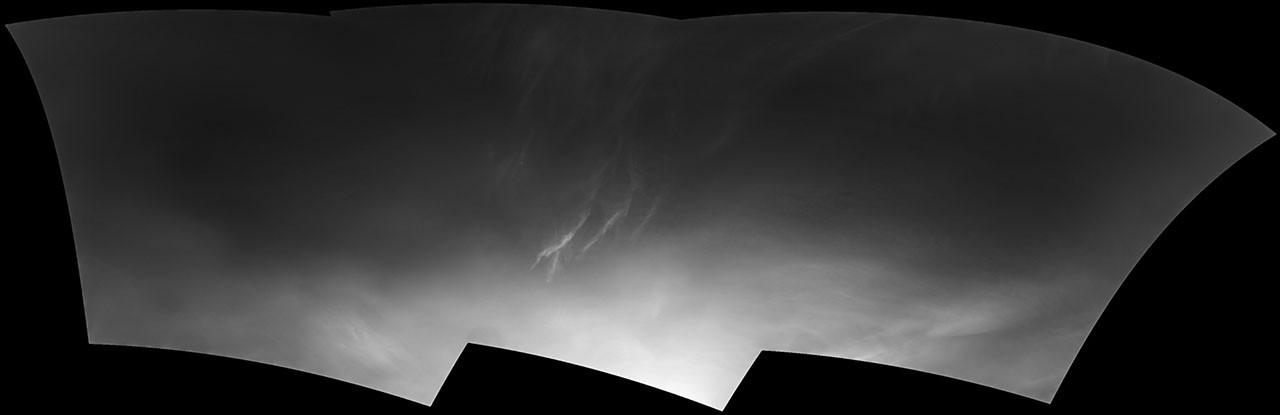
On October 31, 2026 — the 5,061st Martian day of its mission — NASA's Curiosity rover pointed its navigation cameras at the sky after sunset and caught clouds drifting across Gale Crater. The resulting GIF is a few seconds of alien weather, quiet and strange, the kind of image that makes you stop scrolling. Twilight clouds on Mars are a seasonal phenomenon. They appear for only a short window each Martian fall over Gale Crater, visible briefly after sunset when the geometry of light still catches ice crystals at altitude even as the surface falls into darkness. Curiosity has been documenting these clouds as part of its atmospheric science work, building a multi-year dataset of Martian weather patterns from a single location. The technical setup is unglamorous: navigation cameras, designed primarily for driving, repurposed as atmospheric instruments. There is no special hardware here, just clever scheduling and a rover that has outlasted its original mission timeline by an extraordinary margin. Curiosity landed in August 2012. It has been exploring Gale Crater for more than 14 years. What makes the image work is not resolution or color — the nav cameras shoot in grayscale — but duration. The GIF captures motion. You are watching weather happen on another planet in something close to real time. That cognitive shift, from photograph to observation, is what separates planetary imaging from planetary science. Curiosity was built by NASA's Jet Propulsion Laboratory, managed by Caltech in Pasadena, California. JPL leads the mission on behalf of NASA's Science Mission Directorate in Washington as part of NASA's Mars Exploration Program portfolio. The rover continues to operate well past its design life, still generating science and still, apparently, looking up.
Worth reading?
OPTIONAL
Score
48
/100
Space enthusiasts who find quiet wonder in routine planetary science, parents showing kids what another planet looks like, anyone who wants 10 seconds of genuine alien weather.
Cultural Placement
Like the Voyager pale blue dot image but smaller in ambition and more intimate in effect, with the patient observational quality of time-lapse nature photography. Think less Ansel Adams, more a trail camera that happens to be on Mars — the power comes from duration and location rather than compositional virtuosity. Closest kin: the Opportunity rover's final panorama, the Cassini 'Day the Earth Smiled' mosaic, and Chris Hadfield's ISS photography — all cases where the instrument's limitations become part of the aesthetic.
Honest assessment
This is a minor but pleasant piece of ongoing mission output — a seasonal atmospheric observation packaged as a public-facing GIF. It won't change how you think about Mars, but it's real data from another planet rendered as moving weather, and that retains a stubborn power. Best consumed in three seconds, appreciated in context of Curiosity's 14-year run.
What Is NOVEL?
48
/ 100
BedrockNews applies a structured analytical framework called NOVEL to cultural works — games, books, film, music, and more.
How NOVEL worksNerve
1/5
Originality
2/5
Voice
3/5
Endurance
3/5
Lineage
3/5
What did the artist risk? What could have failed?
Minimal risk. Navigation cameras capturing twilight clouds is routine mission ops repurposed as public outreach. Nothing could have failed except the weather not cooperating.
Verified Facts (6)
NASA's Curiosity Mars rover captured these drifting clouds on Oct. 31, 2026, the 5,061st Martian day, or sol, of the mission
twilight clouds appear for only a short time each fall over Gale Crater
Curiosity has been exploring Gale Crater for more than 14 years
Curiosity was built by NASA's Jet Propulsion Laboratory, which is managed by Caltech in Pasadena, California
PIA26805
GIF (2.59 MB)
More latest news
Read all