TEST DIAMETER
20 ft
FACILITY HEIGHT
131 ft
MAX AIRSPEED
117 mph
RE / FT
1.1M
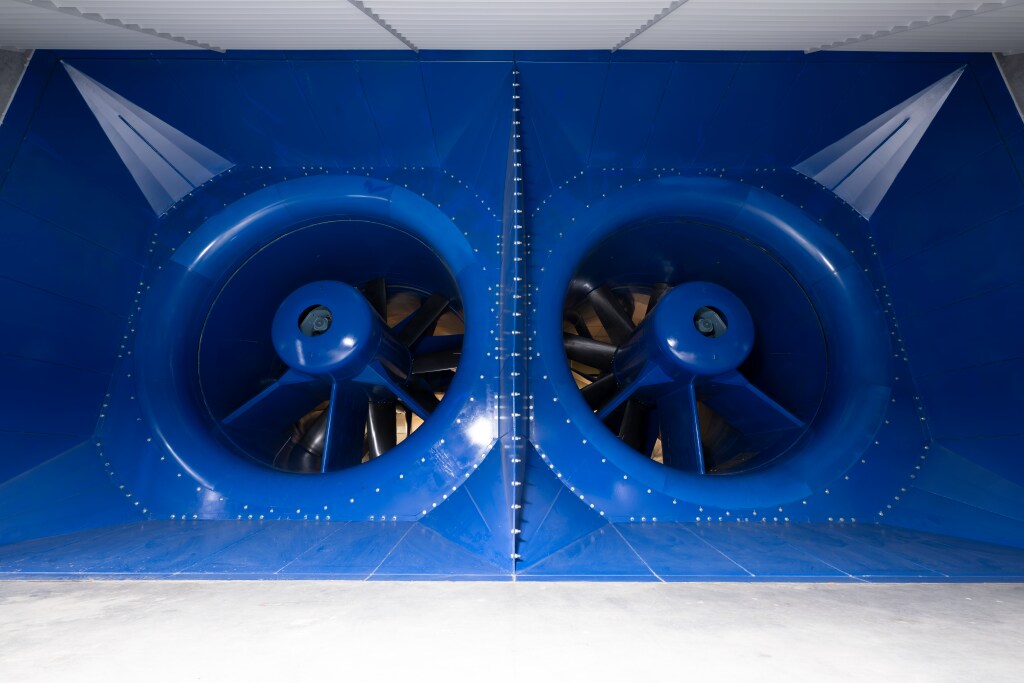
The Flight Dynamics Research Facility is a subsonic vertical wind tunnel operated by NASA, designed specifically for the kind of testing commercial operators avoid: aircraft spin entry, spin recovery, free-fall dynamics, and stability at the edges of controllable flight. Its vertical test section — 20 feet in diameter and 24 feet high — sits inside a structure that rises 131 feet, making it one of the more physically imposing single-purpose research tools in the U.S. aerosciences portfolio.
Extraction Map
The facility's operating envelope is modest by modern standards but precisely fitted to its mission. Airflow tops out at 172 ft/s (117 mph), generating dynamic pressures up to 35 psf at atmospheric pressure. Reynolds numbers reach 1.10×10^6 per foot. The test gas is plain air, actively cooled to a stable 79°F. These are not cutting-edge numbers — they are the right numbers for subscale free-flight model testing where the physics of spin and recovery matter more than raw speed. What makes the FDRF structurally interesting from a GRIN perspective is its role as pure public-goods infrastructure. No airline, no airframe manufacturer, no defense contractor would build and maintain a vertical spin tunnel on its own balance sheet. The economics don't work for any single user. But the aggregate value to aviation safety — every spin-recovery procedure validated here feeds directly into pilot training and aircraft certification — is enormous. This is generativity by design: a shared capability that the market would not produce. The facility sits within NASA's broader Aerosciences Evaluation and Test Capabilities portfolio, alongside pressure-sensitive paint research, aircraft icing simulation software, and advanced imaging systems. Each of these tools serves a similar structural function: pre-competitive research infrastructure that de-risks the entire aviation sector rather than enriching a single player. The extraction story here is effectively zero. Taxpayers fund the facility; the entire aviation ecosystem benefits through safer aircraft designs and validated recovery procedures. There is no rent-seeking intermediary, no tollbooth between the research and its application. The FDRF is a textbook case of non-extractive public infrastructure — the kind of facility that quietly prevents disasters rather than generating headlines. The resilience question is worth flagging, though. A single facility of this type represents a concentration risk. If the FDRF were decommissioned or defunded — not an impossible scenario given periodic budget pressure on NASA's aeronautics division — there is no obvious replacement. The facility's specificity is both its strength and its vulnerability. The page was last updated June 9, 2026, edited by Lillian Gipson, with Jim Banke listed as contact (jim.banke@nasa.gov). It is part of NASA's public documentation of its aerosciences test capabilities.
Worth reading?
RECOMMENDED
Score
76
/100
Generative. The FDRF creates shared capability — spin and recovery testing — that the private market would not produce, with benefits distributed across the entire aviation safety ecosystem.
What Is GRIN?
GRIN stands for Generativity, Resilience, Innovation efficiency, and Novelty openness. These four dimensions capture the essential characteristics of any memetic intelligence — whether a nation, a corporation, a religion, or a movement.
About GRINGenerativity
4/5
Resilience
2/5
Efficiency
4/5
Novelty
4/5
Extractive
0/5
Inverted
Does this create new capability or just redistribute existing value?
Textbook public-goods generativity. A shared test facility that no single firm would build, producing safety knowledge that flows freely to the entire aviation sector.
Verified Facts (10)
The Flight Dynamics Research Facility (FDRF) is a large, subsonic wind tunnel with a vertical test section
Test Section Dimensions: 20 ft. diam. by 24 ft. high
Speed: 0 – 172 ft/s (0 – 117 mph)
Dynamic Pressure: (0 – 35 psf)
Reynolds Number: 0 – 1.10×10^6 per ft.
Temperature: Actively cooled (79° F)
Facility Height: 131 ft.
Last Updated Jun 09, 2026
Editor Lillian Gipson
Contact Jim Banke jim.banke@nasa.gov
More latest news
Read all