LBS/YR · 2023-25
100M+
LBS · 1959 CENSUS
17M
ACRES · LATE 1800s
<100
HURRICANES · 6 YRS
2
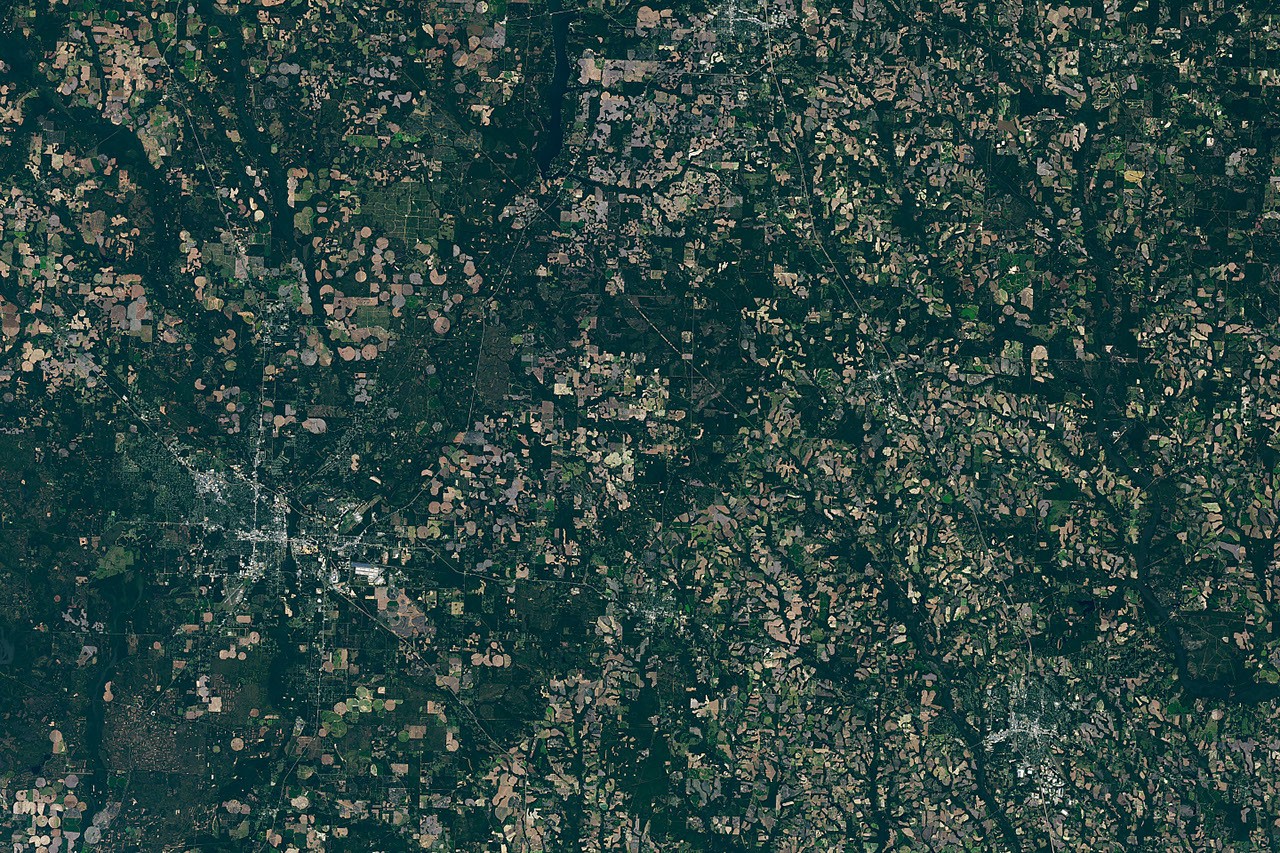
Georgia's southwest corner, centered on Albany in Dougherty County, is the densest pecan-growing region in the country's leading production state. A Landsat 8 image captured on October 23, 2026, during harvest season, shows the orchards sharing the Coastal Plain landscape with peanuts, cotton, and corn. The data feeds the USDA's annual Cropland Data Layer, which maps every crop type across the contiguous United States.
Extraction Map
Pecan trees are water-hungry members of the hickory family (Carya illinoinensis), and their clustering along the Flint River is no accident. The well-drained sandy soils of the Coastal Plain sit above the Floridan aquifer system, giving growers access to irrigation that sustains orchards through Georgia's hot summers. That hydrogeological advantage has shaped the region's agricultural identity for over a century. The industry's arc is striking. In the late 1800s, Georgia had fewer than 100 acres of pecan orchards. A speculative boom in the early 1900s, concentrated in Dougherty and Mitchell counties, saw thousands of acres planted and sold to investors. By 1959, the state led the nation with over 17 million pounds of production. That dominance was eventually challenged by New Mexico and Texas, but Georgia has held on. Two major hurricanes tested the state's pecan infrastructure. Hurricane Michael damaged orchards in October 2018, and Hurricane Helene swept inland in September 2024, dealing another blow to growers who had spent years replanting and recovering. Pecan trees take seven to ten years to reach full production, so hurricane losses compound over long timescales. Despite those setbacks, USDA numbers show Georgia's production has topped 100 million pounds in each of the past three years, 2023 through 2025. That is roughly a sixfold increase from the 1959 census figure, reflecting both expanded acreage and improved cultivars. The state's recovery trajectory is a quiet success story in agricultural resilience. The 2026 season introduced a new challenge: a wet summer created ideal conditions for scab, a fungal disease that causes brown spots on pecan twigs, leaves, and nut shucks. Even so, some growers still recovering from Helene reported the return of a solid crop. The tension between climate volatility and agricultural adaptation is the story's through-line. Landsat's role here is infrastructural rather than headline-grabbing. The satellite program, now decades old, provides the continuous observational record that makes crop mapping possible at national scale. The Cropland Data Layer it feeds is a public good — open data that lets researchers, policymakers, and farmers themselves track land use patterns over time.
Worth reading?
RECOMMENDED
Score
68
/100
Generative. Landsat satellite data feeds an open-access USDA crop mapping system that benefits farmers, researchers, and policymakers without extracting rent from any of them.
What Is GRIN?
GRIN stands for Generativity, Resilience, Innovation efficiency, and Novelty openness. These four dimensions capture the essential characteristics of any memetic intelligence — whether a nation, a corporation, a religion, or a movement.
About GRINGenerativity
4/5
Resilience
3/5
Efficiency
4/5
Novelty
2/5
Extractive
1/5
Inverted
Does this create new capability or just redistribute existing value?
Genuine capability creation. Landsat-to-Cropland-Data-Layer pipeline produces open, national-scale crop intelligence that did not exist before the satellite era. Benefits are non-rivalrous.
Verified Facts (6)
OLI (Operational Land Imager) on Landsat 8 captured this image of the area around Albany on October 23, 2026
In the late 1800s, Georgia had less than 100 acres (40 hectares) of pecan orchards
By the end of the 1950s, Georgia led the nation in pecan production, producing over 17 million pounds, according to 1959 agricultural census numbers
Hurricane Michael damaged orchards in October 2018, and Hurricane Helene dealt another blow when it swept inland in September 2024
USDA numbers show that the state's production has topped 100 million pounds in each of the past three years (2023-2025)
In 2026, a wet summer in parts of the state helped scab take hold
More latest news
Read all