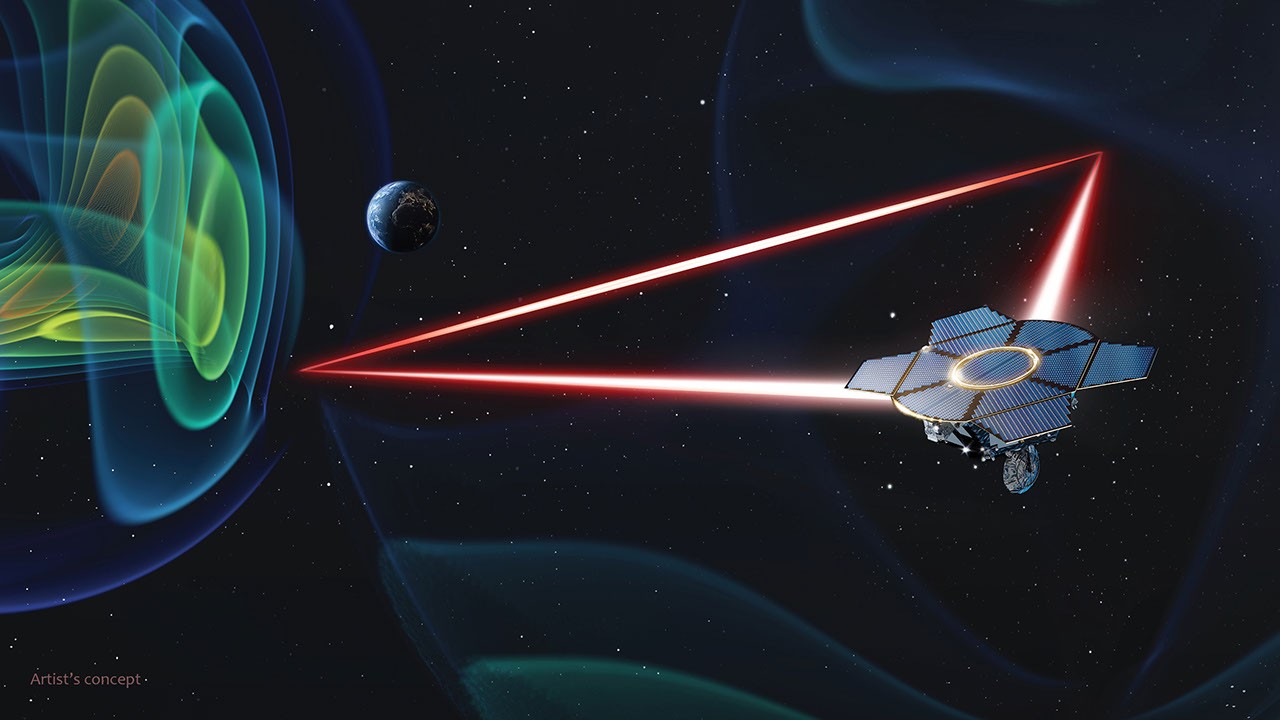
Imagine you're listening to a radio station in your car, and the signal is clean — one steady tone. Now someone mounts the transmitter on a merry-go-round. You'd hear the pitch rise as the transmitter swings toward you and fall as it swings away. That's the Doppler effect. Now imagine instead of sound, the transmitter is broadcasting gravitational waves, and instead of a merry-go-round, a hidden Jupiter-mass planet is tugging the transmitter — a pair of tightly orbiting white dwarfs — in a slow circle. The pitch wobble encodes the planet's mass and orbit. That's the core mechanism of these two papers. Casey McGrath, a postdoctoral researcher at UMBC and NASA Goddard, has worked out where this method hits its sweet spot. Binary white dwarfs with sub-hour orbital periods emit continuous gravitational waves in LISA's detection band. A sufficiently massive planet orbiting the pair induces reflex motion, which imprints Doppler sidebands — secondary frequency peaks flanking the primary signal. McGrath's first paper maps the detection space: which planet masses and orbital periods produce sidebands strong enough for LISA to resolve, potentially out to thousands of light-years. The second paper, co-authored with Scott Noble and Mary Anne Limbach, tackles the confirmation problem. Gravitational wave detections alone can't rule out instrumental artifacts or astrophysical mimics. The team proposes using Webb's infrared sensitivity to detect excess thermal emission from a planet in the system. A five-Jupiter-mass planet would produce a detectable infrared excess out to at least 500 light-years, while LISA itself could detect sub-Jupiter masses under ideal conditions. The two instruments cover complementary parameter space — LISA for range and low masses, Webb for confirmation and characterization. The idea isn't new. Japanese astronomer Naoki Seto proposed gravitational-wave exoplanet detection around double white dwarfs in 2008. What McGrath's papers add is the detailed signal analysis showing where detection is feasible, and a concrete confirmation pathway using existing infrastructure. No exoplanet has ever been found around a binary white dwarf, so any LISA detection would represent an entirely new population — not just a new detection method applied to known targets. Astronomers estimate roughly 10 million double white dwarf systems in the Milky Way have sub-hour periods generating gravitational waves in LISA's band. LISA is expected to individually resolve about 10,000 of these, plus around 100 mixed binaries involving neutron stars or black holes. The observatory itself — three spacecraft in a triangle 2.5 million kilometers on a side, measuring distance changes smaller than a helium atom — is led by ESA with NASA contributing telescopes, laser systems, charge management hardware, and data analysis. The key constraint is sensitivity. Sidebands from planets are faint secondary features riding on a primary signal. Detection depends on the gravitational wave signal-to-noise ratio of the host binary, the planet's mass, and its orbital period. Sub-Jupiter planets are only detectable around the loudest sources under favorable geometry. This is not a survey instrument that will catalog thousands of planets — it's a method that could yield detections in the tens to low hundreds, each representing a system type we've never probed before. LISA's mid-2030s launch timeline means these predictions are testable within a decade. The gravitational wave detection of an exoplanet would be a genuine first — a fundamentally different observable from transit photometry, radial velocity, or direct imaging. It would probe a population of post-main-sequence planetary systems at distances where electromagnetic methods are blind, opening a window into what happens to planets after their host stars die.
The analogy
You're listening to a clean radio tone from a stationary transmitter. Mount the transmitter on a merry-go-round and you hear the pitch wobble — Doppler sidebands flanking the carrier frequency. Now replace the transmitter with two white dwarfs emitting gravitational waves, and the merry-go-round with the tug of an orbiting planet. The wobble in the gravitational wave frequency encodes the planet's mass and orbit, just like the pitch wobble encodes the merry-go-round's speed and radius.
Radio on merry-go-round
Doppler sidebands in the carrier signal reveal the rotation speed and radius of the platform
Planet-tugged binary
Doppler sidebands in the gravitational wave signal reveal the mass and orbital period of the planet
Honest assessment
This is a solid feasibility study, not a detection. It advances a 2008 concept into a concrete observational strategy with mapped sensitivity boundaries and a cross-instrument confirmation pathway. The real test waits on LISA hardware — probably a decade away. Engineers and astrophysicists building LISA data pipelines should care now; everyone else should bookmark this and check back in the late 2030s.
What Is CLAIMS?
57
/ 100
BedrockNews applies a structured analytical framework called CLAIMS to academic papers and technical research releases.
How CLAIMS worksClaim
3/5
Ladder
2/5
Architecture
3/5
Integrity
2/5
Milestone
4/5
Successor
3/5
What is this paper actually committing to?
Real but not first: Seto proposed this in 2008. The advance is detailed sensitivity mapping and a Webb confirmation pathway. Category: feasibility study, not detection.
The field fight
Can gravitational wave observatories do useful astronomy beyond compact-object mergers?
Side A
LISA's primary science is supermassive black hole mergers and galactic binaries — exoplanets are a niche byproduct
Held by: ESA LISA science case, most GW community
Side B
Continuous-wave sources like double white dwarfs are an untapped channel for multi-messenger astrophysics including exoplanet detection
Held by: Seto 2008, McGrath et al., multi-messenger advocates
Milestone tracker
Unlocks: Proof that gravitational waves can probe planetary systems invisible to electromagnetic methods; new population of post-stellar-death planets
Current
0
detections
no GW exoplanets exist
Next
1
detection
first GW exoplanet
~mid-2030s launch + 3-5 years of operations
Verified Facts (8)
The LISA detection method was first proposed by Japanese astronomer Naoki Seto in 2008
Astronomers estimate 10 million double white dwarf systems in the Milky Way with sub-hour orbital periods
LISA is expected to resolve about 10,000 individual systems and around 100 mixed binaries
LISA spacecraft will form a triangular array 1.6 million miles (2.5 million kilometers) on each side
Two papers published in The Astrophysical Journal
Webb could detect an exoplanet about five times Jupiter's mass at 500 light-years; LISA could detect sub-Jupiter under ideal conditions
LISA mission slated for launch in the mid-2030s, led by ESA with NASA as collaborative partner
Gravitational waves first detected by ground-based observatories in 2015
Practical Implications (4)
LISA data pipeline teams should incorporate sideband-search algorithms into their source characterization software now, not after launch
Webb proposal writers can plan infrared follow-up programs for LISA candidate systems once the resolved binary catalog exists
The 10,000 resolved binary catalog will be a public resource — exoplanet sideband searches can be run by any group with matched-filtering expertise
A first gravitational wave exoplanet detection would open a new population of post-main-sequence planetary systems invisible to current methods
More latest news
Read all