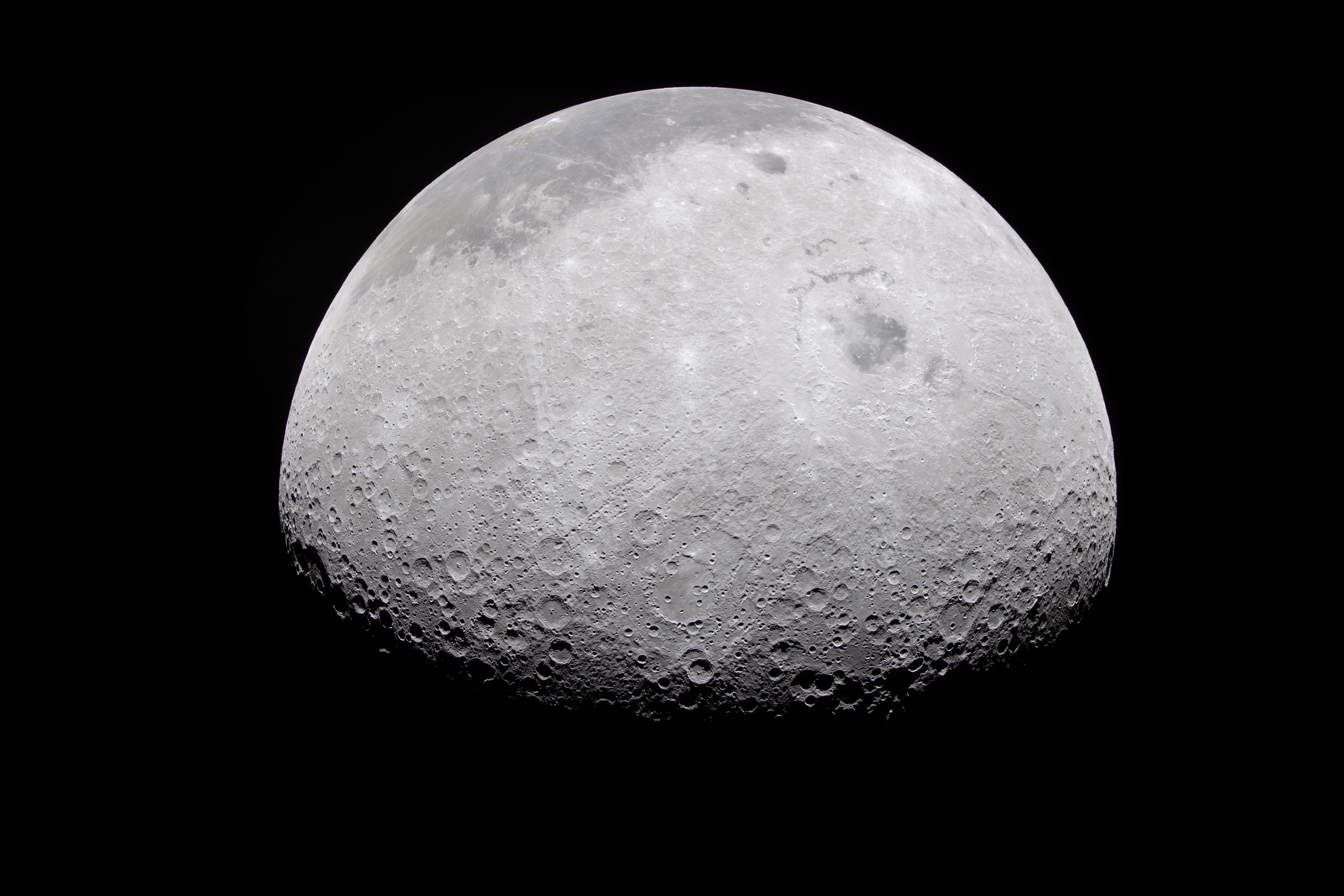
Like Ansel Adams' zone system applied to celestial cartography, with the compositional patience of *Earthrise* but the geological specificity of a USGS survey plate. This image belongs to a tradition of space photography where the camera isn't documenting a mission — it's doing science with light. The Artemis II crew's predecessors understood this: the Apollo 8 *Earthrise* frame changed how humans thought about their planet. This photograph changes how you think about the Moon's surface. The image works because of the terminator — the line where sunlight meets shadow on the lunar surface. That boundary isn't a soft gradient. At the terminator, every crater rim, every ridge, every boulder casts a shadow that reveals depth. The Moon's rocky, uneven, and otherworldly surface features snap into three-dimensional relief precisely where the light runs out. Flat-lit lunar photography gives you a gray disk. Terminator photography gives you terrain. Captured on flight day 6 of the Artemis II mission, the Moon appears half-illuminated, the near side — the face we see from Earth — visible in the dark gray regions at the top of the frame. The composition is deliberate: the crew placed the terminator roughly center-frame, giving equal weight to the illuminated highlands and the shadowed mare. The title, "Hanging in the Balance," is apt without being heavy-handed. What makes this more than a pretty picture is what it teaches you to see. The terminator is a moving phenomenon — it sweeps across the lunar surface as the Moon orbits Earth, and every hour it reveals a different slice of topography. Catching it at this angle, from this distance, with this resolution, is a function of Artemis II's specific trajectory. You couldn't get this shot from Earth, and you couldn't get it from lunar orbit at a different inclination. The near side's dark gray regions — the maria, ancient basaltic flood plains — contrast sharply with the brighter, more cratered highlands. That contrast tells a geological story billions of years old: the maria are younger, smoother, formed by volcanic activity that filled enormous impact basins. The highlands are the Moon's original crust, battered beyond recognition by four billion years of bombardment. One photograph, two geological epochs. As a piece of the Artemis II visual record, this frame does what the best mission photography has always done — it makes the destination real. Not as a destination on a mission timeline, but as a place with texture, depth, and history written in rock and shadow.
Worth reading?
OPTIONAL
Score
48
/100
Space photography enthusiasts, lunar geology fans, and anyone following the Artemis program who wants to understand what the crew actually saw on flight day 6.
Cultural Placement
Like *Earthrise* but geological rather than philosophical, with the topographic precision of a Hasselblad survey frame and the compositional instincts of Ansel Adams' Western landscapes. This sits in the tradition of NASA mission photography where the crew acts as field photographer — not art photography, not press photography, but observation photography where the subject's structure IS the content. The closest predecessors are the Apollo 15 orbital mapping frames and the ISS cupola work of Don Pettit, both of which used lighting angle as a scientific instrument disguised as an aesthetic choice.
Honest assessment
A well-composed mission photograph that uses the terminator line to reveal lunar topography with real clarity. It's not *Earthrise* — it doesn't reframe humanity's self-image — but it's a genuinely useful piece of observational photography that teaches you to read the Moon's surface. Worth a long look if you care about the Moon as a place, not just a destination.
What Is NOVEL?
48
/ 100
BedrockNews applies a structured analytical framework called NOVEL to cultural works — games, books, film, music, and more.
How NOVEL worksNerve
1/5
Originality
2/5
Voice
3/5
Endurance
3/5
Lineage
3/5
What did the artist risk? What could have failed?
Low risk. The crew photographed the Moon from a spacecraft — the shot was always going to be striking. No compositional gamble, no unconventional framing. Competent execution of a known opportunity.
Verified Facts (4)
The Moon appears half-illuminated in this photo captured by the Artemis II crew on flight day 6
The terminator – the difference between light and darkness – provides a stark contrast
The near side, which is what we can see from Earth, appears in the dark gray regions at the top of this image
Image credit: NASA
More latest news
Read all