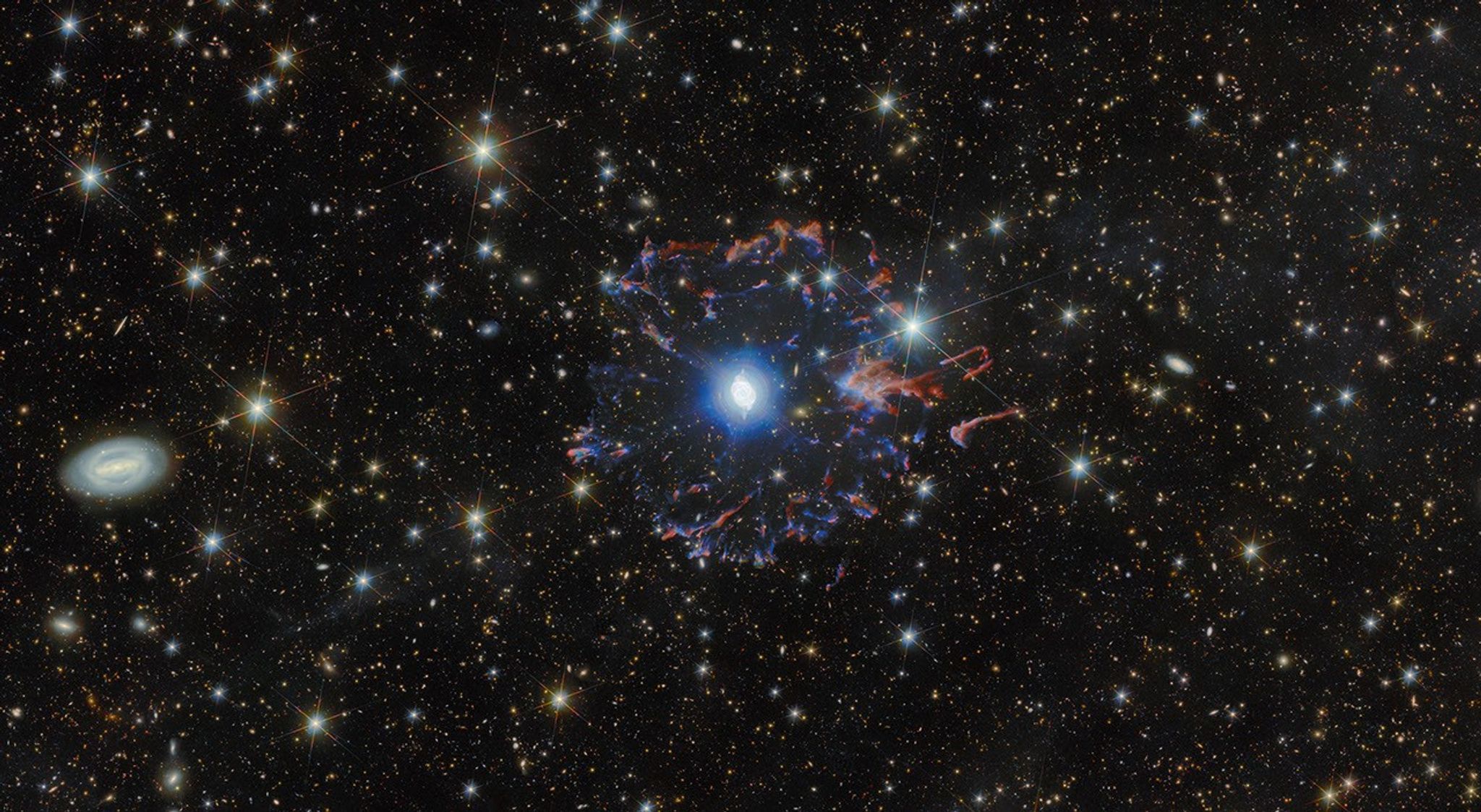
The Cat's Eye Nebula — NGC 6543 — is one of the most studied planetary nebulae in astronomy, first observed by William Herschel in 1786 and one of the first objects examined spectroscopically by William Huggins in 1864. This new composite image pairs two instruments with very different strengths: ESA's Euclid space telescope, designed for wide-field cosmological surveys, and NASA's Hubble, the benchmark for high-resolution visible-light imaging. The result is a portrait that captures both the intimate detail of the nebula's core and its full extended structure in a single frame. What Euclid brings is context. Its wide-field near-infrared and visible-light view reveals the nebula's outer halo — colorful fragments of gas ejected from the central star at an earlier evolutionary stage, before the main nebula at the center formed. These arcs and filaments of the bright central region sit within this older ring of expelled material, creating a layered chronology of stellar death readable in a single image. The halo tells you what the star was doing thousands of years before the inner nebula formed. Hubble's contribution is resolution. Its high-resolution visible-light images capture the very core of the billowing gas — the complex concentric shells, jets, and knots that have made NGC 6543 a poster child for the puzzling complexity of planetary nebulae. The inner structure of the Cat's Eye has defied simple models for decades; the concentric rings suggest episodic ejections, while the bipolar jets indicate something more dynamic, possibly a binary companion influencing the geometry. The backdrop matters too. Euclid's wide field means the whole nebula stands out against a sky teeming with distant galaxies, a visual demonstration of how local astrophysical beauty and the farthest reaches of the cosmos coexist in the same patch of sky. This is not just aesthetic — it's a practical reality of modern survey astronomy, where foreground objects and cosmological targets share the frame and must be separated computationally. The image is a showcase for what multi-mission astronomy can do when instruments with complementary capabilities are pointed at the same target. Euclid was built to map the large-scale structure of the universe, not to study individual nebulae, but its wide-field optics and infrared sensitivity happen to be exactly what's needed to capture the full extent of NGC 6543's halo. Hubble was never going to image the whole halo at this field of view, and Euclid was never going to resolve the core at Hubble's resolution. Together, they provide a rich and complementary view — revealing the delicate interplay between stellar end-of-life processes and the vast cosmic tapestry beyond.
Worth reading?
OPTIONAL
Score
58
/100
What Is What to Watch?
What to Watch highlights the specific signals, decisions, or events that will determine which direction this story goes next.
About GRINEUCLID SURVEY DATA
As Euclid's main cosmological survey progresses, watch for more incidental planetary nebula and nearby-galaxy science extracted from its wide-field data. The Cat's Eye is a proof of concept for this secondary science case.
HUBBLE LONGEVITY
Hubble's gyroscope degradation continues to limit its operational life. Each new Hubble observation is now an argument for keeping the telescope alive — composites like this demonstrate capabilities that no other current instrument can replicate.
NGC 6543 MODELS
The Cat's Eye's inner structure has resisted clean theoretical models for decades. Watch for whether the new Euclid halo data constrains the mass-loss history enough to improve models of the episodic ejection mechanism.
ROMAN TELESCOPE
NASA's Nancy Grace Roman Space Telescope, expected to launch in the coming years, will add another wide-field infrared survey capability. Future three-way composites (Euclid + Hubble + Roman) could push multi-mission imaging even further.
Verified Facts (5)
In Euclid's wide, near-infrared, and visible light view, the arcs and filaments of the nebula's bright central region are situated within a halo of colorful fragments of gas zooming away from the star
This ring was ejected from the star at an earlier stage, before the main nebula at the center formed
Hubble captures the very core of the billowing gas with high-resolution visible-light images, adding extra detail in the center of this image
The whole nebula stands out against a backdrop teeming with distant galaxies
Together, these missions provide a rich and complementary view of NGC 6543 — revealing the delicate interplay between stellar end-of-life processes and the vast cosmic tapestry beyond
Solution Focus (4)
The layered chronology visible in a single image: Euclid's wide field reveals the older outer halo ejected before the main nebula formed, while Hubble resolves the younger inner core — you're reading the star's death in reverse from outside in
A practical demonstration of complementary multi-mission astronomy: Euclid provides the wide-field infrared context that Hubble physically cannot capture, and Hubble provides the core resolution that Euclid cannot match
The galaxy-dense backdrop isn't decoration — it's a visual representation of the data-separation challenge in modern survey astronomy, where foreground astrophysics and cosmological targets share every frame
NGC 6543's inner structure remains genuinely unexplained: the concentric rings suggest episodic mass ejection, but the mechanism and timing are still debated after decades of study
Community Actions (4)
As Euclid's main cosmological survey progresses, watch for more incidental planetary nebula and nearby-galaxy science extracted from its wide-field data. The Cat's Eye is a proof of concept for this secondary science case.
Hubble's gyroscope degradation continues to limit its operational life. Each new Hubble observation is now an argument for keeping the telescope alive — composites like this demonstrate capabilities that no other current instrument can replicate.
The Cat's Eye's inner structure has resisted clean theoretical models for decades. Watch for whether the new Euclid halo data constrains the mass-loss history enough to improve models of the episodic ejection mechanism.
NASA's Nancy Grace Roman Space Telescope, expected to launch in the coming years, will add another wide-field infrared survey capability. Future three-way composites (Euclid + Hubble + Roman) could push multi-mission imaging even further.
More latest news
Read all