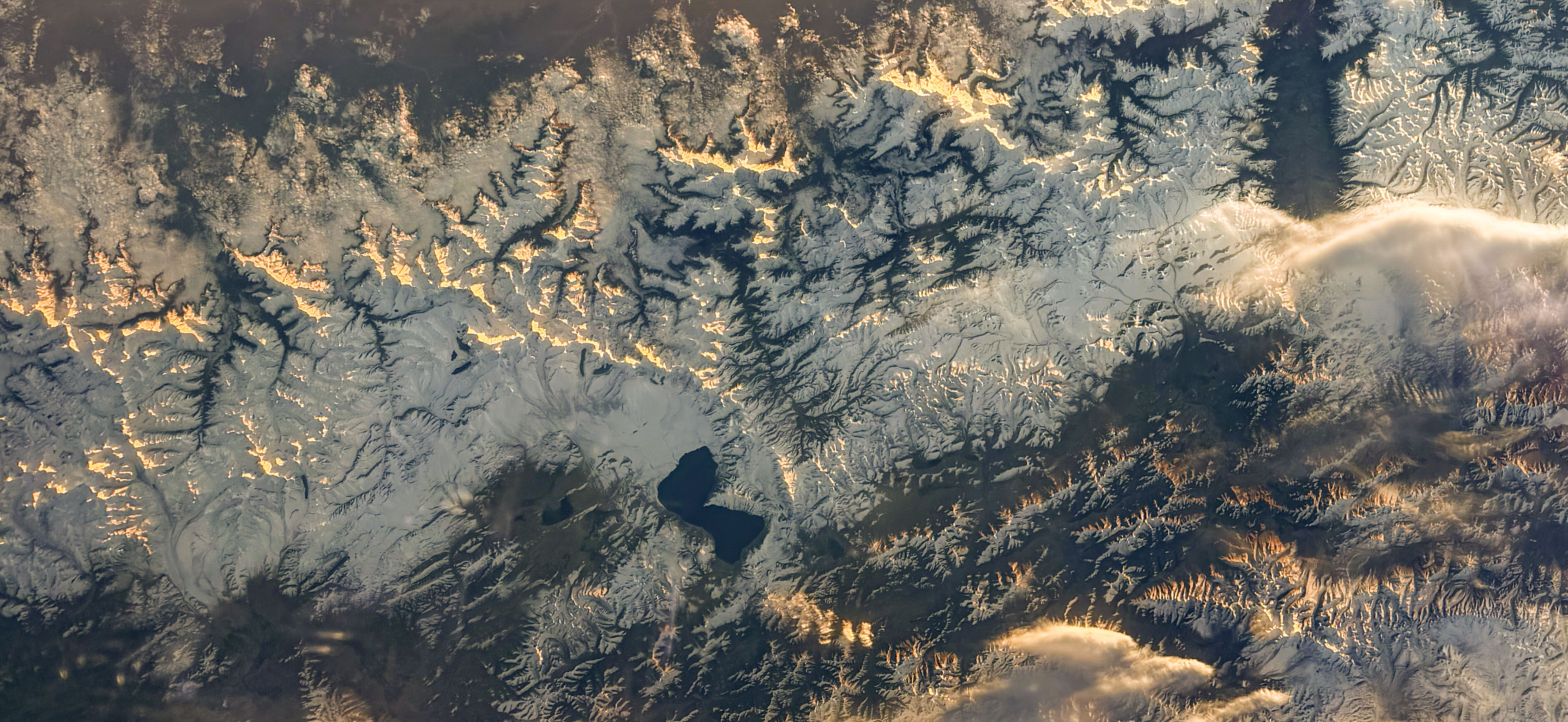
This is a single-sentence photo caption from NASA's image galleries: the International Space Station passed over Asia, an astronaut pointed a camera at the Himalayas, and Lake Pelku appeared near the center of the frame. Nepal on one side, China on the other, snow-capped peaks all around. That is the entire informational payload. There is no story here in the journalistic sense — no data, no trend, no argument, no discovery. The image was filed under "Climate & Energy" but the caption contains nothing about climate, energy, glaciology, hydrology, or any scientific observation whatsoever. It is a photograph with a geographic label. As orbital photography goes, the Himalayas from ISS altitude are reliably spectacular. The perspective — looking down at the highest mountain range on Earth from above — inverts the human experience of those peaks in a way that never quite gets old. Lake Pelku itself, a high-altitude saline lake on the Tibetan Plateau at roughly 4,590 meters elevation, sits in one of the most geologically active and climatically sensitive regions on the planet. But none of that context is supplied by the source material. What we have is a caption that could be a tweet: here is a lake, here is where it is, here is what was flying over it. The classification as "Climate & Energy" content is generous to the point of misleading — there is no climate data, no energy data, no measurement of any kind. The honest assessment: this is a beautiful image doing no analytical work. It exists to remind you that the ISS is up there and that Earth looks extraordinary from 400 kilometers. That is a worthy thing. It is not a worthy article. For the reader who wants to understand what Lake Pelku actually tells us about Himalayan glacier retreat, Tibetan Plateau warming, or high-altitude lake dynamics, this caption provides exactly zero entry points. The science exists — Pelku Tso has been studied for its shrinking glacial inputs and rising temperatures — but none of it is here. What remains is an astronaut photograph of genuine beauty and no analytical substance. We score it as a cultural artifact — a piece of visual media — because that is what it actually is.
Worth reading?
SKIP
Score
20
/100
Unless you are specifically searching for ISS photographs of the Tibetan Plateau, there is nothing here that a Google Earth screenshot wouldn't give you with more context.
Cultural Placement
Like an Ansel Adams landscape stripped of the darkroom craft and compositional intentionality — a point-and-shoot from the most expensive tripod ever built. Sits in the tradition of NASA's 'Image of the Day' gallery alongside Chris Hadfield's ISS photography and the Apollo Earthrise shot, but without any of the narrative framing or scientific context that elevates the best orbital imagery from screensaver to document. More comparable to a stock photo with provenance than to deliberate visual storytelling.
Honest assessment
This is a photo caption miscategorized as a Climate & Energy article. The image itself is fine — the Himalayas from orbit are always worth a glance — but the presentation adds zero informational, scientific, or narrative value. It's content filler, not content.
What Is NOVEL?
20
/ 100
BedrockNews applies a structured analytical framework called NOVEL to cultural works — games, books, film, music, and more.
How NOVEL worksNerve
0/5
Originality
1/5
Voice
1/5
Endurance
1/5
Lineage
2/5
What did the artist risk? What could have failed?
Zero risk. An astronaut pointed a camera out a window at the Himalayas. The caption adds no interpretation, no argument, no framing that could fail.
Verified Facts (2)
Lake Pelku (near center), on the Chinese side of the snow-capped Himalayas with Nepal on the adjacent side
Pictured from the International Space Station as it orbited above Asia
More latest news
Read all