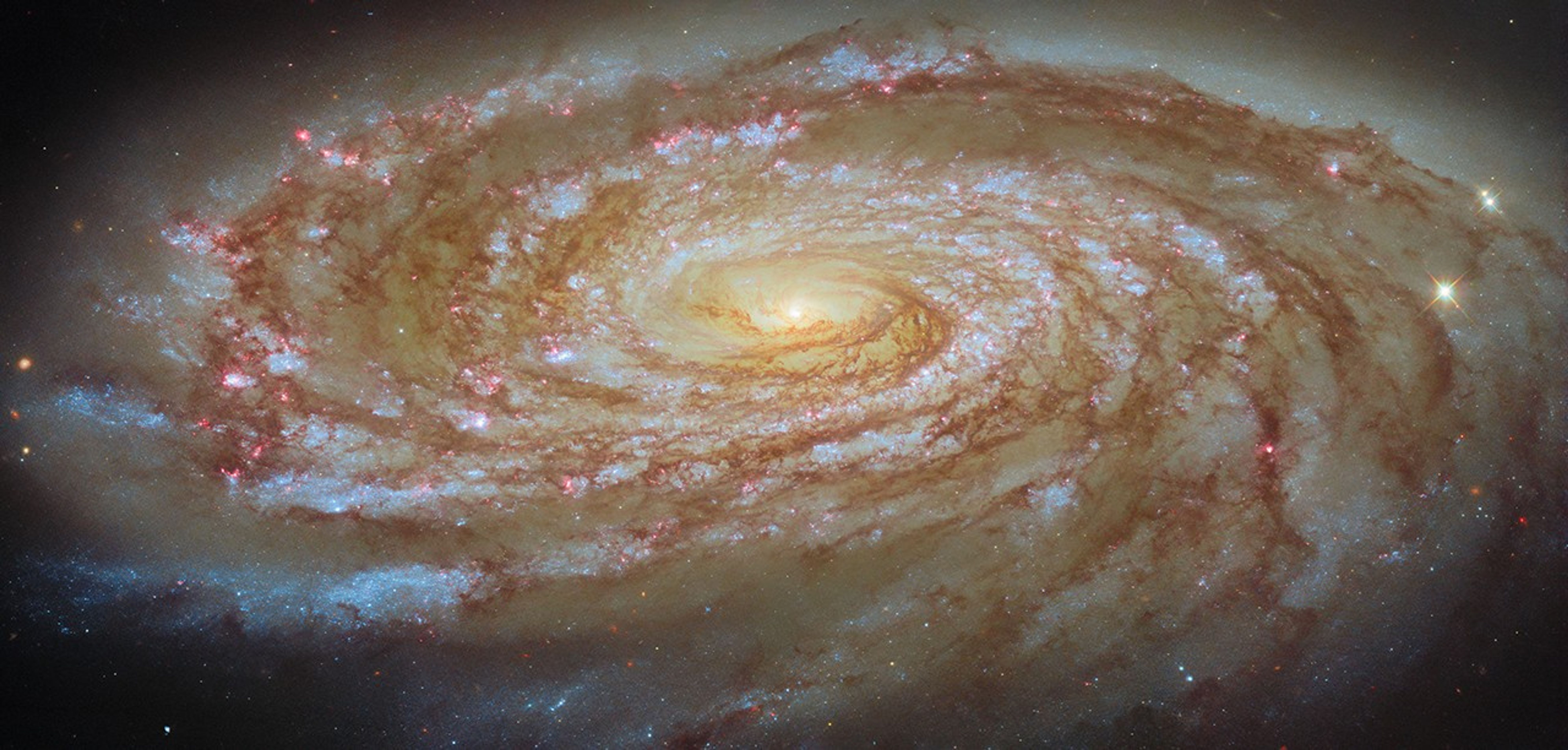
This is a portrait of a galaxy in transit. Messier 88, captured by the Hubble Space Telescope and released May 29, 2026, sits 63 million light-years away in the constellation Coma Berenices — close enough to resolve individual spiral arms, far enough that the light you're seeing left before humans had agriculture. The headline feature isn't the spiral structure, which is textbook-gorgeous. It's the engine at the center: a supermassive black hole estimated at 100 million solar masses, actively feeding on gas and dust. That feeding process — accretion — powers outflows of gas from the galaxy's core, making M88 what astronomers classify as an "active galaxy." The black hole isn't sitting quietly. It's reshaping its host from the inside. The title "Journey to the Center of the Virgo Cluster" points to M88's larger story. This galaxy is falling inward toward the gravitational center of the Virgo Cluster, the nearest large galaxy cluster to our own Local Group. That infall has been happening for hundreds of millions of years and will continue for hundreds of millions more. Along the way, ram pressure from the cluster's hot intergalactic medium is likely stripping gas from M88's outer edges — a slow-motion disassembly that will eventually starve the galaxy of the raw material it needs to form new stars. What makes this image worth pausing on is the tension between two timescales. The black hole operates on scales of years to millennia — actively accreting, blasting outflows. The cluster infall operates on scales of hundreds of millions of years. You're looking at a galaxy being shaped by forces operating at radically different speeds, and Hubble caught it in a single frame. The image credit goes to ESA/Hubble & NASA, with principal investigator D. Thilker. It's a reminder that Hubble, now over 36 years in orbit, continues to produce science-grade imagery that no ground-based telescope can match at these wavelengths. The telescope's longevity is itself a quiet engineering triumph. M88 is also cataloged as NGC 4501 — one of Charles Messier's original 110 objects, first spotted in 1781. That a comet-hunter's nuisance catalog from the 18th century still organizes how we talk about galaxies says something about the durability of good observational frameworks.
Worth reading?
OPTIONAL
Score
48
/100
Amateur astronomers, space-photography enthusiasts, and anyone who finds genuine awe in well-contextualized deep-space imagery. Skip if you need narrative or novelty from your science content.
Cultural Placement
Like the best Astronomy Picture of the Day entries but with NASA's institutional framing — closer to the contemplative pacing of Terrence Malick's cosmic sequences than to pop-science clickbait. The tradition here is Hubble Heritage imagery: photographs that function simultaneously as data products and as secular icons of scale. Think the Pillars of Creation or the Hubble Deep Field — images that changed how non-astronomers think about the universe. M88 sits in that lineage without reaching for the same iconic status; it's a solid mid-catalog entry, not a career-defining shot.
Honest assessment
A solid, well-framed Hubble release that delivers exactly what the format promises: a beautiful galaxy image with enough scientific context to make you think about timescales. It's not trying to be more than that, and it succeeds at what it attempts. Best consumed as a 90-second pause in your day, not as a destination.
What Is NOVEL?
48
/ 100
BedrockNews applies a structured analytical framework called NOVEL to cultural works — games, books, film, music, and more.
How NOVEL worksNerve
1/5
Originality
2/5
Voice
3/5
Endurance
3/5
Lineage
3/5
What did the artist risk? What could have failed?
Low risk. This is Hubble doing what Hubble does — point at a known Messier object, image it beautifully, release with context. No formal or conceptual gamble here.
Verified Facts (6)
Messier 88 (M88), also known as NGC 4501
located about 63 million light-years away in the constellation Coma Berenices
black hole is around 100 million times as massive as the Sun
powering outflows of gas from the galaxy's center
NASA/ESA Hubble Space Telescope image released on May 29, 2026
Image credit: ESA/Hubble & NASA, D. Thilker
More latest news
Read all