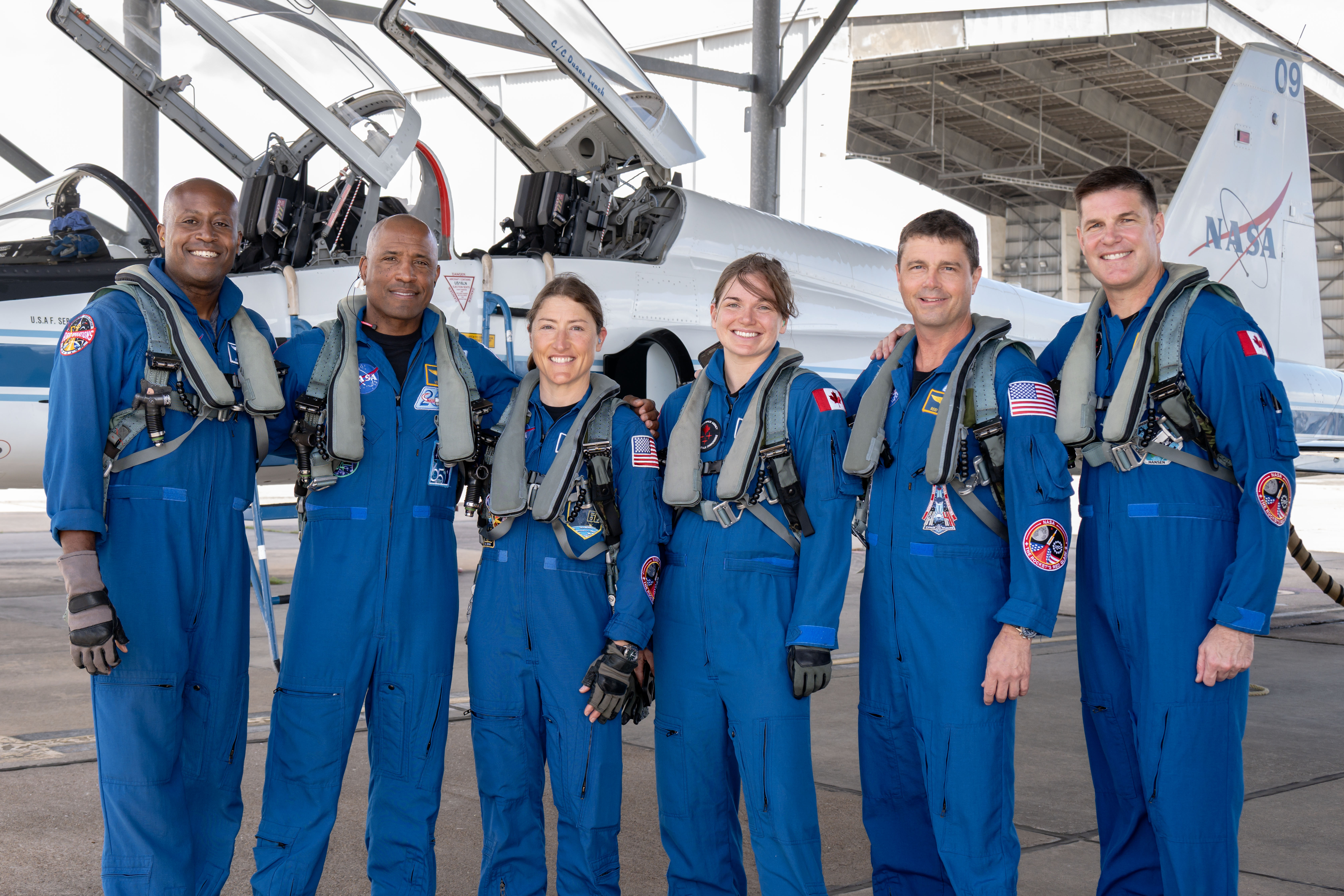
Six astronauts from two space agencies stood together for a photograph on March 27, 2026, before the Artemis II crew proceeded to a media event. From left to right: NASA astronauts Andre Douglas, Victor Glover, and Christina Koch; Canadian Space Agency astronaut Jenni Gibbons; NASA astronaut Reid Wiseman; and CSA astronaut Jeremy Hansen. The composition of this crew photo tells you something about how Artemis differs from Apollo. Two Canadian astronauts stand alongside four Americans — a structural feature of the Artemis program's international architecture, not a courtesy. Canada's contribution to the Lunar Gateway station, the Canadarm3 robotic system, bought CSA seats on lunar missions. Hansen and Gibbons are there because Canada built something NASA needs. Victor Glover, if he proceeds as part of the mission crew, would become the first Black astronaut on a lunar mission. Christina Koch, who co-performed the first all-female spacewalk in 2019 and holds the record for the longest single spaceflight by a woman (328 days), would be the first woman on a lunar trajectory. These aren't symbolic gestures — they're the natural result of a crew selection pipeline that's been widened over decades. Reid Wiseman commands the mission. A Navy test pilot and ISS veteran, Wiseman represents the traditional astronaut archetype — but his crew around him represents how far the definition has expanded. Andre Douglas, an engineer with a background in coast guard service, rounds out the NASA contingent. The photo itself is a genre piece — the pre-mission crew portrait, a tradition stretching back to Mercury. What changes is who's in the frame. The last time humans posed for a lunar mission sendoff, it was December 1972: three white American men. This photo has six people, two nationalities, and a crew that looks meaningfully different from any that came before it. The media event that followed this photo is part of the public engagement architecture that Artemis has built more deliberately than Apollo ever did. NASA learned from the shuttle era and the ISS that public attention is a resource that requires active maintenance. The sendoff isn't incidental to the mission — it's part of how the mission justifies its continued funding.
Worth reading?
OPTIONAL
Score
58
/100
What Is What to Watch?
What to Watch highlights the specific signals, decisions, or events that will determine which direction this story goes next.
About GRINARTEMIS II MISSION
Artemis II mission timeline and launch window — whether the crew proceeds to lunar orbit on schedule
ARTEMIS III CREW
Artemis III crew selection — the landing mission that follows will determine who actually walks on the Moon
CANADA'S LUNAR GATEWAY
Canada's Lunar Gateway contributions — the Canadarm3 development timeline directly affects CSA's continued seat allocation
PUBLIC ENGAGEMENT METRICS
Public engagement metrics — whether Artemis captures sustained attention or follows the pattern of brief excitement followed by indifference that plagued later Apollo missions
Verified Facts (1)
From left to right, NASA astronauts Andre Douglas, Victor Glover, and Christina Koch, CSA (Canadian Space Agency) astronauts Jenni Gibbons, NASA astronaut Reid Wiseman, and CSA astronaut Jeremy Hansen pose for a photo before the Artemis II crew proceed to a media event on March 27, 2026
Solution Focus (4)
Six astronauts from NASA and CSA together — Canada's inclusion reflects a hardware-for-seats exchange (Canadarm3 for crew positions), not a symbolic gesture
Victor Glover and Christina Koch would mark historic firsts for Black astronauts and women on lunar missions
The 53-year gap since the last crewed lunar mission sendoff (Apollo 17, December 1972) makes this photo a generational marker
The crew mix — Navy test pilot commander, engineer, record-holding spacewalker, two Canadian astronauts — shows how the astronaut pipeline has structurally changed
Community Actions (4)
Artemis II mission timeline and launch window — whether the crew proceeds to lunar orbit on schedule
Artemis III crew selection — the landing mission that follows will determine who actually walks on the Moon
Canada's Lunar Gateway contributions — the Canadarm3 development timeline directly affects CSA's continued seat allocation
Public engagement metrics — whether Artemis captures sustained attention or follows the pattern of brief excitement followed by indifference that plagued later Apollo missions
More latest news
Read all