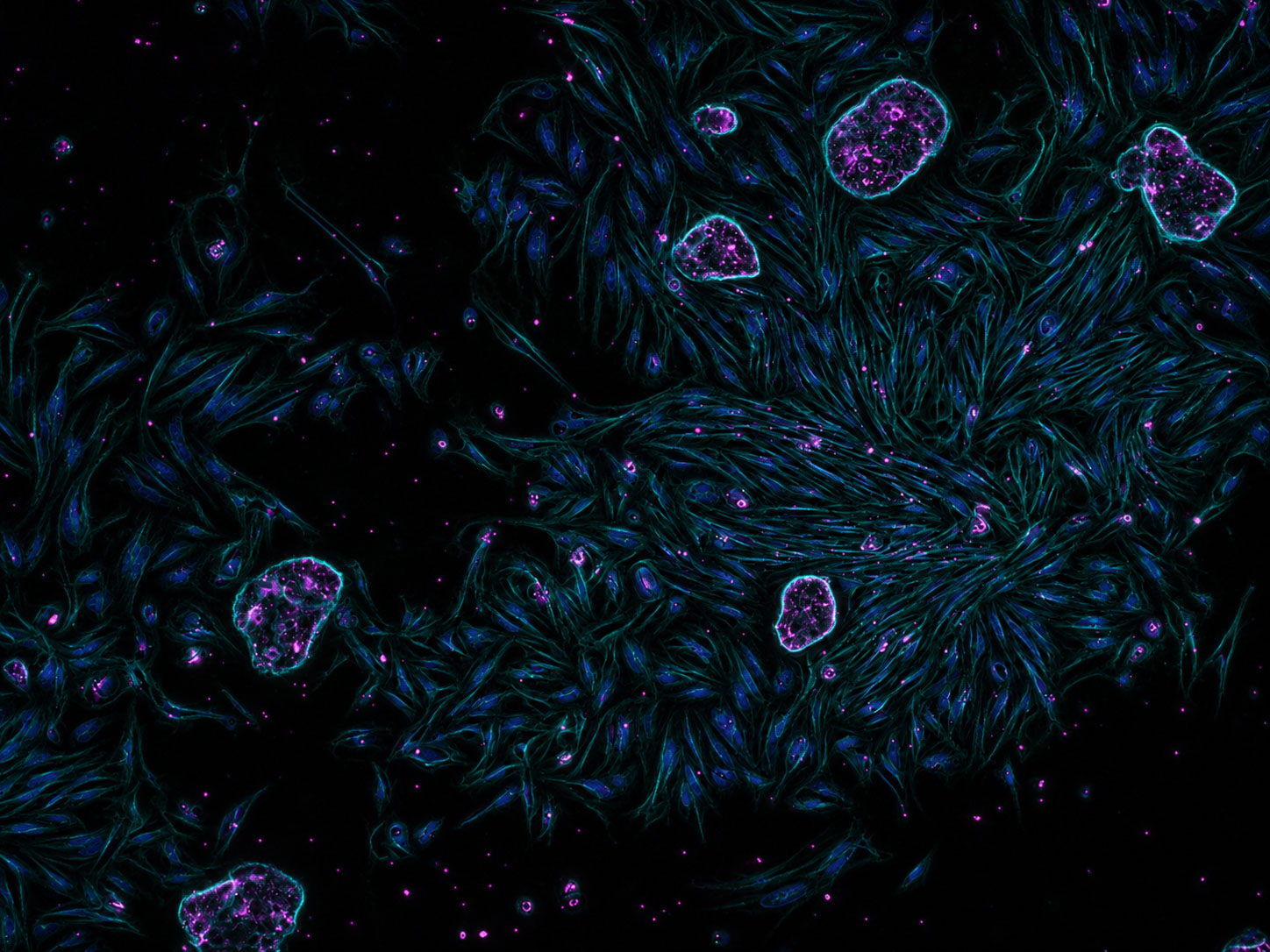
Imagine you're trying to understand how a crowd moves through a city, but you can only watch from directly above — everyone looks like dots on a flat map. You can see who clusters together, but you can't tell who's pushing, who's climbing over whom, or how the architecture of the streets channels movement. Now imagine you could float a camera at every angle simultaneously. That's the core mechanism shift of microgravity cancer research: removing the gravitational force that pins cells flat against culture dishes on Earth, letting them organize, migrate, and interact in three dimensions that more closely mimic conditions inside a human body. The Encapsulate-1 investigation, conducted aboard the International Space Station, studies patient-derived tumor samples — not immortalized cell lines, but cells taken from actual patients — to better understand how cancer cells move and interact in microgravity. The committed claim: microgravity provides a uniquely informative environment for observing tumor cell behavior that is obscured or distorted by Earth-based culture conditions. This is not a therapeutic claim. It is a tool-and-observation claim — that the ISS environment reveals cellular dynamics you cannot see in a standard lab. The ladder here is tricky. Ground-based 3D culture systems — organoids, spheroids grown in Matrigel, rotating wall vessels, microfluidic chips — have been advancing rapidly. These tools already give researchers partial access to 3D tumor behavior without leaving the planet. The honest question Encapsulate-1 must answer is whether true microgravity reveals behaviors that these increasingly sophisticated Earth-based 3D systems miss, or whether the ISS is an expensive redundancy. Previous spaceflight cell biology experiments (from both NASA and JAXA) have shown altered gene expression, changed proliferation rates, and modified cell-cell adhesion in microgravity — but quantifying the delta over modern 3D culture remains an open comparison. Architecturally, this sits in the family of observational cell biology experiments using spaceflight as an environmental perturbation. The method leans on the hardware property of sustained microgravity (~10⁻⁶ g) over days to weeks — something no ground simulator perfectly reproduces. The use of patient-derived samples rather than standard cell lines is a meaningful design choice: it trades reproducibility for clinical relevance, betting that tumor heterogeneity matters more than experimental tidiness. Integrity is the dimension where space biology has historically struggled. Sample sizes are tiny — ISS payload constraints mean you're often running single-digit biological replicates. Controls must be carefully matched on the ground, and the logistics of launch, culture maintenance, fixation, and return introduce variables that don't exist in a bench experiment. Whether Encapsulate-1's validation regime can overcome these inherent constraints is the question. NASA's track record on publishing spaceflight biology data through GeneLab (their open-access repository) is a genuine strength — data sharing norms in this niche are better than many Earth-based fields. The milestone to watch is whether microgravity observations lead to a specific, testable mechanistic insight about metastasis — say, identifying a migration pathway or cell-cell interaction pattern — that is then validated in ground-based models and eventually in animal or clinical studies. The gap between "interesting observation in space" and "this changed how we treat cancer" remains enormous. No spaceflight cancer experiment has yet crossed that bridge. The obvious successor experiment the team likely wants to run: comparative transcriptomics between ISS-cultured patient tumors and matched organoids grown in the best available ground-based 3D systems, head-to-head. The honest read on why it probably hasn't happened yet is logistics and cost — the payload, launch, and analysis pipeline for even one ISS experiment is so resource-intensive that designing a properly powered comparison study against ground controls is a multi-year, multi-mission undertaking. They're building the foundation first.
The analogy
Like trying to understand crowd dynamics from a top-down drone vs. floating cameras at every angle. Gravity pins cells flat in a dish the way a bird's-eye view flattens a 3D crowd into dots — microgravity removes that compression, letting you see the pushing, climbing, and channeling you'd otherwise miss.
Crowd from above
Overhead drone flattens 3D crowd movement into 2D dot patterns, hiding vertical interactions
Tumor in μg
Microgravity removes gravitational flattening of cell cultures, revealing 3D migration and interaction patterns
Honest assessment
Encapsulate-1 is a well-motivated early-phase experiment that bets patient-derived tumor samples in true microgravity will reveal migration and interaction dynamics invisible in ground labs. The core challenge is that modern 3D culture has narrowed the gap, and tiny ISS sample sizes make it hard to prove the delta. This matters to space biology researchers and cancer biologists interested in novel observation platforms — but it is years away from clinical relevance, and the honest answer to 'does this change anything today?' is no.
What Is CLAIMS?
43
/ 100
BedrockNews applies a structured analytical framework called CLAIMS to academic papers and technical research releases.
How CLAIMS worksClaim
2/5
Ladder
1/5
Architecture
3/5
Integrity
2/5
Milestone
2/5
Successor
3/5
What is this paper actually committing to?
Tool-and-observation claim, not therapeutic. Patient-derived samples in microgravity push clinical relevance, but the core idea (cells behave differently in space) is well-established. Incremental advance on a known template.
The field fight
Does true microgravity reveal tumor biology that modern ground-based 3D culture systems cannot?
Side A
Organoids, microfluidics, and rotating wall vessels now approximate 3D conditions well enough — ISS experiments are too expensive and low-N to advance cancer biology meaningfully
Held by: Ground-based 3D culture community, organ-on-chip researchers
Side B
Sustained microgravity removes artifacts that no ground simulator fully eliminates; unique cellular behaviors emerge only in true freefall
Held by: NASA space biology, JAXA cell experiments, Encapsulate-1
Milestone tracker
Unlocks: First causal link between a microgravity-identified mechanism and a clinically actionable cancer biology insight
Current
observation
phase
Encapsulate-1
Next
1
validated pathway
Mechanistic ground confirmation
5-10+ years; depends on ISS access, follow-up funding, and ground validation pipeline
Verified Facts (2)
The Encapsulate-1 investigation studies patient-derived tumor samples aboard the International Space Station
The investigation aims to better understand how cancer cells move and interact in microgravity
Practical Implications (3)
For cancer researchers: microgravity experiments may eventually reveal 3D migration behaviors worth modeling in ground-based organoid or microfluidic systems — treat this as a hypothesis-generating platform, not a results source
For drug developers: no near-term therapeutic implications; the observation-to-treatment pipeline from space biology has never been completed
For space biology: patient-derived samples set a higher bar for clinical relevance than standard cell lines; future ISS biology proposals should follow this precedent
More latest news
Read all