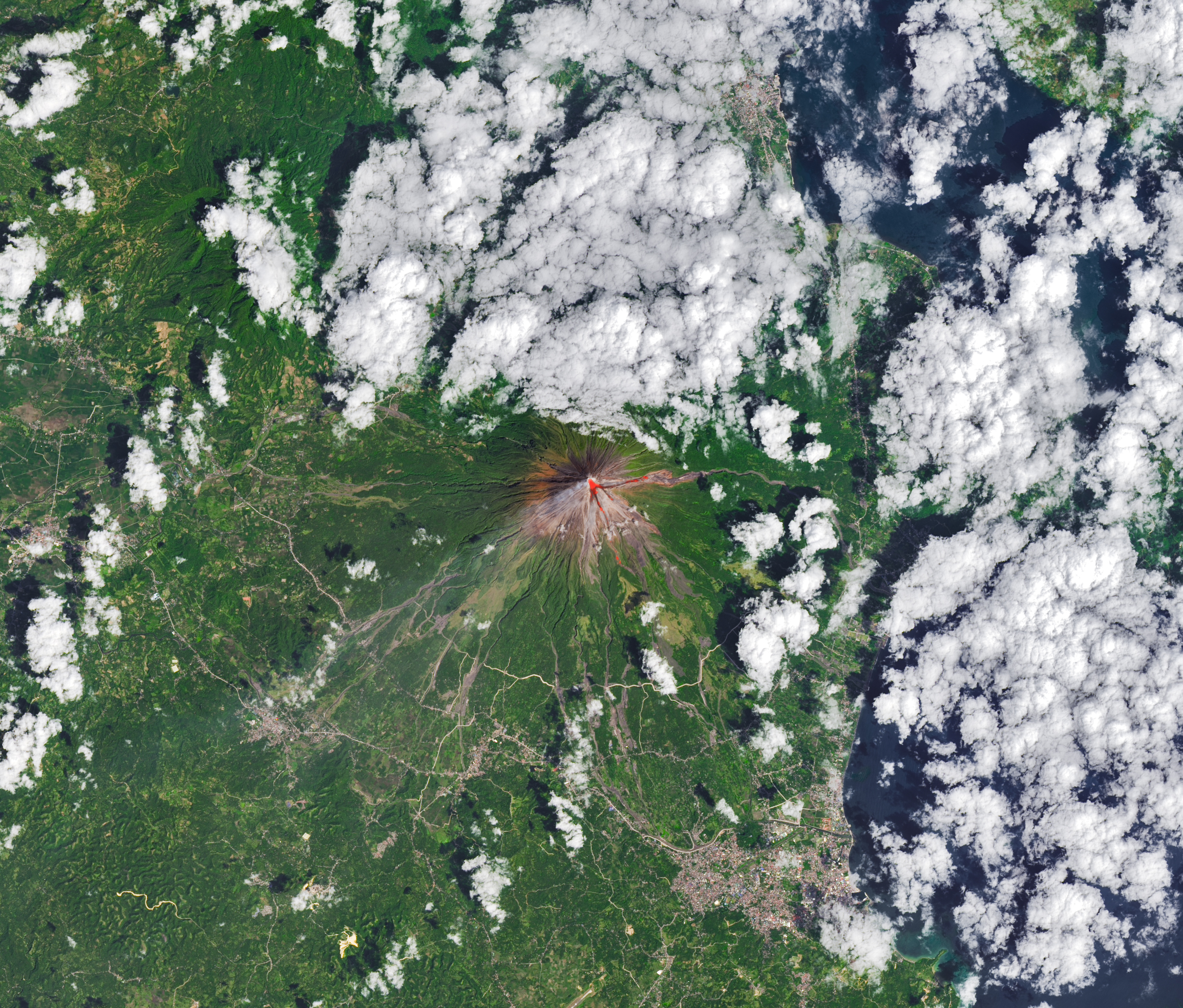
At any given moment, about 20 volcanoes on Earth are actively erupting. Mayon — the most active volcano in the Philippines — is frequently among them. NASA has captured imagery of lava flowing down the volcano, adding another frame to the long-running visual record of one of the planet's most reliably active stratovolcanoes. Mayon sits in Albay province on the island of Luzon, roughly 330 kilometres southeast of Manila. Its near-perfect conical symmetry makes it one of the most visually distinctive volcanoes on Earth and a fixture of Philippine geography and culture. It has erupted more than 50 times since records began in 1616, with major destructive events in 1814, 1897, 1984, and 2018. The 1814 eruption buried the town of Cagsawa, leaving only a church bell tower visible above the volcanic debris — a site that remains one of the most visited landmarks in the Bicol region. The source content here is minimal — a NASA image caption noting the lava flows and Mayon's status as the country's most active volcano. There is no indication of alert level changes, evacuations, or unusual activity. This appears to be observational documentation rather than crisis reporting. What makes Mayon persistently interesting to volcanologists is its regularity. Unlike volcanoes that go dormant for centuries and then erupt catastrophically, Mayon releases pressure frequently, producing lava flows, pyroclastic density currents, and lahars (volcanic mudflows triggered by rain mixing with ash deposits) on a recurring basis. This pattern means the surrounding population — Albay province has over 1.3 million residents — lives in a state of perpetual negotiation with the volcano: farming its fertile slopes during quiet periods, evacuating during escalations, returning when alert levels drop. The roughly 20 volcanoes erupting at any given moment is a useful baseline number for understanding Earth's volcanic activity. The Smithsonian Institution's Global Volcanism Program tracks this figure, and it has remained remarkably stable over the decades of modern monitoring. It's a reminder that the planet's geological processes operate on their own schedule, indifferent to news cycles.
Worth reading?
SKIP
Score
35
/100
What Is What to Watch?
What to Watch highlights the specific signals, decisions, or events that will determine which direction this story goes next.
About GRINPHIVOLCS ALERT LEVEL
The Philippine Institute of Volcanology and Seismology sets Mayon's alert level on a 0-5 scale. Any change from the current level would signal whether this activity is routine or escalating toward a major event.
LAHAR SEASON
The Philippine rainy season (June-November) transforms volcanic ash deposits into destructive lahars. Watch for rainfall patterns in Albay province — rain on fresh deposits is when Mayon's eruptions become most dangerous to downstream communities.
GLOBAL ERUPTION COUNT
The Smithsonian's Global Volcanism Program maintains the running tally of active eruptions worldwide. Significant deviations from the ~20 baseline would be noteworthy for volcanology and climate science.
Verified Facts (2)
At any given moment, about 20 volcanoes on Earth are actively erupting
Mayon—the most active volcano in the Philippines
Solution Focus (3)
The baseline statistic: roughly 20 volcanoes are erupting on Earth at any given moment, and Mayon is frequently one of them
Mayon is the most active volcano in the Philippines, with 50+ recorded eruptions since 1616
NASA Earth observation imagery contributes to the ongoing monitoring record of persistently active volcanoes
Community Actions (3)
The Philippine Institute of Volcanology and Seismology sets Mayon's alert level on a 0-5 scale. Any change from the current level would signal whether this activity is routine or escalating toward a major event.
The Philippine rainy season (June-November) transforms volcanic ash deposits into destructive lahars. Watch for rainfall patterns in Albay province — rain on fresh deposits is when Mayon's eruptions become most dangerous to downstream communities.
The Smithsonian's Global Volcanism Program maintains the running tally of active eruptions worldwide. Significant deviations from the ~20 baseline would be noteworthy for volcanology and climate science.
More latest news
Read all