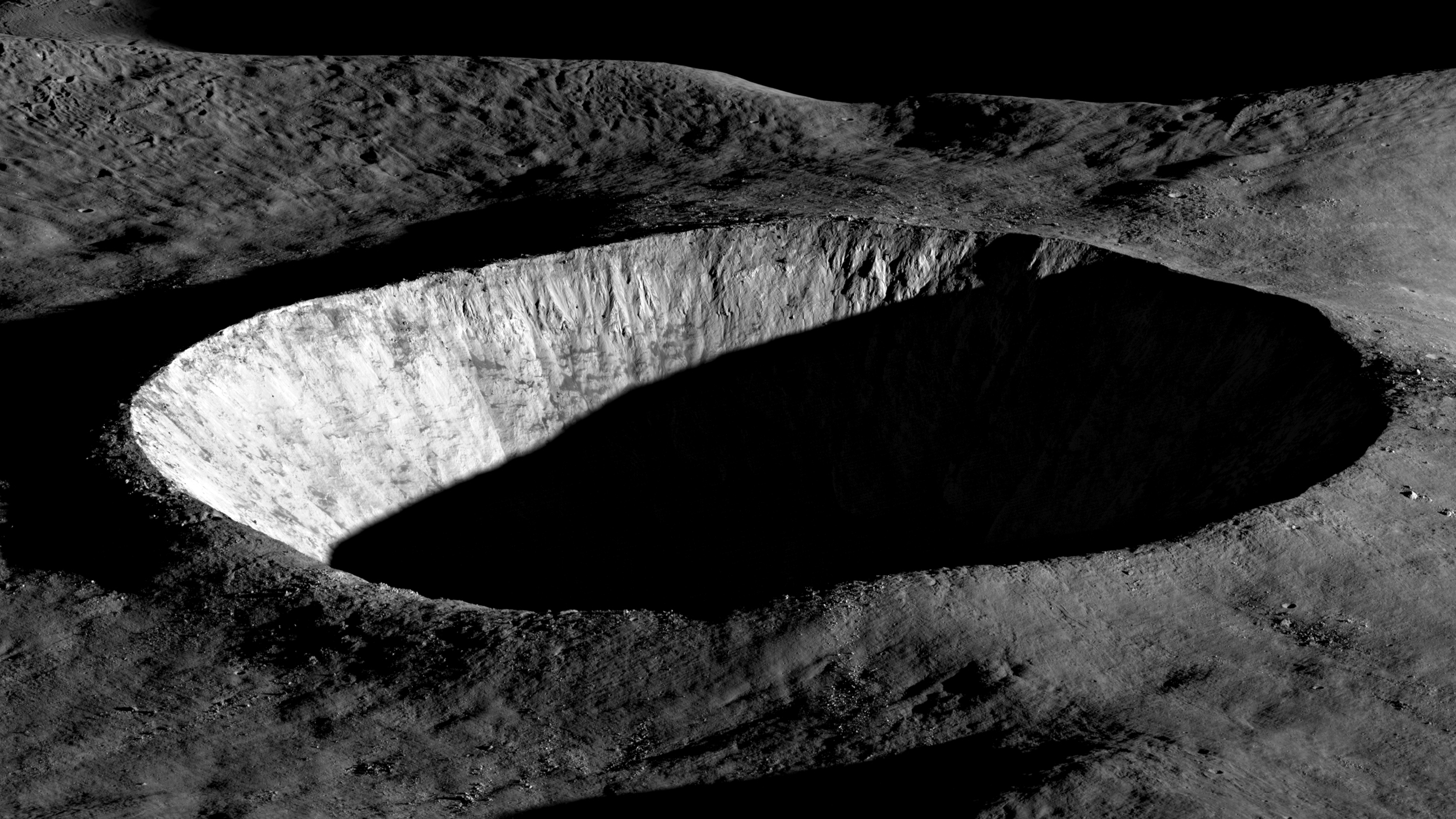
The Lunar Reconnaissance Orbiter Camera captured this image on August 30, 2023: early morning sunlight illuminating the western wall of an unnamed crater on the Moon, with deep shadows pooling on the ground and across the interior. That's it. That's the entire content. And it's enough. The image belongs to a genre that NASA has quietly perfected over the LRO mission's fifteen-plus years in lunar orbit — the single striking photograph released with a caption short enough to fit on a postcard. No science paper, no mission update, no policy context. Just light hitting rock in a place where no atmosphere scatters it, no weather softens it, and no human has ever stood. What makes these images worth pausing for is the lighting. The Moon has no atmosphere to diffuse sunlight, so the boundary between illumination and shadow is absolute — a knife edge. When the Sun is low on the lunar horizon, as it is here at local dawn, that knife edge turns every crater wall into a study in high-contrast geometry. The western wall is brilliantly lit; everything behind it is black. There is no twilight on the Moon. There is no gradual transition. There is light, and there is not-light. The crater is unnamed, which means it is one of millions. The Moon's surface is saturated with impact craters at every scale, from basin-sized scars thousands of kilometres across to pits smaller than a footprint. Most will never be named. The LRO has photographed the lunar surface at resolutions down to 0.5 metres per pixel, producing a dataset of the Moon's topography more detailed than most maps of Earth's ocean floor. This image is one frame from that ongoing atlas. NASA titled it 'Good Morning, Moon.' The title does what NASA's best public communications do: it makes the alien feel domestic. A greeting. A moment of recognition. The Sun rises on the Moon as it rises everywhere in the solar system — indifferent, reliable, and, if you happen to have a camera in orbit, very good at its job.
Worth reading?
OPTIONAL
Score
50
/100
What Is What to Watch?
What to Watch highlights the specific signals, decisions, or events that will determine which direction this story goes next.
About GRINNASA'S ARTEMIS PROGRAM
NASA's Artemis program lunar surface missions, which will produce ground-level photography of terrain that LRO has only mapped from orbit
LRO'S CONTINUED OPERATION
LRO's continued operation — the spacecraft has been in lunar orbit since 2009 and continues to produce science data and imagery
Verified Facts (2)
Early morning sunlight illuminates the western wall of this unnamed crater, leaving deep shadows on the ground and in the interior
The image was taken on August 30, 2023, by LROC (Lunar Reconnaissance Orbiter Camera)
Solution Focus (2)
The absolute light-shadow boundary created by the Moon's lack of atmosphere produces a visual drama that no terrestrial photograph can replicate — the western crater wall is fully illuminated while the interior is pitch black
The crater is unnamed, one of millions, captured by LROC at resolutions down to 0.5 metres per pixel as part of an ongoing lunar atlas
Community Actions (2)
NASA's Artemis program lunar surface missions, which will produce ground-level photography of terrain that LRO has only mapped from orbit
LRO's continued operation — the spacecraft has been in lunar orbit since 2009 and continues to produce science data and imagery
More latest news
Read all