Get it
AMPERE Challenge
on NASA Tech Maturation
TOTAL PRIZE POOL
$500K
WINNERS SELECTED
2
PROPELLANT EFFICIENCY
10×
REG DEADLINE
Jan 27 '27
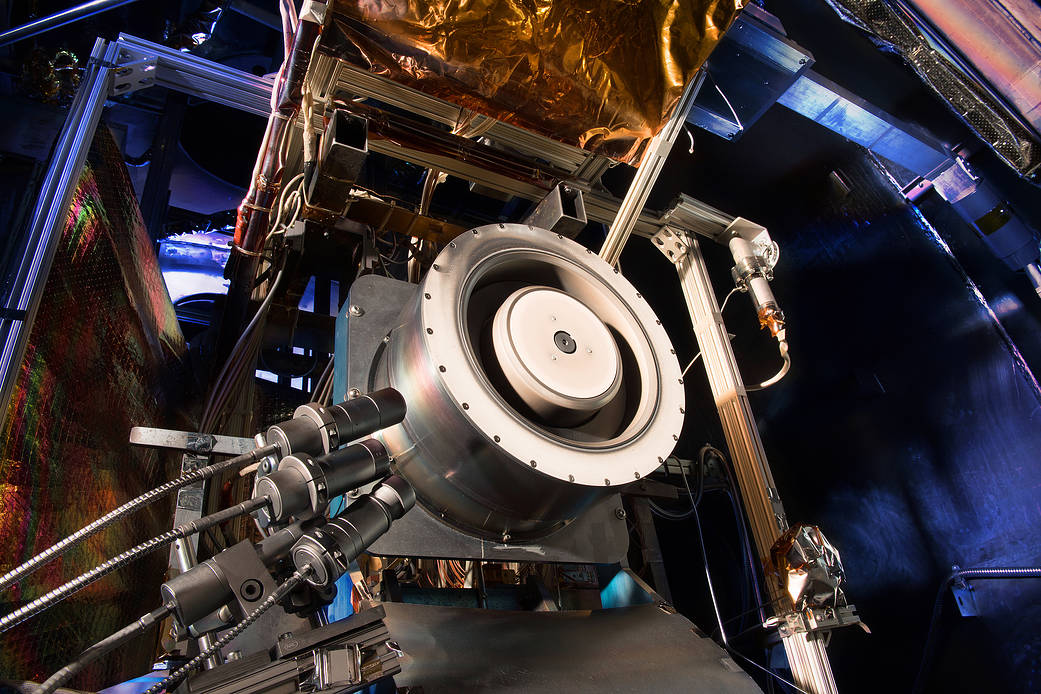
NASA has launched the Advanced Mid-Power Electric Rocket (AMPERE) Challenge, a three-phase competition inviting U.S. companies to build prototypes of mid-power Hall effect thrusters — electric propulsion systems that use an electric field to accelerate propellant gas, producing efficient thrust for long-duration satellite and deep-space missions. Hall thrusters use roughly one-tenth the propellant of equivalent chemical rockets, making them essential hardware for any serious cislunar or deep-space logistics architecture.
Extraction Map
The prize pool is $500,000, split between two winners at $250,000 each. That number is not meant to fund development — it is seed money attached to something far more valuable: no-cost access to NASA Glenn Research Center's testing facilities, subject matter expertise, and no-cost licensing of NASA-developed krypton-propellant Hall thruster technologies. The real subsidy is infrastructure access, not cash. The competition runs in three phases. Phase 1 is a paper exercise: concept design, manufacturing plan, cost and performance projections. NASA selects up to two winners to advance to Phase 2, where teams build actual prototypes in collaboration with NASA personnel. Phase 3 puts those prototypes through testing at NASA Glenn at no cost to the teams. Registration closes January 27, 2027. AMPERE is the inaugural entry in NASA's Tech Maturation Prize series, a new programmatic vehicle designed to push breakthrough technologies from lab bench to commercial viability. The framing is deliberate: NASA wants to be the customer, not the sole developer. The challenge is managed jointly by NASA Glenn and JPL, funded through the Research and Technology Mission Directorate, and administered by Yet2 through a contract with NASA's Center of Excellence for Collaborative Innovation. The strategic logic is straightforward. NASA and the Department of Defense need mid-power electric propulsion for cislunar operations, orbital transfer vehicles, and deep-space robotic missions. The current supply chain for these systems is thin. By giving two companies free access to its IP and test facilities, NASA is attempting to bootstrap a domestic commercial supplier base — buying down risk for companies that might otherwise not invest in a market with uncertain near-term demand. The krypton propellant detail matters. Most operational Hall thrusters run on xenon, which is expensive and supply-constrained. Krypton is cheaper and more abundant but requires different thruster engineering. NASA has already done some of that engineering work and is now offering it to industry for free — a classic technology transfer play aimed at shifting the propellant economics of the entire sector. Whether $500,000 and lab access is enough to actually create a viable commercial market remains the central question. The prize money is trivial relative to development costs. The real bet is that facility access and IP licensing lower the barrier enough for companies already working in adjacent propulsion spaces to pivot into mid-power Hall thrusters without betting the company.
Worth reading?
RECOMMENDED
Score
76
/100
Generative — NASA is deliberately transferring publicly funded IP and infrastructure access to seed a commercial supply chain it needs, distributing capability rather than concentrating it.
What Is GRIN?
GRIN stands for Generativity, Resilience, Innovation efficiency, and Novelty openness. These four dimensions capture the essential characteristics of any memetic intelligence — whether a nation, a corporation, a religion, or a movement.
About GRINGenerativity
4/5
Resilience
4/5
Efficiency
4/5
Novelty
3/5
Extractive
1/5
Inverted
Does this create new capability or just redistribute existing value?
Genuine capability creation. Free IP licensing and facility access lower barriers for new entrants in a market that barely exists. The goal is a domestic supplier base, not a single vendor.
Verified Facts (10)
NASA's AMPERE Challenge offers $500,000, split between two winning U.S. companies
Hall effect thrusters use an electric field to accelerate a propellant gas
Hall thruster systems use 10 times less propellant than equivalent chemical rockets
Teams can gain early access to NASA-developed Hall effect thruster technologies that use krypton as a propellant through no-cost licensing
Phase 3 prototypes will be tested at NASA Glenn at no cost to the participating teams
AMPERE Challenge is open for registration until Jan. 27, 2027, at 5 p.m. EST
The competition is the first of NASA's Tech Maturation Prize series
AMPERE Virtual Industry Day hosted by NASA on Thursday, Nov. 19
Managed by NASA Glenn and NASA's Jet Propulsion Laboratory in Southern California
Yet2 administers the challenge through a contract with the NASA Center of Excellence for Collaborative Innovation
More latest news
Read all