DRONES / MONTH
1000s
GRANT → COMPANY
~4 yrs
USRC AWARDS
2
AG3 FOUNDED
2024
Gavin Gardner was a Michigan State engineering student when he and his team received a NASA University Student Research Challenge grant in 2021 to build a cargo drone that could hitchhike on city buses. The technical concept — a drone docking on public transit to recharge mid-delivery — was novel enough, but Gardner says the real education was learning to manage budgets, handle large sums, and pitch technical work to non-engineers. That business training, not just the lab hours, is what NASA's USRC is actually selling.
Extraction Map
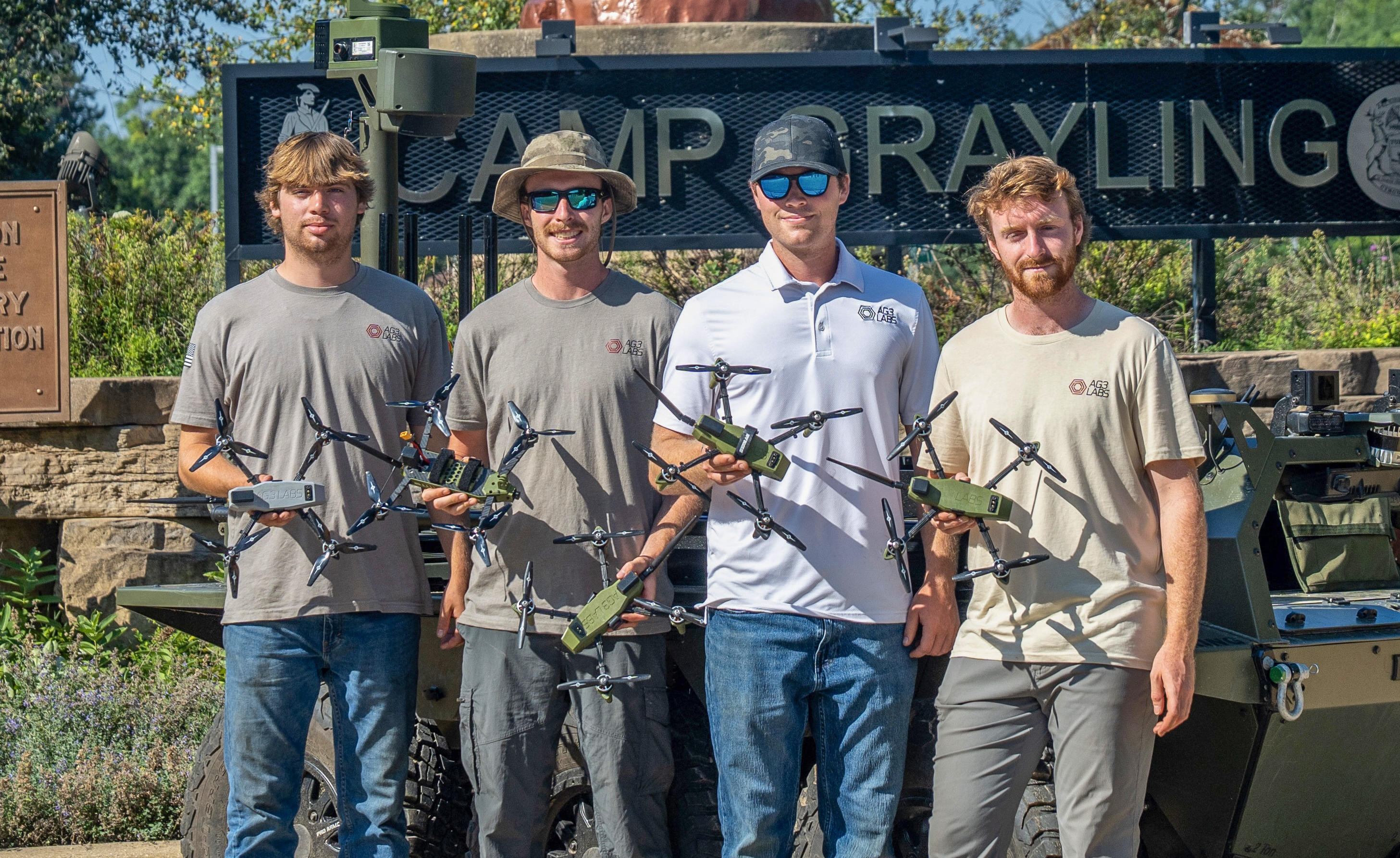
The USRC program is structured around a dual mandate: engineering skill and entrepreneurship. Student teams receive grants and guidance, then must demonstrate both technical execution and the ability to promote and fund their work. Gardner's team proved out two drone concepts across two USRC awards — the bus-riding delivery drone (AIDED) and a laser-powered in-flight charging system (LEADS) — before deciding the commercial drone market's regulatory burden was too steep. The pivot came fast. In late 2024, approaching his master's graduation, Gardner co-founded AG3 Labs with his brother Gryson and other USRC alumni. A friend suggested the military needed low-cost drones for testing counter-drone systems. An initial U.S. Army contract led to more, and AG3 now claims a production capability of thousands of drones per month. The company demonstrated its hardware at a U.S. Army event at Camp Grayling, Michigan. The trajectory is instructive. NASA funded civilian aeronautics research. The students built civilian prototypes. They hit a regulatory wall in the commercial space. They pivoted to military contracts where regulatory friction is lower and procurement budgets are larger. This is not a failure of the program — it is a feature of the broader incentive landscape. Defense contracting remains the path of least resistance for small hardware startups with drone expertise. NASA USRC manager Steven Holz frames the outcome as validation: the program produces future workforce and contributes to aviation industry growth. Gardner credits USRC specifically for the business training — learning to communicate technical work to non-technical audiences and manage money at scale. The internship pipeline also functioned, routing Gardner through NASA Glenn Research Center during graduate school. The numbers that matter here are structural. Gardner's team went from first USRC grant in 2021 to company founding in late 2024 to thousands-per-month drone production in 2025-2026 — roughly four years from student grant to scaled military supplier. That velocity reflects both the program's effectiveness and the military drone market's current appetite. What this story actually demonstrates is that relatively modest public investment in student research can produce functioning companies, but the market those companies serve is shaped by forces far outside NASA's control. The USRC built capability. Where that capability flows — civilian delivery, military training, counter-drone — is determined by which buyers have money and which regulators have fences.
Worth reading?
RECOMMENDED
Score
68
/100
Moderately generative — NASA's grant built real human capital and transferable skills, but the value flowed into military contracting rather than civilian innovation, partly due to regulatory barriers in the commercial drone market.
What Is GRIN?
GRIN stands for Generativity, Resilience, Innovation efficiency, and Novelty openness. These four dimensions capture the essential characteristics of any memetic intelligence — whether a nation, a corporation, a religion, or a movement.
About GRINGenerativity
4/5
Resilience
3/5
Efficiency
3/5
Novelty
3/5
Extractive
1/5
Inverted
Does this create new capability or just redistribute existing value?
Real capability creation: engineering skills, business acumen, and a functioning company emerged from a student grant. Value narrows at the output — military drones, not the civilian aeronautics NASA funded.
Verified Facts (8)
Gardner received first USRC grant in 2021 for AIDED (Aerial Intra-city Delivery Electric Drones)
Second USRC award in 2023 for LEADS (Laser Energized Aerial Drone System)
AG3 Labs co-founded in late 2024 by Gavin Gardner, Gryson Gardner, Matt Atkinson, and Ryan Atkinson
AG3 demonstrated at U.S. Army event at Camp Grayling, Michigan
Production capability enables thousands of drones to be built each month
Gardner graduated spring 2025 with a master's degree from Michigan State
Gardner interned at NASA Glenn Research Center in Cleveland
USRC manager is Steven Holz
More latest news
Read all