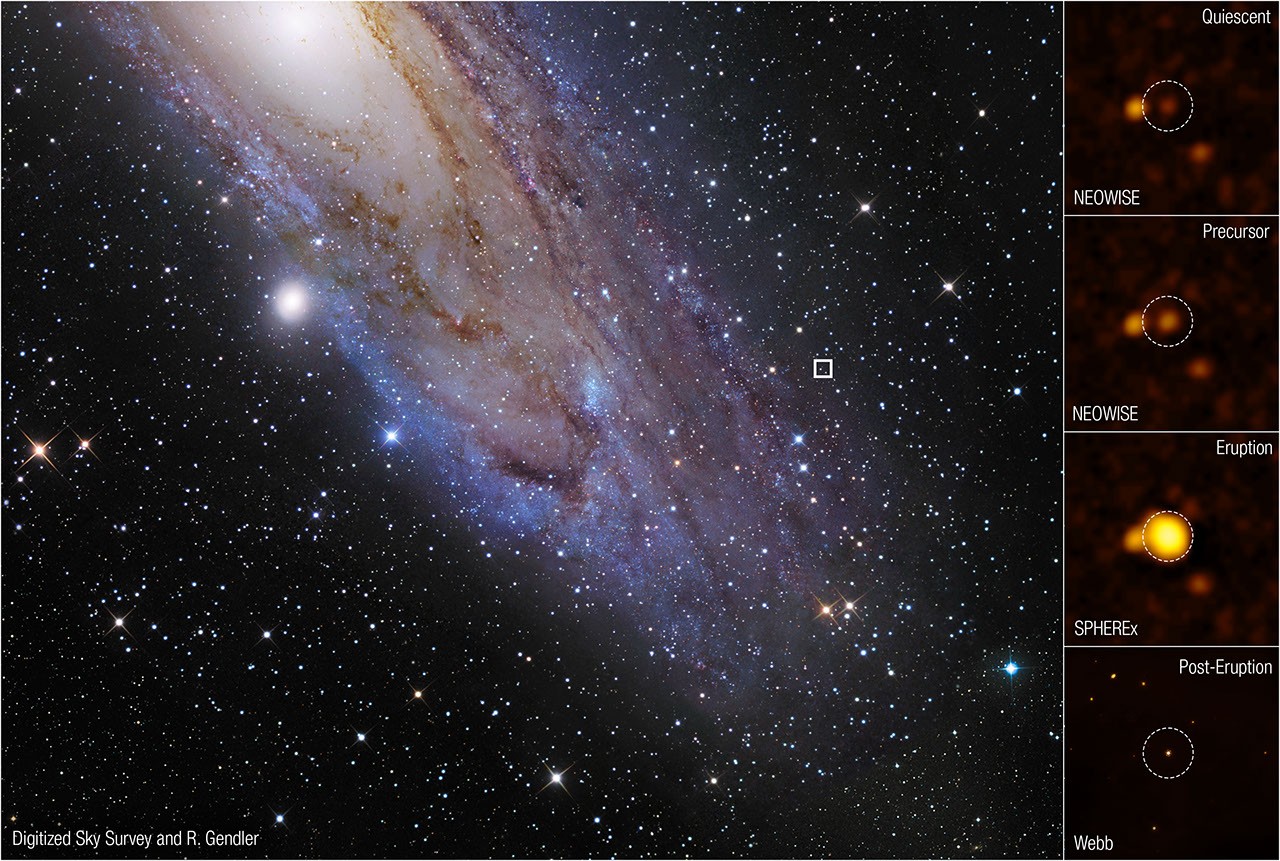
Imagine you've been watching a security camera feed of a quiet parking lot for years. One day, two cars start circling each other. Within seven loops, one slams into the other. You have the footage from before, during, and after. That's what happened here — except the parking lot is the Andromeda galaxy and the cars are stars. The committed claim: researchers observed, in real time, a lower-mass star (~0.7 solar masses) spiral into and merge with a supergiant (~7 solar masses, 350 solar radii) in just seven orbits — roughly seven years — and then caught the aftermath with Webb's mid-infrared instruments only 47 days after the eruption peaked. This is the first time anyone has reconstructed a complete common envelope evolution event from pre-merger brightening through merger to post-merger dust shell, using multi-wavelength data captured as it happened rather than reverse-engineered centuries later. The ladder matters here. Previous stellar merger observations — the classic being V838 Monocerotis in 2002 — involved smaller stars and were caught mid-event without pre-merger baselines. The luminous red nova V1309 Scorpii (2008) provided the first confirmed contact-binary merger, but only for two similar-mass stars with thousands of pre-merger orbits. Bao is structurally different: a massive primary engulfing a much smaller companion in just seven orbits, with pre-merger data from NEOWISE going back to before 2018, real-time monitoring from WINTER and SPHEREx, eruption detection from ZTF, and post-eruption spectroscopy from Swift, Gemini North, and Webb. No previous event had this temporal coverage across this many wavelength regimes. The architecture is observational rather than computational, but the analysis pipeline is worth noting. The team used updated hydrodynamic simulations to match Webb's mid-infrared observations of the dust shell, constraining both stellar masses and the efficiency of common envelope energy transfer. This is the measurement that matters: common envelope efficiency (often parameterized as alpha-CE in binary evolution codes) is the single most uncertain parameter in predicting which binary systems produce neutron stars, black holes, gravitational wave sources, and Type Ia supernovae. Every population synthesis model in the field uses an assumed value. This team measured one directly. Integrity is strong for an observational discovery. The data chain is independently verifiable: NEOWISE archival data is public, ZTF is a public survey, and Webb observations were taken under Director's Discretionary Time (meaning they were fast-tracked but peer-reviewed for scientific justification). The team published a first paper before the eruption occurred, which functions as a kind of natural pre-registration — they identified the system as interesting before the main event happened. The simulation matching is the weakest link: the team is fitting their own models to their own data, and independent groups will need to run competing simulations against the same observations. The milestone is concrete and imminent. NASA's Roman Space Telescope, now operational, will conduct the Galactic Bulge Time-Domain Survey, which should yield many more transient events in this category. The gap isn't technological — it's statistical. One measured alpha-CE value from one system is a data point, not a distribution. The field needs 10-20 such measurements across different mass ratios and evolutionary stages to actually constrain population synthesis models. Roman's survey cadence and infrared sensitivity make it the instrument most likely to deliver them within 5-10 years. The successor experiment the team did not run — and almost certainly could not run — is spectroscopic monitoring of Bao over the next 1-3 years to watch the merged star settle into its new equilibrium configuration. The paper explicitly notes that 'only future observations will identify how its heft settles.' This isn't evasion; the physics literally hasn't happened yet. The more interesting gap is whether anyone will attempt to independently model the common envelope phase with different simulation codes (MESA, Phantom SPH, Athena++) and see if they converge on the same alpha-CE value. That's the real integrity test, and it's probably 1-2 years out as other groups get access to the published data.
The analogy
Imagine you've watched security camera footage of a parking lot for years. Two cars start circling each other. Within seven loops, one slams into the other. You have before, during, and after footage — and for the first time, you can measure the coefficient of friction from the skid marks while they're still fresh. That's what this team did with a stellar merger: caught the whole event in real time and measured the energy transfer efficiency directly, rather than reconstructing it from cold debris centuries later.
Crash footage
Security camera captures two circling cars colliding; skid marks let you measure friction coefficient while fresh
Stellar merger
Multi-wavelength telescopes capture two stars merging in real time; dust shell lets you measure common envelope efficiency while fresh
Honest assessment
This is a genuine first-of-kind observation, not a methods increments paper. The team caught a rare event with the right instruments at the right time and extracted a physically meaningful measurement (common envelope efficiency) that the field has been assuming rather than measuring for decades. The load-bearing element is the pre-eruption paper — it converts a lucky observation into a scientifically rigorous sequence. What would weaken it: if independent simulation codes fitted to the same Webb data produce a substantially different alpha-CE value. Who should care today: anyone working on binary population synthesis, gravitational wave rate predictions, or Type Ia supernova progenitor channels. In 5 years: this becomes the template for how Roman survey data gets analyzed.
What Is CLAIMS?
83
/ 100
BedrockNews applies a structured analytical framework called CLAIMS to academic papers and technical research releases.
How CLAIMS worksClaim
5/5
Ladder
4/5
Architecture
4/5
Integrity
4/5
Milestone
4/5
Successor
4/5
What is this paper actually committing to?
Genuine first. No previous team caught a giant-star common envelope event from pre-merger through eruption to dust shell with this wavelength coverage. The claim is committed and specific.
The field fight
How efficient is common envelope energy transfer (alpha-CE), and can it be measured directly rather than assumed in population synthesis models?
Side A
Alpha-CE must be calibrated from post-CE system demographics and reverse-engineering; direct measurement is impractical
Held by: Population synthesis community (Belczynski, Dominik, et al.)
Side B
Direct real-time observation of CE events can constrain alpha-CE empirically, one system at a time
Held by: Transient survey community (Karambelkar, De, this paper)
Milestone tracker
Unlocks: Reliable predictions of compact binary formation rates — directly impacts gravitational wave event rate forecasts for LIGO/LISA
Current
1
measured alpha-CE
this paper (Bao)
Next
10-20
measured alpha-CE values
constrain population synthesis
~5-10 years via Roman Galactic Bulge Time-Domain Survey
Verified Facts (13)
Primary star was seven times as massive as the Sun, 350 times the radius, and 18,000 times brighter
Companion star was about 0.7 solar masses with a slightly smaller radius than the Sun
Merger occurred after only seven orbits (about seven years)
Webb observed Bao 47 days after the eruption peaked — described as the earliest ever follow-up of such an event
Bao first caught attention in February 2023 via NEOWISE data
Object had consistent luminosity before 2018
WINTER observations in September 2024 showed brightening and dust emission
SPHEREx detected rapid fading in visible light and brightening in infrared in July 2025
Zwicky Transient Facility detected the eruption on Oct. 17, 2025
Webb observations taken on Dec. 24, 2025 under Director's Discretionary Time
Paper published in Nature; first author Viraj Karambelkar, NASA Hubble Fellow at Columbia University
Formal designation is AT 2025abao
Research funded in part by NASA's Astrophysics Data Analysis Program
Practical Implications (4)
Population synthesis models (COMPAS, COSMIC, StarTrack) can now calibrate alpha-CE against at least one empirical data point rather than treating it as a free parameter
LIGO/Virgo/KAGRA gravitational wave rate predictions depend on compact binary formation rates, which depend directly on common envelope efficiency — this constrains that chain
Roman Space Telescope's Galactic Bulge survey pipeline should be designed with rapid-follow-up protocols for transient events matching Bao's pre-eruption brightening signature
Webb DDT rapid-response programs proved their scientific value here and should be maintained as a institutional capability
More latest news
Read all