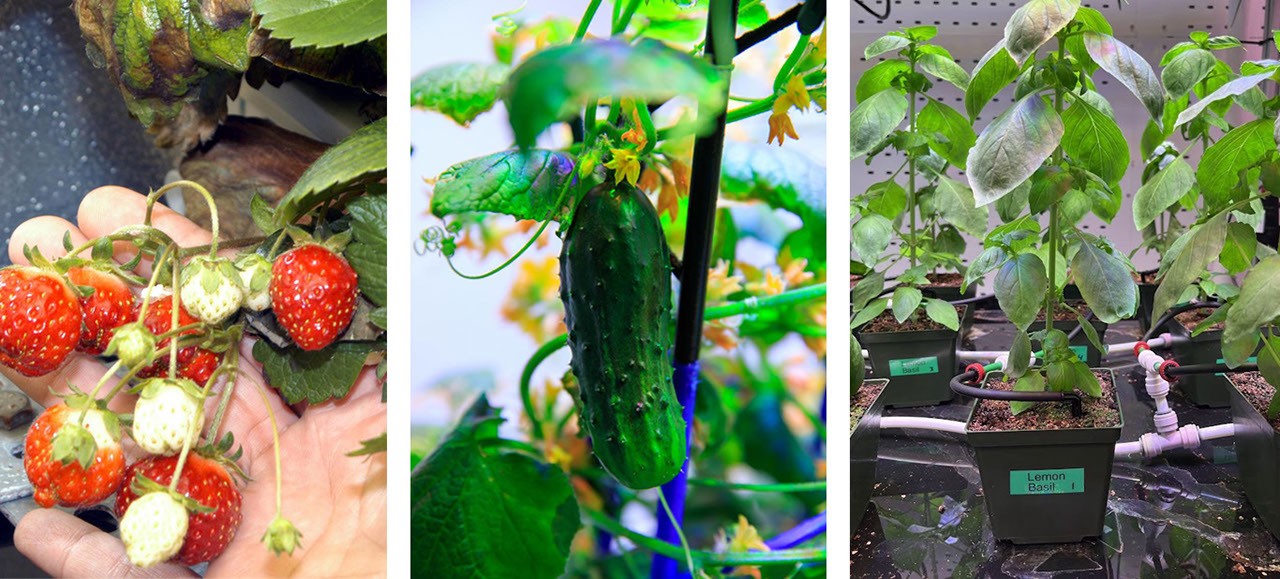
CROP CANDIDATES
3
WILD VS DELIZZ YIELD
2×
GOURD IN SPACE
1st
NEW ISS CHAMBER
1
NASA's Biological and Physical Sciences Division is building a crop pipeline for deep-space missions, testing candidate plants in flight-like growth chambers at Kennedy Space Center and aboard the International Space Station. The goal is not just nutrition but closed-loop life support: plants that absorb CO₂, produce oxygen, and recycle water while also feeding crews on missions lasting months or years.
Extraction Map
Three candidates have cleared early gates. Strawberries — one of the few sweet fruits under consideration — are self-pollinating and aromatic, qualities that matter when you cannot open a window. NASA's leading cultivar, 'Delizz,' was tested against a wild strawberry by researchers at Kennedy, the University of Melbourne, and the University of Western Australia. The wild variety produced twice as many buds, flowers, and fruit when grown from seed, but its aggressive runner growth disqualified it: every cubic centimeter aboard a spacecraft is accounted for. Results were published in September in Life Sciences in Space Research. Cucumbers would be the first gourd-family crop grown in space. NASA-funded researchers evaluated them for growth, yield, and nutrition under spaceflight conditions, finding steady fruit production despite some enlarged-leaf anomalies. The study appeared in August in HortScience. Biodiversity in the crop mix is not aesthetic preference — it is risk mitigation. Monocultures fail catastrophically; a diverse plant roster improves the odds that at least some crops survive unforeseen stressors on a two-year Mars transit. Lemon basil, an edible herb with a citrus profile, has passed preliminary testing and seed sanitization — a required step to prevent microbial contamination of the station environment. Its next milestone is growth trials in plant pillows, the modular growing units used aboard the ISS. The herb's value is partly psychological: menu fatigue is a documented problem on long-duration missions, and fresh herbs can transform packaged rations into something tolerable. A new prototype growth chamber from NASA's Biological and Physical Sciences Division is set to launch to the ISS, designed to provide data for scaling crop production systems toward future Moon Base habitats and Mars missions. This is the hardware bridge between small-scale ISS experiments and the production volumes needed to actually feed a crew. The underlying logic is generative: every crop that proves viable in space expands the life-support toolkit available to mission planners. There is no incumbent being protected and no value being extracted. The constraints are physics, biology, and volume — not politics or markets. The research is public, the partnerships are international, and the beneficiaries are future crews and, eventually, the broader knowledge base of controlled-environment agriculture on Earth. The limiting factor remains scale. Current ISS plant experiments produce garnishes, not meals. Closing the gap between a few basil leaves and caloric self-sufficiency for a Mars crew is a multi-decade engineering problem that requires not just better chambers but integrated waste-recycling, lighting, and water systems. The crop candidates are real; the production system is still a prototype.
Worth reading?
RECOMMENDED
Score
72
/100
Generative. Public research expanding closed-loop life-support capability with no extraction mechanism — open publications, international partnerships, dual-use knowledge for terrestrial controlled-environment agriculture.
What Is GRIN?
GRIN stands for Generativity, Resilience, Innovation efficiency, and Novelty openness. These four dimensions capture the essential characteristics of any memetic intelligence — whether a nation, a corporation, a religion, or a movement.
About GRINGenerativity
4/5
Resilience
3/5
Efficiency
2/5
Novelty
4/5
Extractive
0/5
Inverted
Does this create new capability or just redistribute existing value?
Genuine capability creation. Each validated crop adds a building block to closed-loop life support for deep space. Dual-use: controlled-environment agriculture knowledge transfers directly to Earth applications.
Verified Facts (8)
Delizz and wild strawberry study published in September in Life Sciences in Space Research
Wild strawberry produced twice as many buds, flowers, and fruit as Delizz when grown from seed
Wild strawberry produced small, yellow fruit due to a recessive genetic mutation
Cucumber study published in August in HortScience
No gourd-family crop has been grown in space to date
Researchers at NASA Kennedy, University of Melbourne, and University of Western Australia conducted the strawberry comparison
Lemon basil passed preliminary space crop testing and seed sanitization
A new prototype growth chamber from NASA's Biological and Physical Sciences Division is set to launch to the ISS
More latest news
Read all