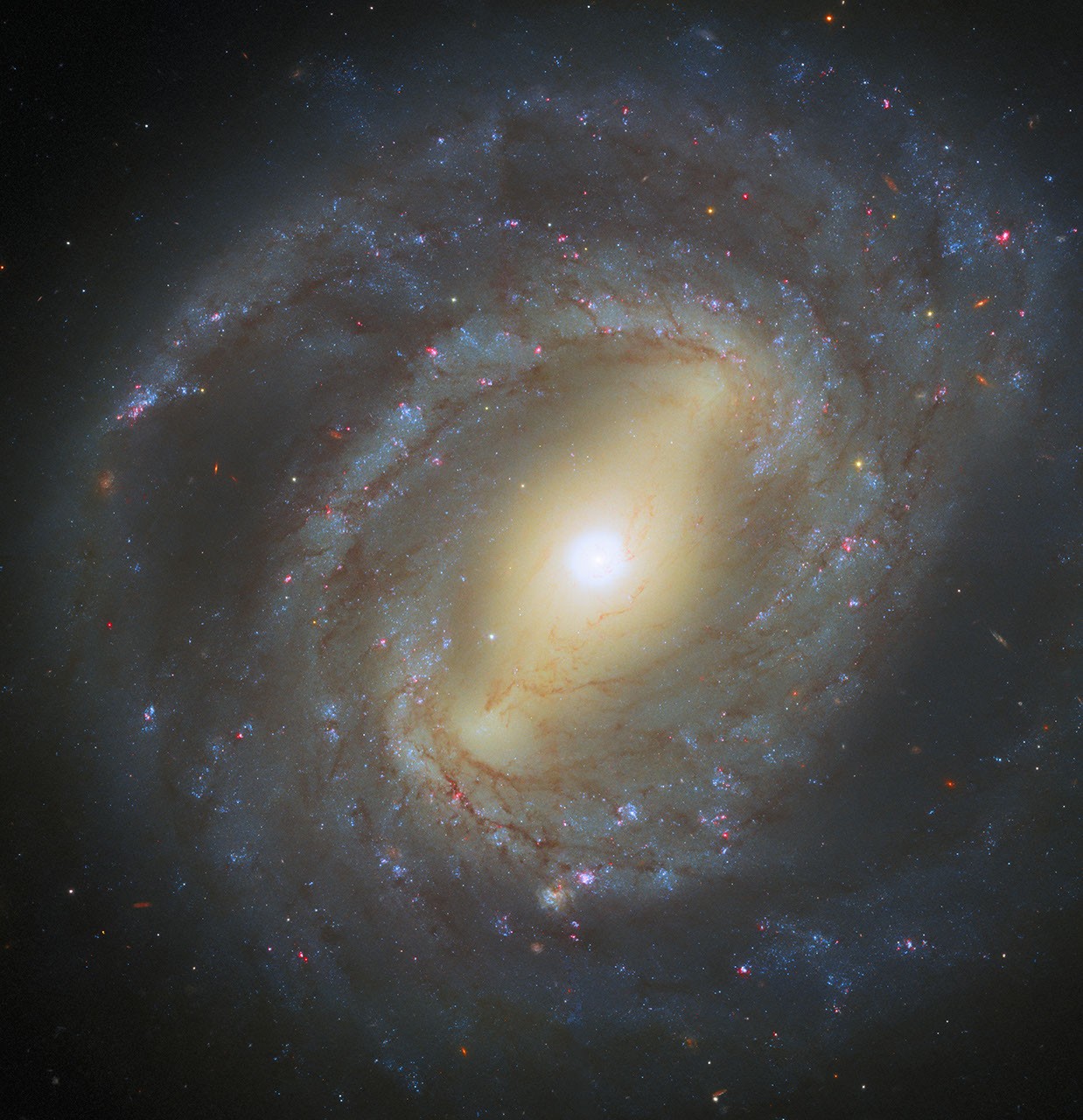
Imagine you're a coroner, but instead of a single body you have 40 — all found in the same neighborhood, all dead from apparently different causes. Your job isn't to describe each corpse but to figure out whether the neighborhood itself is lethal. That's the MAUVE-HST program (#18103), and NGC 4394 is one of its 40 subjects. The headline image is gorgeous, but the science underneath it matters more than the portrait. NGC 4394 sits 55 million light-years away in the Virgo Cluster — the nearest large galaxy cluster to us, home to over 1,000 galaxies. This isn't an isolated spiral drifting in the void; it's embedded in an environment dense enough that the cluster itself may be systematically strangling star formation. The MAUVE-HST team, led by David Thilker, used Hubble's Wide Field Camera 3 across a broad wavelength range to date individual star clusters within NGC 4394 and 39 other galaxies. The technique is straightforward: different wavelengths reveal different stellar populations, and by decomposing the light you can build an age census. If star formation is shutting down, the youngest clusters disappear first. The previous Hubble image of NGC 4394, released a decade ago, was essentially an accident — a parallel-field capture while another instrument was studying the neighboring galaxy Messier 85. That 2006-era image came from observing program #10515, focused on M85's unusual globular cluster population. The new image isn't a lucky bystander shot; it's purpose-built for a specific scientific question: how does quenching differ between cluster galaxies and isolated field galaxies? NGC 4394 is a barred spiral, and that bar matters structurally. About 65% of nearby spirals have bars, formed when the stellar disk becomes gravitationally unstable — through tidal nudges from passing galaxies, internal resonances, or other perturbations. Circular stellar orbits elongate into the bar shape. Critically, bars are more common in the present-day universe than they were billions of years ago, and research suggests they're self-limiting: as bars gain mass, they can destabilize themselves. The bar is not just a visual feature — it's a dynamical clock that encodes the galaxy's interaction history. There's a second intriguing thread: NGC 4394 may harbor a LINER (low-ionization nuclear emission-line region), as the Milky Way possibly does. LINERs show up as specific spectral signatures near a galaxy's center — certain ionized or neutral elements that could be powered by either a low-luminosity active galactic nucleus (a feeding but not feasting supermassive black hole) or by intense post-starburst stellar populations. The LINER question connects directly to the quenching question: if star formation is shutting down, the LINER could be a symptom rather than a cause. The bar-formation frequency trend — more bars now than in the past — also feeds into the quenching narrative. Bars can funnel gas toward galaxy centers, potentially triggering bursts of star formation that exhaust the gas supply. In a dense cluster like Virgo, where ram-pressure stripping already removes gas from infalling galaxies, a bar might accelerate the process. The MAUVE-HST program's strength is that it can test this by comparing bar-hosting cluster galaxies against bar-hosting field galaxies. What we don't have yet are the results. This is an image release, not a data paper. The MAUVE-HST program's publications — with the actual star-cluster age distributions, quenching timescales, and cluster-vs-field comparisons — are what will carry the scientific weight. The image is the appetizer. The 40-galaxy statistical sample, when published, will either confirm or complicate the standard picture of environmental quenching.
The analogy
Imagine you're a coroner with 40 bodies found in the same neighborhood. Each died at a different time, and by dating the deaths precisely you can determine whether the neighborhood itself is toxic — or whether each death was just bad luck. The MAUVE-HST team dates star clusters the way a coroner dates time of death: by examining the chemical and spectral signatures left behind. The 'neighborhood' is the Virgo Cluster, and the question is whether dense cluster environments systematically kill star formation.
Forensic coroner
Dates 40 deaths in one neighborhood by decomposing biological signatures to determine if the environment is the cause
MAUVE-HST survey
Dates star clusters in 40 Virgo galaxies by decomposing broadband light to determine if cluster environment kills star formation
Honest assessment
This is a beautiful image release, not a scientific result. The underlying MAUVE-HST program is well-designed — 40 Virgo Cluster galaxies observed with WFC3 to date resolved star clusters and map quenching — but until the catalog and analysis are published, there's nothing to evaluate scientifically. The galactic-bar discussion and LINER mention are real astrophysics but presented here as contextual color, not new findings. Worth bookmarking for the eventual data paper; not worth treating as a science story today.
What Is CLAIMS?
37
/ 100
BedrockNews applies a structured analytical framework called CLAIMS to academic papers and technical research releases.
How CLAIMS worksClaim
1/5
Ladder
0/5
Architecture
3/5
Integrity
1/5
Milestone
3/5
Successor
3/5
What is this paper actually committing to?
No claim presented. This is an image release, not a paper. The underlying program targets a real question — environment-driven quenching — but no results exist to evaluate.
The field fight
What kills star formation in cluster galaxies — rapid ram-pressure stripping or slow strangulation of gas supply?
Side A
Ram-pressure stripping acts fast: cluster gas removes galactic gas on ~100 Myr timescales
Held by: Gunn & Gott, Tonnesen & Bryan, jellyfish galaxy studies
Side B
Strangulation is dominant: gas supply is cut off slowly, quenching takes 1-4 Gyr
Held by: Larson-Tinsley-Caldwell, Peng+ 2015 mass-quenching models
Milestone tracker
Unlocks: Statistical discrimination between ram-pressure stripping and strangulation timescales in the nearest galaxy cluster
Current
40
galaxies observed
MAUVE-HST data in hand
Next
40
galaxy catalog published
Quenching timescales
~1-2 years for catalog publication
Verified Facts (9)
NGC 4394 is in the constellation Coma Berenices, about 55 million light-years away
NGC 4394 is one of more than 1,000 galaxies that make up the Virgo Cluster
Astronomers estimate 65 percent of nearby spiral galaxies have a galactic bar
Galactic bars are more common among galaxies in the universe today than they were several billion years ago
Previous image was part of observing program #10515 (PI: Peng) focused on Messier 85
New image incorporates observations from program #18103 (PI: Thilker) studying how star formation ends in dense cluster environments
NGC 4394 is one of 40 galaxies studied in the MAUVE-HST program
Researchers used Hubble's Wide Field Camera 3 to determine the ages of individual star clusters
NGC 4394 and the Milky Way might both contain a LINER (low-ionization nuclear emission-line region)
Practical Implications (3)
No immediate practical implications — this is an image release for an ongoing observational program
When the MAUVE-HST catalog publishes, it will provide the most detailed resolved star-cluster age maps of Virgo Cluster galaxies, useful for calibrating galaxy evolution simulations
The 65% barred-spiral statistic and the bar-instability lifecycle are well-established results, not new findings from this release
More latest news
Read all