MILES FROM EARTH
16B+
LIGHT TRAVEL TIME
24hrs
MISSION DURATION
~50yrs
PROBES IN INTERSTELLAR
2
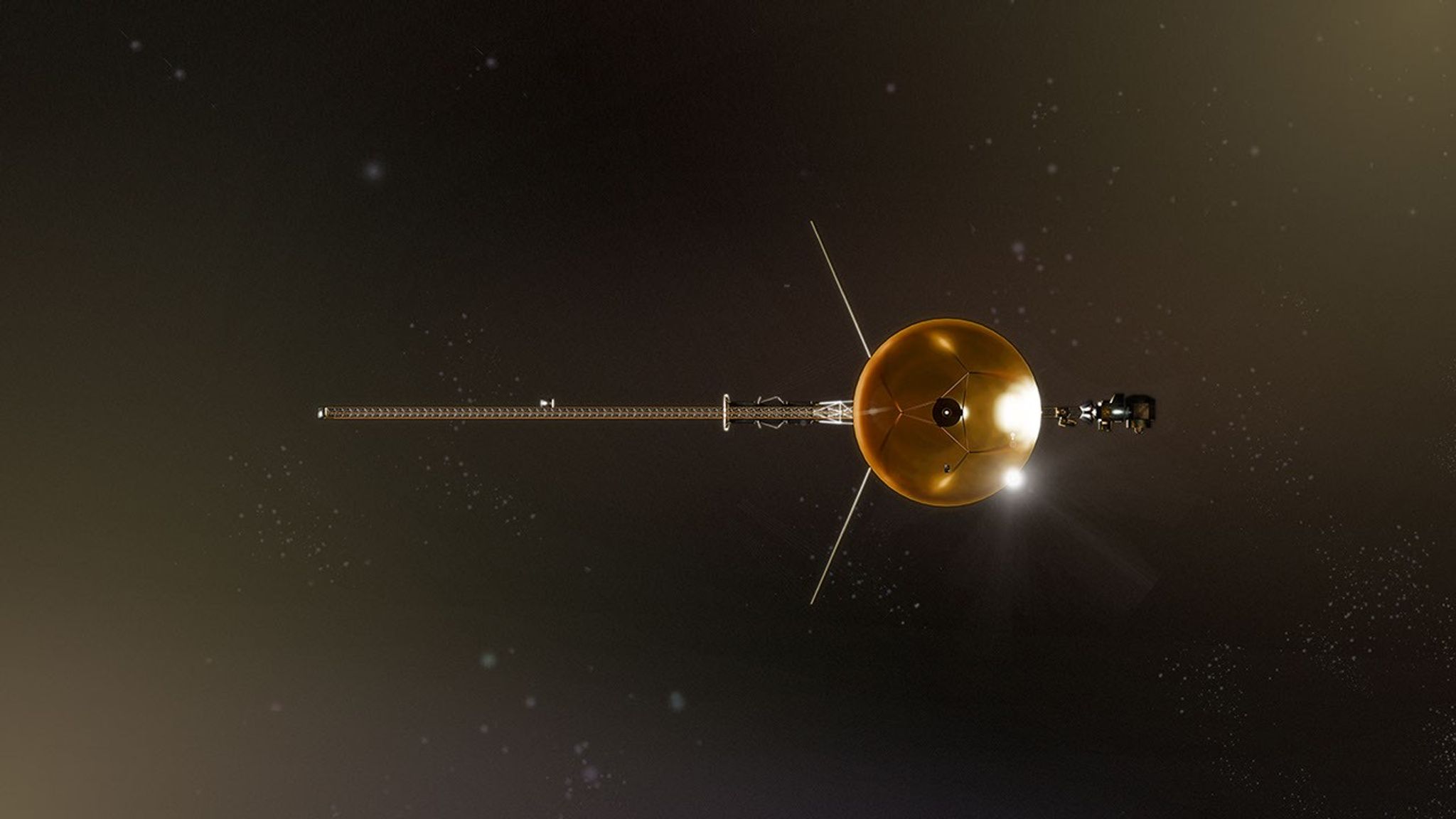
On November 18, NASA's Voyager 1 will cross a symbolic threshold: one light-day from Earth, meaning more than 16 billion miles (25.9 billion kilometers) of empty space between the spacecraft and its makers. Any signal from Earth now takes 24 hours to reach the probe. It is the most distant human-made object in existence, and it is still transmitting.
Extraction Map
NASA is marking the occasion with two events. On November 17, the agency invites the public to participate in "Shine Bright for Voyager's Light-Day," a coordinated display where participants use a NASA-built web tool to flash "VGR" — Voyager's call sign — in Morse code from their phones and tablets after sunset. The goal is a symbolic wave of golden light circling the planet. Photos and videos are encouraged, tagged @NASA. The more substantive event follows on November 19 at JPL's von Kármán Auditorium. A moderated panel featuring Nicky Fox (associate administrator, Science Mission Directorate), Jonathan Lunine (JPL chief scientist), Suzanne Dodd (Voyager project manager), Kareem Badaruddin (mission manager), and Jamie Rankin (deputy project scientist, Princeton) will discuss the operational status of both Voyager 1 and 2, the unique interstellar science still being gathered, and the engineering challenge of maintaining spacecraft nearly half a century old at distances that make troubleshooting a multi-day conversation. The panel will also preview a NASA+ documentary on the Voyager mission, slated for release in 2027 to coincide with the mission's 50th anniversary. The event streams live at nasa.gov/live, with media credentialing available for in-person attendance at JPL. Voyager 1 entered interstellar space in 2012; Voyager 2 followed in 2018. Both continue to return data on conditions beyond the heliosphere — the Sun's protective bubble — making them the only instruments humanity has in true interstellar space. The mission was designed to exploit a planetary alignment that occurs once every 176 years, and the spacecraft were built by JPL, managed by Caltech, and communicate via NASA's Deep Space Network. The one-light-day milestone is more poetic than scientific — it marks no change in the spacecraft's capability or trajectory. But it is a useful frame for comprehending the scale of what Voyager has achieved: a 1977 machine, built with less computing power than a modern key fob, still doing science at a distance where light itself needs a full day to commute. The mission is funded through NASA's Heliophysics Division. What matters operationally is whether the aging hardware can keep transmitting. Power from the plutonium-238 radioisotope thermoelectric generators degrades each year, and instrument shutdowns have been required to extend the mission. The JPL panel is the real content here — any update on remaining power budgets and instrument prioritization will determine how many more milestones Voyager gets to mark.
Worth reading?
ESSENTIAL
Score
80
/100
Generative — a publicly funded mission returning irreplaceable scientific data from a region no other instrument can reach, with public engagement layered on top at negligible marginal cost.
What Is GRIN?
GRIN stands for Generativity, Resilience, Innovation efficiency, and Novelty openness. These four dimensions capture the essential characteristics of any memetic intelligence — whether a nation, a corporation, a religion, or a movement.
About GRINGenerativity
4/5
Resilience
2/5
Efficiency
5/5
Novelty
4/5
Extractive
0/5
Inverted
Does this create new capability or just redistribute existing value?
Irreplaceable capability. Voyager is the only human instrument in interstellar space. The data it returns cannot be obtained any other way and expands fundamental knowledge of the heliosphere's boundary.
Verified Facts (9)
Voyager 1 on Wednesday, Nov. 18 will have traveled one light-day from Earth, which is more than 16 billion miles (25.9 billion kilometers)
Launched nearly 50 years ago in 1977
Any light from Earth would take 24 hours to reach the spacecraft
Voyager 1 entered interstellar space in 2012. Following a different trajectory, Voyager 2 entered in 2018
Planetary alignment that occurs once every 176 years
NASA+ Voyager documentary, planned for release in 2027 for the mission's 50th anniversary
Nicky Fox, associate administrator, Science Mission Directorate
Suzanne Dodd, Voyager project manager, NASA JPL
Jamie Rankin, Voyager deputy project scientist, Princeton University
More latest news
Read all