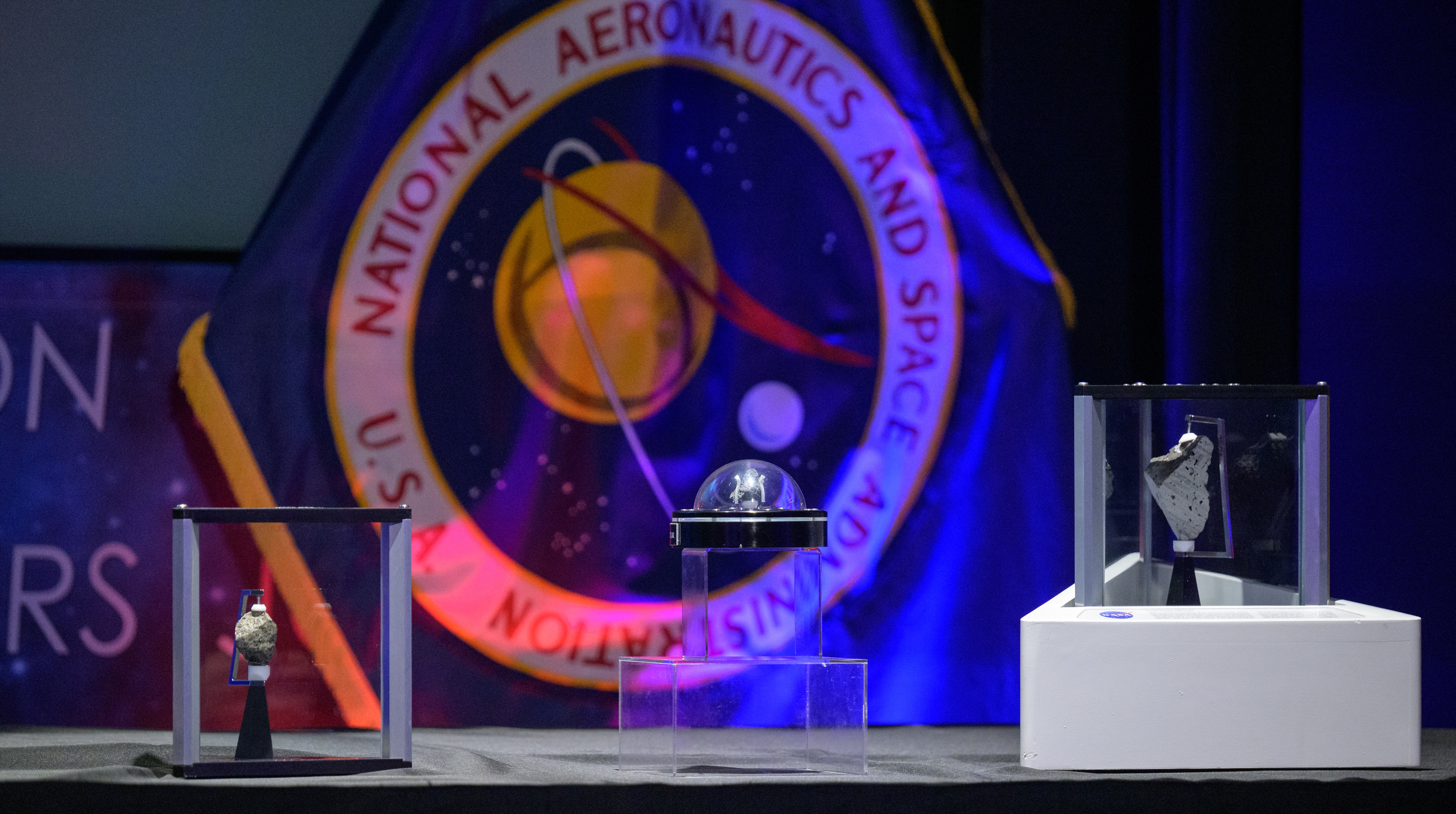
On March 24, 2026, NASA held an event outlining how the agency is executing the National Space Policy and accelerating preparations for America's return to the surface of the Moon by 2028. Moon rocks were displayed at the event — a visual bridge between Apollo-era achievement and the Artemis programme's stated ambitions.
Extraction Map
This is a photo caption from NASA, not a substantive policy document or mission update. The informational content is minimal: an event happened, moon rocks were present, and the 2028 lunar surface target was reiterated. What makes it worth noting is the language — "accelerating preparations" signals that NASA is framing the current phase as picking up pace, and the 2028 date remains the public commitment. The 2028 target for a crewed lunar surface return has been the Artemis III goal since the programme's recalibration. Following Artemis II's successful crewed flyby and splashdown in April 2026, the programme has demonstrated that Orion works with crew aboard. The remaining gates are the human landing system (SpaceX's Starship HLS and Blue Origin's competing lander), a possible 2027 low-Earth-orbit demonstration mission, and the SLS Block 1B upgrade. Each of these is on a separate development timeline with independent risk. The National Space Policy reference is the structural anchor. NASA events that explicitly frame agency activity as "executing" presidential policy signal institutional alignment — the agency is telling its political principals that it is on mission. This matters because NASA's budget, programme continuity, and contractor relationships all depend on sustained political support across administrations. Displaying moon rocks at a policy alignment event is not nostalgia — it's a credibility prop that says: we did this before, we can do it again, keep funding us. With only a photo caption to work from, the GRIN assessment is necessarily thin. But the underlying dynamics are clear: the Artemis programme is the highest-generativity public space investment in decades, the international coalition (60+ Artemis Accords signatories) provides political resilience, and the introduction of commercial lander competition creates efficiency pressure that Apollo never had. The open question is whether 2028 holds or slips — and this event's function is to publicly commit to it holding.
Worth reading?
SKIP
Score
35
/100
Generative — the Artemis programme aims to restore crewed lunar surface capability lost for over 50 years, with commercial competition and international coalition providing structural value. This event is a policy commitment, not a delivery milestone.
What Is GRIN?
GRIN stands for Generativity, Resilience, Innovation efficiency, and Novelty openness. These four dimensions capture the essential characteristics of any memetic intelligence — whether a nation, a corporation, a religion, or a movement.
About GRINGenerativity
4/5
Resilience
4/5
Efficiency
3/5
Novelty
4/5
Extractive
1/5
Inverted
Does this create new capability or just redistribute existing value?
High potential, pending execution. The 2028 lunar surface return would restore a capability absent since 1972. This event reaffirms the commitment but delivers no new hardware or milestone.
Verified Facts (2)
Moon rocks are seen during a March 24, 2026, event where NASA is outlining how the agency is executing the National Space Policy
accelerating preparations for America's return to the surface of the Moon by 2028
More latest news
Read all