SIGNATORIES
68
AFRICAN NATION
6th
ACCORDS EST.
2020
ARTEMIS III TARGET
2028
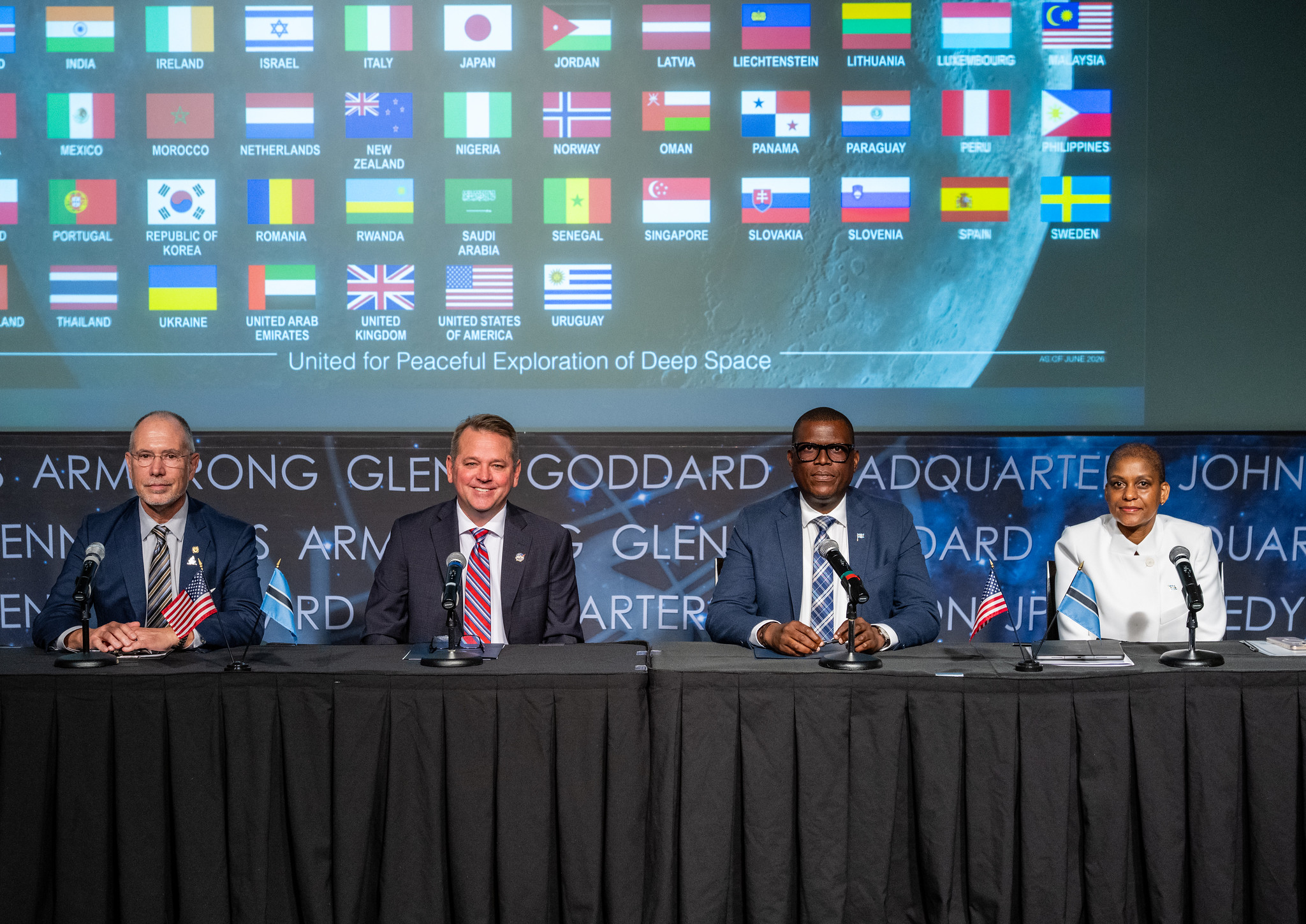
Botswana signed the Artemis Accords on June 25, 2026, at NASA headquarters in Washington, becoming the 68th nation and sixth African country to join the U.S.-led framework for peaceful space exploration. Minister of Communications and Innovation David Tshere signed on behalf of Botswana, with NASA Deputy Administrator Matt Anderson, State Department Senior Advisor for Space Gregory Autry, and Acting Ambassador Mabedi Ngwenya participating in the ceremony.
Extraction Map
The signing is not a scientific event. It is a governance move. The Artemis Accords, established in 2020 during the first Trump Administration by NASA and the State Department with seven founding nations, lay down practical principles for lunar activity — transparency, mutual aid, open scientific data, non-interference, and preservation of heritage sites. These principles will matter enormously when lunar resource extraction begins. The country that writes the rules captures the default. Botswana brings a thin but real space history to the table. It participated in the Landsat satellite program in the early 1970s and launched its first Earth observation satellite, Botswana Satellite 1, aboard a SpaceX Falcon 9 in March 2025. The Accords signing builds on decades of U.S.-Botswana collaboration in space-based Earth observation, giving the relationship a formal diplomatic upgrade. Anderson framed the timing pointedly: "Botswana joins at an important moment. Earlier this month, we announced the crew of Artemis III and, as we speak, their spacecraft is being assembled." The Artemis III crew announcement, an early 2028 target for the first lunar landing, and a new demonstration mission scheduled for 2027 all signal that the program's operational tempo is accelerating alongside its diplomatic footprint. The coalition math tells the real story. At 68 signatories, the Accords now represent a critical mass of spacefaring and aspiring nations aligned under U.S.-drafted principles — a deliberate counterweight to the China-Russia-led International Lunar Research Station framework. Each new signatory reinforces the normative architecture before contested questions about lunar mining, orbital slots, and heritage protection become acute. For Botswana specifically, the value proposition is access and alignment. The Accords commit signatories to share scientific data and coordinate activities, which for a country with one satellite means plugging into a network of capabilities it could not build alone. The cost is alignment with U.S. space governance preferences, which may constrain future partnerships with non-Accords spacefaring nations. The Accords remain a statement of principles, not a treaty with enforcement teeth. Their power lies in establishing norms before the infrastructure exists to violate them. If 68 nations agree on transparency and non-interference now, it becomes diplomatically expensive to defect later. The question is whether principles drafted in 2020 will hold when actual lunar resources are at stake.
Worth reading?
RECOMMENDED
Score
60
/100
Mildly generative. The Accords expand participation in space governance norms and data-sharing, but the structure is hub-and-spoke with the U.S. as drafter and gatekeeper of the framework.
What Is GRIN?
GRIN stands for Generativity, Resilience, Innovation efficiency, and Novelty openness. These four dimensions capture the essential characteristics of any memetic intelligence — whether a nation, a corporation, a religion, or a movement.
About GRINGenerativity
3/5
Resilience
3/5
Efficiency
3/5
Novelty
3/5
Extractive
2/5
Inverted
Does this create new capability or just redistribute existing value?
Moderate generativity. Opens data-sharing and coordination pathways for smaller nations, but the framework is U.S.-drafted and U.S.-centered. Botswana gains access; it does not gain agency over the rules.
Verified Facts (8)
Botswana signed the Artemis Accords Thursday, June 25, 2026, becoming the 68th signatory and sixth African nation.
NASA Deputy Administrator Matt Anderson hosted the ceremony at NASA headquarters in Washington.
Minister of Communications and Innovation David Tshere signed on behalf of Botswana.
Botswana participated in the Landsat satellite program in the early 1970s.
Botswana launched its first Earth observation satellite, Botswana Satellite 1, in March 2025, aboard a SpaceX Falcon 9.
The Artemis Accords were established in 2020 during the first Trump Administration with seven other founding nations.
Artemis III crew was announced earlier in June 2026; spacecraft is being assembled.
NASA continues to target early 2028 for the first Artemis lunar landing.
More latest news
Read all