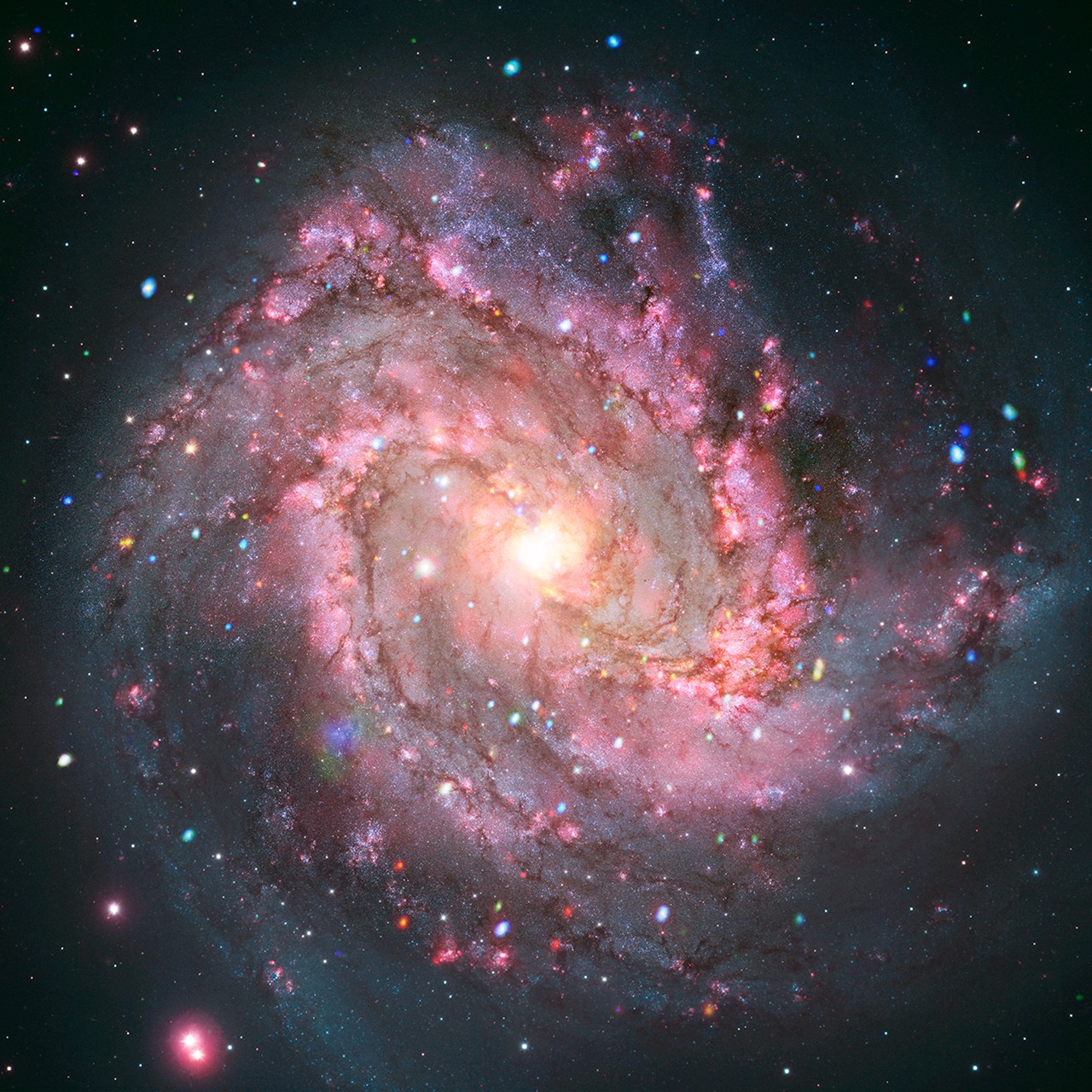
You know how a campfire, once the logs burn down, just slowly dims? Embers cool, heat radiates away, and eventually you're left with ash. That's the textbook model of a supernova remnant — the expanding debris cloud from a stellar explosion, fading over centuries. So imagine pointing a camera at 22 old campfire sites and finding that half of them are flaring back up, sometimes brighter than before. That's what Chandra just caught in galaxy M83. The committed claim: roughly half of 22 X-ray sources associated with supernova remnants in M83 showed dramatic brightness changes over 14 years of Chandra observations (2000–2014) — behavior completely inconsistent with the standard model of a passively cooling debris cloud. This isn't a single anomalous source. It's a population-level result, and that's what makes it significant. The leading explanation is elegant and testable. These aren't just remnants — they're high-mass X-ray binaries (HMXBs) hiding inside supernova debris shells. The scenario: a binary star system where the heavier star explodes, leaving a black hole or neutron star, while the lighter companion survives. The compact object then begins stripping material from the surviving star's surface, superheating it and producing wildly variable X-ray emission. HMXBs have been known for decades, but finding 20+ candidates embedded within supernova remnants in a single galaxy is unprecedented. Previously, only a handful had been identified across all observed galaxies combined. The ladder here is interesting. The prior baseline was essentially zero — nobody expected supernova remnants to vary on decadal timescales, so no systematic survey had looked for it. The closest prior art is individual HMXB identifications within remnants, numbering in the single digits galaxy-wide. This paper doesn't beat a competitor; it opens a category. The one known exception in their sample, SN 1957D, has a conventional explanation (shock interaction with circumstellar material), which the authors correctly flag as insufficient for the remaining sources. The architecture is observational X-ray astronomy at its most patient. Fourteen years of Chandra ACIS data across 13 separate observation epochs, with source detection and brightness measurement for each epoch. The key hardware property is Chandra's sub-arcsecond angular resolution — without it, you cannot isolate individual point sources at M83's 15 million light-year distance. The method leans on multi-epoch photometry and spatial correlation with optical supernova remnant catalogs. The team strengthened the case by showing variable remnants cluster in regions of higher massive-star density, exactly where binary systems should be more common. Integrity is solid for an observational discovery paper. The data span is genuinely long (14 years), the sample is defined by prior optical catalogs (not cherry-picked from X-ray data), and the result — ~50% variability — is a population statistic, not a single-source anecdote. The M51 follow-up by Hoiland and Kilgard finding similar behavior in another star-forming galaxy provides early cross-validation. The main integrity gap: the team acknowledges that M83's distance limits the detail observable, meaning they cannot definitively distinguish HMXBs from fallback accretion (debris recapture) for individual sources. The obvious next experiment the authors did not run: spectral analysis of the variable sources to distinguish HMXB signatures (power-law spectra, Fe emission lines) from shock-heated remnant spectra (thermal plasma). The honest read is (a) — Chandra's photon counts at M83's distance are likely too low for reliable spectral fitting of individual sources across epochs. They would need either a next-generation X-ray telescope with larger collecting area, or extraordinarily deep targeted observations of the brightest variables. This is a resource limitation, not a hidden negative result. The follow-up in M51 is the most important structural detail. If variable remnant-embedded X-ray binaries turn out to be a generic feature of star-forming galaxies, it reshapes how we think about the lifecycle of massive binary systems and the formation rate of X-ray binaries. The 20-year question: are HMXBs born primarily inside supernova remnants, and have we been miscounting them by treating remnants and binaries as separate populations?
The analogy
Imagine pointing a security camera at 22 old campfire sites in a forest and finding that half of them are flaring back up weeks later. The fires aren't reigniting — something alive is still there, feeding fuel into the embers. That's what Chandra found: not dead remnants, but living binary systems hiding inside the debris.
Campfire watch
Monitoring 22 extinguished campfire sites with a security camera and catching half of them flaring back up — something alive is feeding the embers
Chandra survey
Monitoring 22 supernova remnants over 14 years and catching half showing dramatic X-ray variability — surviving companion stars are feeding compact objects
Honest assessment
This is a genuine observational discovery — a population-level result that rewrites the assumed relationship between supernova remnants and X-ray binaries. The 14-year baseline and ~50% variability rate are hard to dismiss, and the M51 cross-check adds real weight. The main load-bearing assumption — that variability implies HMXBs rather than some other mechanism — remains unconfirmed spectroscopically. If spectral follow-up shows these are mostly fallback accretion or foreground contamination, the HMXB interpretation collapses. But the population statistics and spatial correlation with massive-star regions make the HMXB explanation the cleanest fit. Astrophysicists working on binary evolution, HMXB formation channels, or gravitational wave source populations should read this now; everyone else can watch for the spectral confirmation paper.
What Is CLAIMS?
67
/ 100
BedrockNews applies a structured analytical framework called CLAIMS to academic papers and technical research releases.
How CLAIMS worksClaim
4/5
Ladder
2/5
Architecture
4/5
Integrity
3/5
Milestone
3/5
Successor
4/5
What is this paper actually committing to?
Category-opener. Not a methods increment — a population-level discovery that ~50% of remnant X-ray sources in M83 are variable, implying a hidden HMXB population inside debris shells. Genuinely new.
The field fight
Are high-mass X-ray binaries primarily born inside supernova remnants, or do they form independently and only occasionally coincide?
Side A
HMXBs and remnants are separate populations that occasionally overlap by chance
Held by: Standard X-ray binary catalogs, most textbook treatments
Side B
HMXBs form routinely inside remnant shells in star-forming galaxies — we've been miscounting by treating them as separate
Held by: This paper, Hoiland & Kilgard M51 follow-up
Milestone tracker
Unlocks: Revised HMXB formation rates, binary evolution models, and gravitational wave source population estimates
Current
22
variable sources
M83 sample
Next
100+
confirmed HMXBs in remnants
population statistics across 5+ galaxies
~5-10 years; requires next-gen X-ray telescope (Athena) or systematic deep Chandra campaigns
Verified Facts (11)
Galaxy M83 located about 15 million light-years from Earth
Researchers analyzed 14 years of Chandra data spanning 2000 to 2014
Roughly half of the 22 X-ray sources associated with supernova remnants showed changes in X-ray brightness
SN 1957D, debris from a supernova first observed nearly 70 years ago
Previously, only a handful of supernova remnants associated with HMXBs had been identified across observations of all galaxies
Andrea Prestwich of the Catholic University of America led the study
Michael McCollough of the Center for Astrophysics | Harvard & Smithsonian (CfA) is co-author
Roy Kilgard of Wesleyan University is co-author
Follow-up study of M51 by Zoe Hoiland of Vassar College and Kilgard
Results presented at the American Astronomical Society meeting in Pasadena, California, and published in The Astrophysical Journal
Chandra data began with single observations in 2000 and 2001, followed by 10 observations from 2010 to 2011 and another in 2014
Practical Implications (3)
HMXB population models used for gravitational wave source rate estimates may need upward revision if remnant-embedded binaries have been systematically missed
Future X-ray surveys of star-forming galaxies should treat supernova remnant catalogs as candidate HMXB hunting grounds, not separate populations
Binary stellar evolution codes should test whether the observed ~50% embedding rate is consistent with current massive-binary formation models
More latest news
Read all